Ever since the CC started growing a window-sill herb garden, he's been buffeted with advice.
Everyone knows that house plants die from overwatering. A little judicious neglect is better than "loving" them too much. (a moral that owners of very fat pets should learn!)
What they don't tell you that oregano needs a lot more water than what is claimed. The CC has managed to make it wilt twice (it has recovered and flourished both times so far.)
Experience v. Theory. It's not even a fair battle.
Tuesday, April 14, 2009
Sunday, April 12, 2009
The Mercado in Florence : Part 1 : Tripe
Courtesy of the same friend, some pictures from Florence.
All the parts of a calf, pig or cow are for sale. Most considered Florentine delicacies. A bit like being at an anatomy lesson said my friend. Special note to be made of the beef nerves and pig lungs.
Shocked animal-eaters and vegetarians should note that this is both eco-friendly and rooted in a culture of respect of the animal by not wasting any of its parts.
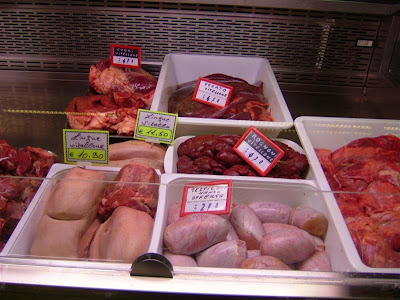


All the parts of a calf, pig or cow are for sale. Most considered Florentine delicacies. A bit like being at an anatomy lesson said my friend. Special note to be made of the beef nerves and pig lungs.
Shocked animal-eaters and vegetarians should note that this is both eco-friendly and rooted in a culture of respect of the animal by not wasting any of its parts.


Wednesday, April 8, 2009
Cuts of Beef
Virtually every culture differs on how to cut the cow. Perhaps the most precise (and most anal-retentive, it goes without saying) were the Austrians during the era of the Hapsburg Empire.
The CC presents an excerpt from a classic ("Tafelspitz for the Hofrat") by the great Joseph Wechsberg.
To read it in its entirety, and it's definitely one of the best food tales the CC has ever read, you'll have to go to the source. The apotheosis of the story would be hard pressed to be matched.
The CC presents an excerpt from a classic ("Tafelspitz for the Hofrat") by the great Joseph Wechsberg.
To read it in its entirety, and it's definitely one of the best food tales the CC has ever read, you'll have to go to the source. The apotheosis of the story would be hard pressed to be matched.
Few Americans think of boiled beef as the gastronomic treat it is known for in Central Europe. In Vienna there was a restaurant that was held in high esteem by local epicures for its boiled beef -- twenty-four different varieties of it, to be exact.
The restaurant was Meissl & Schadn, and the boiled beef specialties of the house were called Tafelspitz, Tafeldeckel, Rieddeckel, Beinfleisch, Rippenfleisch, Kavalierspitz, Kruspelspitz, Hieferschwanzl, Schulterschwanzl, Schulterscherzel, Mageres Meisel (or Mäuserl), Fettes Meisel, Zwerchried, Mittleres Kügerl, Dünnes Kügerl, Dickes Kügerl, Bröserlfleisch, Ausgelöstes, Brustkern, Brustfleisch, Weisses Scherzl, Schwarzes Seberzl, Zapfel, and Ortschwanzl.
The terminology was bound to stump anyone who had not spent the first half of his adult life within the city limits of Vienna. It was concise and ambiguous at the same time; even Viennese patriarchs did not always agree exactly where the Weisses Scherzl ended and the Ortschwanzl began. Fellow Austrians from the dark, Alpine hinterlands of Salzburg and Tyrol rarely knew the fine points of distinction between, say, Tafelspitz, Schwarzes Scherzl, and Hieferschwanzl -- all referred to in America, with extreme vagueness, as brisket or plate of beef -- or between the various Kügerls. Old-time Viennese butchers with the self-respect and the steady hand of distinguished surgeons were able to dissect the carcass of a steer into thirty-two different cuts and four grades of meat. Among the first-quality cuts were not only tenderloin, porterhouse, sirloin, and prime rib of beef, as elsewhere, but also fine cuts used exclusively for boiling: two Scherzls, two Schwanzls, and Tafelspitz. In old Vienna, unlike present-day America, where a steer is cut up in a less complicated, altogether different manner, only the very best beef was considered good enough to be boiled.
You had to be a butcher, a veterinarian, or a Meissl & Schadn habitué of long standing to know the exact characteristics of these Gustostückerln. Many Viennese had been born in the Austro-Hungarian monarchy's provinces of Upper Austria, Serbia, Slovakia, South Tyrol, Bohemia, or Moravia. (Even today certain pages of the Vienna telephone directory contain as many Czech-sounding names as the Prague directory.) These ex-provincials were eager to obliterate their un-Viennese past; they tried to veneer their arrivisme; they wanted to be more Viennese than the people born and brought up there. One way to show one's Bodenständigkeit was to display a scholarly knowledge of the technical terms for boiled beef. It was almost like the coded parlance of an exclusive club. In Vienna, a person who couldn't talk learnedly about at least a dozen different cuts of boiled beef, didn't belong, no matter how much money he'd made, or whether the Kaiser had awarded him the title of Hofrat (court councilor) or Kommerzialrat.
Monday, April 6, 2009
The Rialto Market
Pictures from Venice courtesy a friend who's currently visiting. Clearly identifiable are the cuttlefish (seppie), octopus, bronzini, flounder, clams, pilgrim scallop (ventaglio), various kinds of prawns and crabs.


Friday, April 3, 2009
CC, CC, Quite Contrary
How does your garden grow?


L to R: mint, parsley, thyme, oregano, chives, sage, tarragon, rosemary


Wednesday, April 1, 2009
Molecular Gastronomy
A group of influential international chefs have sequestered since yesterday in Alicia, Spain. Their mission has been to find a more palatable term for the dreaded “Molecular Gastronomy”. The consensus seems to be leaning towards ORGASMIC, an acronym for ORganoleptics, Gastronomy, Art, & Science Meet In Cuisine. A final vote on the proposed name change is scheduled for tomorrow morning, followed by the unveiling at a press conference.
Monday, March 30, 2009
The Conservativeness of Addiction
Ever go to a favorite restaurant and order the same thing every single time?
The CC is addicted to the pansoti at this particular restaurant. They are homemade ravioli stuffed with wild-greens (nettle, dandelion, borage, wild chard) and served with a garlicky, lip-smacking walnut sauce.
The rest of the menu is excellent but the CC succumbs to the inevitable every single time because you can't find this elsewhere.
This is a pattern. We stick to the familiar when we should really experiment. Particularly when we know that the quality of the product is likely to be amazing or even excellent.
Excellence breeds conservatism.
Especially when we don't get to the restaurant often or it's in a reasonably far-out place (read this post as to why that would happen.) We keep trying to recreate that first menu that blew our socks off when we really should be adventurous and try something else given that the absolute worst case is likely to be a "good" meal rather than an "amazing" meal.
The only logical explanation is when the restaurant is rather pricey in which case the CC supposes that people are justified in being somewhat conservative. Even then his inner instinct argues for the opposite fully well knowing that he doesn't exactly always follow his own dictum.
The only solution that the CC has come up with is to dictate by fiat that nobody (including himself) will be ordering an old dish, and if they want to they can sit at a different table. When forced to, the denizens of the world find a creative solution. It works via a radical upending of the social structure but it's not always possible.
Anybody have any interesting ideas on how to approach the problem a little more creatively?
Saturday, March 28, 2009
Petai
 The CC went to a Malaysian restaurant where a dish called sambal petai caught his eye. It was described as made with "Malaysian peas" but had a note: "please consult the server before you order".
Needless to say instructions like that are catnip for the CC, and when asked, the waitress replied that they were "peas" that were bitter and warned us. Needless to say, the CC felt compelled to order the dish. (Of course, later when we told the waitress that we loved the dish, she beamed at us with great fondness and pride as if she had known all along that we would love it.)
They were not "peas" of course but a species of bean called parkia speciosa. The colloquial name seems to be "stink bean" which seems a bit unfair because there was nothing stinky about it. Of course, it had been stir-fried with the very strong shrimp paste in a sweet-sour-umami sauce along with other veggies and shrimp. (The sourness came from tamarind.)
The taste is best described as slightly bitter with an astringent component. They are decidedly an acquired taste (what bitter food including beer isn't?) but quite delicious.
Friday, March 27, 2009
Recycling your leftovers

 The same thing stir-fried a few days later (after the rice has "dried out") with some eggs.
And that is how you waste precious little, my fellow depression-istas!
Thursday, March 26, 2009
Just Pregnant with Possibilities
 The world continues to amaze the CC.
It's a Japanese (who else?) soft-drink made from "horse placenta". Two varieties - orange and black. The black one is "more concentrated" because it is harvested "while the afterbirth is still potent."
It has all kinds of supposed "good" qualities - and will set you back $50 and $300 respectively.
Even the CC is feeling just the tiniest bit squeamish.
Wednesday, March 18, 2009
Laziness
Everyone is too lazy to cook sometimes. That's when the twin forces of laziness and the need for good food collide. Thankfully, in the CC's case, the latter always wins. And those are the times to get back to the basics.
Since, this is a post about laziness, first read this about technique.
Then, the basic concept is "loosely cooked rice" stir-fried with cumin, vegetables (carrots, peas, corn) and cashews.
If you can't grasp the recipe, read the archives.
Peace, man!

Vegetable Pulao with Cumin
Since, this is a post about laziness, first read this about technique.
Then, the basic concept is "loosely cooked rice" stir-fried with cumin, vegetables (carrots, peas, corn) and cashews.
If you can't grasp the recipe, read the archives.
Peace, man!
Monday, March 16, 2009
Grilling Tandoori Chicken
 The general recipe has been posted here.
The CC works his ass off, and people want originality but they don't bother reading all the good stuff that has been published before.
Of such laziness is a readership made!
Saturday, March 14, 2009
Hash Browns and Scrambled Eggs
There is only one trick to making successful hash browns. You need extraordinarily dry potatoes where the cells are broken to remove the moisture.
To that end, you must first grate the potatoes and then wash them (to remove surface starch.) Then you need to squeeze them until they are dry. Then place them between towels, and squeeze them with a rolling pin to squeeze out even more liquid. Then squeeze them again.
Squeeze, squeeze, squeeze. Then, squeeze some more!
Then put them in a very hot skillet with oil and fry. Spread them in an extraordinarily thin layer, and press periodically with a spatula. Only if they are really dry, are you going to be able to do the successful "omelette" flip.
(For less dexterous people, slide it onto a plate, invert onto another plate and slide it back into the hot skillet. This is safe, efficient and guaranteed to succeed.)
For instructions on scrambled eggs, read here.

Thursday, March 12, 2009

Tuesday, March 10, 2009
Creating Novelty
Long before, the advent of "nouvelle cuisine", the grandmas of virtually every cuisine in the world were technically adept at creating novelty out of nowhere.
Faced with the seasonality of ingredients, how do you create "interesting" food day after day after day, in a world where the airplane and refrigeration had yet to be invented, and the audience (as always) craved novelty?
The answer is shockingly simple - vary the proportion of spices.
You can serve the meat with more black pepper than ginger, and vice versa, and bingo! they taste different.
And since this scales exponentially in the number of ingredients (Ed: math geek alert!), this is a game that the grandmas were good at, and doggone it, they were not playing for mere stakes, they were playing to win!
Which brings us to the present. Multiple recipes for the same idea. Whenever the CC posts a classic spice recipe, there is a hangover that follows ("my family does it differently.")
Well, DUH!!!! Of course, they do. Which doesn't make it more "authentic". It just makes it as the baseline against which you compare.
The CC once made string beans with a classic North-Indian twist. Stir-fried with ajwain and cumin. The audience just pushed it away.
"This is not how I conceptualize string beans."
Total abject failure. Not one would eat it.
"Where's the coconut milk?", said one, his Asian roots showing.
Anyway, to get back to the subject before yet another post about the dubiousness of "authenticity" surfaces, back in the day, they made these spices in industrial-strength sizes. We are a little more circumspect, and need to tone it down a bit as explained by this post.
So when the next need to complain about "authenticity" arises, why not just lie down until it goes away?
Thursday, March 5, 2009

Wednesday, March 4, 2009

Tuesday, March 3, 2009
I ♥ Kuhn-Rikon
 The most expensive piece of equipment in the CC's kitchen. The Rolls-Royce of pressure cookers which you may only pry away from the CC out of his "cold dead hands".
Adminis-trivia
The CC has had a hard-drive crash (quite a bit of picture loss) and is coincidentally down with a nasty cold but he'll be back.
Subscribe to:
Posts (Atom)
