Showing posts with label art. Show all posts

Tuesday, December 31, 2019

La Raie


This wonderful painting of a skate by Jean Simone Chardin has been exhibited in the Louvre for the longest time. Dating to 1728, it was widely condemned for fairly obvious reasons but has always courted favor with the painters for its dramatic flair and painterly realism. The geometric composition was much admired by the Impressionists. You can easily see why Cézanne would be fascinated.

Note the composition of the cat - its foreshortened perspective is also in the shape of a diamond neatly mirroring the diamond composition of the skate. It's also provides the "drama" in this little mini-narrative.

The cat is ignoring the fish and the oysters, and its hackles are up — what is it looking at? A potential competitor for these riches?!?

Saturday, October 13, 2018

Markets


Game Market (Source: LACMA, Los Angeles.)


Fish Market
(Source: Hermitage Museum, St. Petersburg.)

Originally a set of four paintings (along with Vegetable Market and Fruit Market), these are masterpieces by Frans Synders in the Dutch still-life tradition.

The peacock feathers don't come across that well in rendition. You will have to visit LA to see the gorgeous plumage in person. (And yes, peacocks and swans were definitely eaten in the middle ages!)

The CC particularly loves the little cats (and kittens!) all clawing away at the fish and meat.

Wednesday, June 6, 2018

2-acetyl 1-pyrolline

Do you love Thai food?

Do you love fresh bread?

Do you love basmati or jasmine rice?


If so, you're in love with this particular molecule.

It amplifies itself in both Indian and Thai culture with their love of jasmine blossoms and pandanus leaves — both of which have the above molecule as a dominant fragrance — and which are added to rice to amp up the already existing fragrance.

Sanskrit literature has a tendency to have lovers' meetings beneath jasmine trees. The majority of Indian miniature paintings in the "romantic lovers' mode" feature jasmine trees. Even today, jasmine is the dominant flower for weddings in India.

Clearly in the modern parlance, 2-acetyl 1-pyrolline, you got game!

Sunday, September 17, 2017

Grasshoppers Grilled in the Fashion of Saint John the Baptist

It is not very well known that the artist Henri Toulouse-Lautrec was a terrific cook. We have descriptions of his endlessly inventive cooking and drink recipes during the belle epoque.

He clearly thought that food and art were collinear. He is once said to have ended a meal by unveiling a masterpiece of Degas, "Gentlemen, here's your dessert."

Just the name of the recipe is so suggestive.

As everyone knows St. John the Baptist was beheaded at the request of Salomé in Herod's court. The Biblical themes of locusts and beheadings resonate as does the exquisite detail to color (yellow, pink, red) characteristic of Toulouse-Lautrec's work.

From a large swarm of grasshoppers, choose the most beautiful, the pink rather than the brown or the yellow.

Put them on a screen and let them grill lightly over a charcoal fire while at the same time sprinking them with a few pinches of coarse salt.

Tear off the the head by turning them so that they whole digestive tract will come out intact.

Lay the grasshoppers on a dish garnished with rounds of lemon; season to taste with salt and ordinary red pepper.

Shell and eat the desert grasshoppers (locusts) in the same way as "grasshoppers" of the English Channel, that is to say shrimps, which have the same savor.

Sunday, April 23, 2017

Line Drawings

The CC is a complete sucker for line drawings rather than photographs in cookbooks.

Years ago, the CC once met an illustrator who interestingly was employed in both the Paleontology and Egyptology (sic) departments. They actually fought over her to the point where they "agreed" to a 50-50 time-commitment split. (Needless to say, she was excellent at her job!)

When she talked about line drawings, the CC blurted out, "It's obvious, right? A photograph shows all details. With a line drawing, you can highlight or suppress details at will."

She started laughing and asked me how the CC figured it out. It was cookbooks naturally.

It's particularly useful in architectural stuff especially when the ancient monuments have deteriorated. You can do a theoretical reconstruction. While the CC is talking about black and white line drawings, he also understands that there is room for subtle polychrome work too.

Many of the greats — Julia Child's classic, for example, feature line drawings not photographs.

Years later, the CC read an interview with the formidable Anna Gosetti della Salda who pointed out that "Styles of photographs go in and out of fashion. Line drawings are classic and don't need to be updated."

There you have it.

Friday, July 1, 2016

Mugi Gohan (Barley Rice)

The CC is insanely fond of this dish.

This is the ultimate "poor people" dish in Japan and even today there's a slight disdain towards it.

Historically peasants paid rice as taxes in the feudal era. They had a tendency to hide stuff from the authorities — tax evasion is as old as mankind! — a point memorably made in Kurosawa's The Seven Samurai (七人の侍). The peasants frequently mixed other grains that were not taxed to their cooked rice — barley, millet, etc. which contributes to their "lower class status". Ironically, this is why the they  never suffered from beri beri but the upper classes did.

It was also served as army rations and today is often served in school lunches, all of which add up the reasons that it is really resented.

Which is too bad because it's freakin' awesome!

Since the CC has no associations with it, the CC is free to love it. It has texture, nutrition, lack of boredom (white rice?), flavor and chewiness.

Ingredients

1/2 cup barley
1 cup rice

3 cups dashi (or water)
salt

Recipe

Note 1: The only "trick" is that the barley needs to be soaked ahead of time for 30 minutes so that they can be cooked together.

Note 2: You can vary the proportions. More barley, less rice, etc. This is the median that the CC likes.

Note 3: Use dashi if you can.

Soak the barley for 30 minutes. Rinse the rice under cold water until it runs clear. Let it sit for about 10-15 minutes.

Put all the ingredients in an open pot. Cook until the rice is done. Depending on the humidity you may need to add a little more water at the end.

Sunday, December 20, 2015

Petrified Bacon

The title is a reference to an absolutely brilliant piece by the sculptor Isamu Noguchi and part of a series of "petrified" works which also feature petrified rye bread, cheese, sugar and ice cream!

The reference, of course, is to the famous meat-shaped stone (肉形石) in the collection of the National Palace Museum in Taipei.

While the CC understands the need not to touch art, never before has he seen sculpture which has such an overwhelming tactile quality. You just want to reach out and touch it. It positively screams for it.

What's clear is the artist's unerring eye in identifying natural rock samples and then sculpting them minimally to perfection.

Tuesday, January 13, 2015

The Adaptation & Appropriation of Dishes

The CC really wanted to include this article under that of The Naming of Dishes but there was a lot more to be said about this subject than just the naming portion so he decided to spin it off into its own little post.

The world has always been global.

We've had traders and merchants traveling the seas trading across countries and continents. It's not uncommon even today to find Roman coins in India when land gets dug up for some new project. The largest collection of gold artifacts in the world was discovered in Surigao in the Philippines in 1981 as part of an irrigation project. Its connections to ancient India of the 10th century is quite well established (Source: Ayala Museum.)

Along these trade routes flowed something else besides spices, grain and gold — recipes and techniques for recipes.

The most famous of these routes is undoubtedly the Silk Road over land but equally important were the three sailing routes. One across the Mediterranean from Alexandria (modern-day Egypt) hopping counter-clockwise, hugging the coast, all the way to Rome and also from Cyrene (modern-day Libya) and Carthage via Alexandria to Rome. The other was the route from the modern-day Gulf of Eden hugging the coast of the modern-day Middle East all the way down the western coast of India to Calicut (modern-day Cochin). And finally the extension of this route around the southern tip of India hugging the eastern coast of India to Burma and from there on to Thailand, Indonesia and the far East.

The most powerful of impulses that the traders appealed to was that of the "exotic". Anything remotely exotic is lapped up by any population as long as it is not too far off from their own conception. Whether these are colorful clothes or dishes or spices hardly mattered to the traders just as long as it could be sold for a profit.

Not knowing anything about a foreign culture — remember travel was hard before the last 75 years or so — local dishes with some exotic ingredient are just the ticket for a sharp businessman with a marketing strategy.

Exoticism sells. Nobody from emperors to laymen are immune.

This is not just a theory. We have evidence.

Queen Victoria was crowned the Empress of India in 1876 and the British went crazy over "anything Indian". There were "Indian-themed" parties and "Indian food" marketed by the East India Company. This is also the birth of the infamous curry powder — a non-existent concept in Indian cooking. This powder marketed globally is now ubiquitous in such far-flung places as France, Thailand, Singapore and Japan all thanks to the marketing of the East India Company.

In the 1950's and 1960's there was a worldwide craze of "Hawaiian". Needless to say the folks from Italy and India and Vietnam or even most of the United States for that matter had never been to Hawaii but "Hawaiian Salad" was all the craze globally. The exotic element was pineapple. Take a typical salad with a mayo-based dressing and toss in some pineapple to get the afore-mentioned dish. Needless to say this had about as much to do with Hawaiian cuisine as chalk has to do with cheese. There were "Hawaiian cakes", "Hawaiian cocktails", you name it! All with pineapple. It was all marketing, of course. (Yes! The "Mad Men" had their hands all over this. We have the ads to prove this.)

The relatively recent movement towards "authenticity" is not more than about 30-40 years old. Sure there were pioneers even in the 1930's towards an honest and detailed assessment of global cuisine but its mass adoption is a relatively recent phenomenon.

This trend towards exoticism isn't relegated to dishes. Ask yourself if you really know what entrée means. It means "appetizer" in French from the verb entrer — to enter. Same goes for hors d'oeuvres which means "first course" in French but has taken on the meaning of "appetizer" in English. (Appetizers would be des toasts — "nibbles" in French.) Clearly some things got lost just getting across the English Channel and if that's the case, you can just imagine how much got lost when recipes migrated longer distances in older times.

Every culture appropriates dishes. Whether it is the Sicilian adaptation of Arabic eggplant recipes or the Malaysian appropriation of Indian recipes (roti canaicanai probably comes from Chennai but the concept is, quite likely, from Kerala), or the Japanese versions of "spaghetti" and "ma po tofu", it's universal. You also have wholescale adaptations like the Hakka-originated "Indian-Chinese cuisine". Not to mention chop suey and the like which are American adaptations of Chinese dishes.

Italian cuisine is a particularly special case. There's the Italian-American branch but that, at least, can be understood as the reaction of new immigrants to a foreign land and its native resources. What no Italian would recognize is Japanese "spaghetti napolitan" (sic) or Filipino "spaghetti" (made with banana ketchup!) or even Indian "masala spaghetti".

It's lost in translation but why?

To truly master a cuisine, you must first internalize its grammar. And every cuisine has an unmistakable grammar. A set of rules, techniques and ingredients that work in a specific set of combinations and in a very narrow context (historically) to create a meal. Only after you know this grammar backwards and forwards can you truly break free into true creativity. Science helps.

Needless to say, mastering different grammars is insanely hard work. It's far easier for cooks to get a superficial understanding of some foreign cuisine, just use the local grammar of cooking instead of mastering a foreign one, and make something vaguely in that style. It would've been even more the norm in older times since travel and authenticity were so hard. In time, the dish gets appropriated into the local cuisine and becomes "native".

So how does one distinguish incompetence at rendering a foreign cuisine from a slapdash effort from a  deliberate rethinking/reworking?

The answer lies in a similar one from the world of art.

In order to break the rules, you first have to understand and master them.

Not many people know that Picasso was a master draftsman and painter. His early paintings where he copies the classical works and even the Impressionists and out-flanks them are not well known. It's only after complete mastery of older techniques that that he broke new ground both aesthetic and technical. The same goes for Matisse.

It always pays to master different grammars. Picasso "borrowed" shamelessly from African art, and almost all painters of that era borrowed extensively from Japanese art. So it goes with any artistic endeavor.

The bias should be towards mastery of grammar and technique. The "going beyond" follows as a natural consequence.

Sunday, December 2, 2012

Going Pork Crazy!

In the National Palace Museum in Taipei, there's a rather famous sculpture of a meat-shaped stone (肉形石).

From the catalog:
At first glance, this meat-shaped piece of stone looks like a luscious, mouth-watering piece of "Tung-p'o meat". Made from banded jasper, it is a naturally occurring stone that accumulates in layers over many years. With time, different impurities will result in the production of various colors and hues to the layers. The craftsman who made this meat-shaped stone took the rich natural resources of this stone and carved it with great precision, and then the skin was stained. This process resulted in the appearance of skin and lean and fatty layers of meat, the veining and hair follicles making the piece appear even more realistic.

Wednesday, March 21, 2012

A Sensational Woman in a Man's World

Anne Vallayer-Coster may very well be forgotten now but it's important to know that she was recognized as a progidy in her time. Her precocious talent was recognized, and rewarded at the French court particularly by Marie Antoinette.


What ended her career was the French revolution and the guillotine. Still she managed to maneuver her way by painting for Napoleon and died at a ripe old age.

Her masterpiece is the Still Life with Lobster.

In order to understand why it must, absolutely must be a lobster, you must read this.

Monday, February 27, 2012

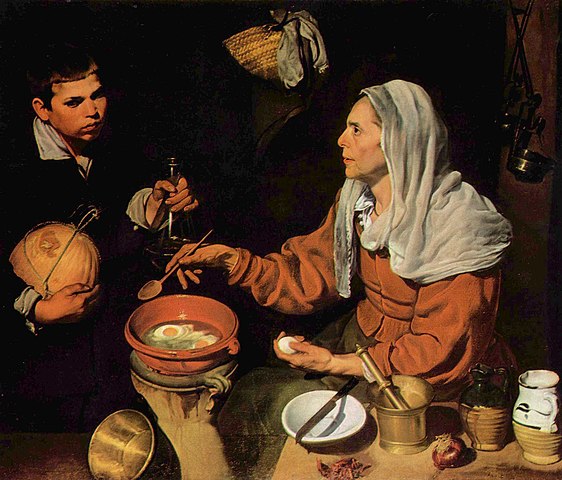
An Old Woman Fries Eggs

One of the great paintings by Velázquez is that of an old woman frying eggs while a young boy looks on and helps her.

The wonderful chiaroscuro is a joy to behold with the light appearing to come from the left. It was painted during his Seville period.

(Source of painting: Wikipedia.)

But what is she doing?

She is making huevos fritos con puntilla. These are eggs fried in hot olive oil where the oil is flicked around the edge of the egg to achieve a delicate lacey frill like that of a traje de Sevillana.

The evidence is the hot oil that she should be flicking over the edges of the egg whites with her wooden spoon. This is a reasonably high-risk procedure with the chance of hot droplets of oil splashing all over. Her right sleeve covers her hand to protect it but not her left. Most importantly, since this procedure can easily make the egg whites overcooked without the yolk having set, she seems instructing the boy to add a slug of olive oil to the earthenware cooking pot to cool down the oil.

She seems to be about to speak to him but his interest seems to have wandered. He just wants his abuela to make the damned eggs, and enough with the instruction already.

The eternal drama of youth and old age captured in a succint way!

Friday, June 3, 2011

Giuseppe Arcimboldo

Italian painter (1527-1593) best known for his paintings made entirely out of fruits, vegetables, flowers, fish, etc.

His most famous cycle is the one about the four seasons.

He was a favorite of the Surrealists for fairly obvious reasons.

Please note that there are no tomatoes in summer nor potatoes in winter since the produce of the New World had not yet made its way into common knowledge.


Sunday, November 21, 2010

Food as Character

Food is character.

There's no getting away from it. It defines us. It strips naked completely what we would like to have hidden.

One can tell more about a person from what they will or won't eat, conditional on their background, than all the degrees, documents, and recommendations that they trot out.

If you want to learn about a person, watch them at dinner.

Observe how they hold their fork, and ask them what they feel about eating animal innards, and you will quickly strip them emotionally naked. Observe their inward or outward delight (or lack thereof) to a perfectly executed dish, and you will learn more about them than by asking a thousand questions.

Food is character.

Great writers have noticed this forever. When Edith Wharton describes food, she is not describing the food as much as the society that would make such food, and the elements of the society that would eat it. Food becomes the barely neutral turf on which the anxieties of society play.

Giuseppe Tomasi di Lampedusa in his one and only, wondrous novel Il Gattopardo observes his characters, and in turn, has them observe each other through the medium of food.

If you've never heard of Lampedusa, or his only novel, the CC urges you to seek it. Most people's knowledge of Lampedusa comes from the eponymous, and equally wondrous Visconti movie.
The Prince was too experienced to offer Sicilian guests, in a town of the interior, a dinner beginning with soup, and he infringed the rules of haute cuisine all the more readily as he disliked it himself. But rumours of the barbaric foreign usage of serving an insipid liquid as first course had reached the notables of Donnafugata too insistently for them not to quiver with a slight residue of alarm at the start of a solemn dinner like this. So when three lackeys in gold, green and powder entered, each holding a great silver dish containing a towering macaroni pie, only four of the twenty at the table avoided showing pleased surprise: the Prince and Princess from foreknowledge, Angelica from affectation and Concetta from lack of appetite. All the others (including Tancredi, I regret to say) showed their relief in varying ways, from the fluty and ecstatic grunts of the notary to the sharp squeak of Francesco Paolo. But a threatening circular stare from the host soon stifled these improper demonstrations.

Good manners apart, though, the aspect of these monumental dishes of macaroni was worthy of the quivers of admiration they evoked. The burnished gold of the crusts, the fragrance of sugar and cinnamon they exuded, were but preludes to the delights released from the interior when the knife broke the crust; first came a spice-laden haze, then chicken livers, hard-boiled eggs, sliced ham, chicken and truffles in masses of piping hot, glistening macaroni, to which the meat juice gave an exquisite hue of suede.

The beginning of the meal, as happens in the provinces, was quiet. The arch-priest made the sign of the Cross and plunged in head first without a word. The organist absorbed the succulent dish with closed eyes; he was grateful to the Creator that his ability to shoot hare and woodcock could bring him ecstatic pleasures like this, and the thought came to him that he and Teresina could exist for a month on the cost of one of these dishes; Angelica, the lovely Angelica, forgot little Tuscan black puddings and part of her good manners and devoured her food with the appetite of her seventeen years and the vigour given by grasping her fork halfway up the handle. Tancredi, in an attempt to link gallantry with greed, tried to imagine himself tasting, in the aromatic forkfuls, the kisses of his neighbour Angelica, but he realised at once that the experiment was disgusting and suspended it, with a mental reserve about reviving his fantasy with the pudding; the Prince, although rapt in the contemplation of Angelica sitting opposite him, was the only one at the table to notice that the demi-glace was overfilled, and made a mental note to tell the cook so next day; the others ate without thinking of anything, and without realising that the food seemed so delicious because sensuality was circulating in the house.

Monday, June 14, 2010

Aristocratic Banquet

From Giuseppe Tomasi di Lampedusa's only novel Il Gattopardo:
Beneath the candelabra, beneath the five tiers bearing towards the distant ceiling pyramids of home-made cakes that were never touched, spread the monotonous opulence of buffets at big balls: coraline lobsters boiled alive, waxy chaud-froids of veal, steely-lined fish immersed in sauce, turkeys gilded by the oven's heat, rosy foie-gras under gelatine armour, boned woodcocks reclining on amber toast decorated with their own chopped guts, dawn-tinted galantine, and a dozen other cruel, coloured delights. At the end of the table two monumental silver tureens held limpid soup, the tint of burnt amber. To prepare this supper the cooks must have sweated away in the vast kitchens from the night before.

'Dear me, what an amount! Donna Margherita knows how to do things well. But it's not for me!'

Scorning the table of drinks, glittering with crystal and silver on the right, he moved left towards that of the sweetmeats. Huge sorrel babas, Mont Blancs snowy with whipped cream, cakes speckled with white almonds and green pistachio nuts, hillocks of chocolate-covered pastry, brown and rich as the top soil of the Catanian plain from which, in fact, through many a twist and turn they had come, pink ices, champagne ices, coffee ices, all parfaits and falling apart with the squelch of a knife cleft; a melody in major of crystallised cherries, acid notes of yellow pineapple, and green pistachio paste of those cakes called 'Triumphs of Gluttony', shameless 'Virgins' cakes' shaped like breasts. Don Fabrizio asked for some of these, and as he held them on his plate looked like a profane caricature of Saint Agatha claiming her own sliced-off breasts. 'Why didn't ever the Holy Office forbid these puddings when it had the chance? 'Triumphs of Gluttony' indeed! (Gluttony, mortal sin!) Saint Agatha's sliced-off teats sold by convents, devoured at dances! Well! Well!'

Friday, February 12, 2010

Ol' School Beer Pong

Think fratboy drinking games are something new? Think again, kiddo!

This is a wine/mead game c. 1570.

You get to blow into the pipe which makes the sails of the windmill churn, fill the glass, and chug, chug, chug. Behind the windmill is a "timer" with numbers. If you can't finish before the sails of the windmill stop, you get to drink as many glasses as indicated on the timer.

(Source: V&A Museum, London.)

Tuesday, October 20, 2009

Frozen Elegance

Frozen Food (with String Beans) 1977.

Irving Penn is better known for his fashion photography but never before has frozen food looked so elegant. It almost makes you want to eat it.

Wednesday, October 7, 2009

The "other" L-O-V-E

(Site: Willets-ramp entrance to Flushing Meadows.)

Thursday, July 16, 2009

Going Native

It has been noted by many participants that the CC's posts have a strong region-inflected Italian, Indian, Thai bias.

It's not that surprising. These are the cuisines which the CC understands at a "native" level. The grammar of the conception of the dish is completely transparent to the CC's "mental taste buds" to the point where not only does a recipe translates into a "mental taste" instantaneously but the underlying logic of how to conceptualize a meal has a clearly delineated grammatical structure.

To use an art metaphor, while Indian recipes have the texture and taste of oil paints, Thai recipes are much more akin to water colors in their limpidity and transparency.

(If you have no clue what that last statement meant, you really need to re-examine your understanding of these cuisines!)

Even invoking such a metaphor means that you must first understand the underlying structure (or grammar) by which such recipes are constructed. Needless to say, these structures are accidents of geography and history but isn't that the very definition of "culture"?

Monday, July 21, 2008

Delacroix's Lobsters

One of the many masterpieces by the French Romantic, Eugène Delacroix, his "Still life with lobsters" (1826-27.)

Before anything else, take a good luck at the picture again.

First, there's a landscape receding into the horizon in true perspective. You see the horses and the huntsmen in the background; you see the muskets and the game bags; you see the shot hare, some other game birds, a pheasant.

And you see a lobster.

What on earth is a lobster doing in a scene about game? This makes no sense.

And even more bizarrely the lobster is obviously cooked (from the color), and the rest of the game is clearly raw.

Shades of Surrealism a century before it took root? A Dali before his time? Trying to outdo Nerval?

Not quite.

To understand the image, we need to take a tour to Galen (129 A.D.), an ancient physician whose theories dominated medicine and food for more than a millenium.

Each person supposedly has a temperament composed of four elements: air (warm and wet), earth (cold and dry), fire (hot and dry) and water (cold and wet.)

Likewise each food had a characteristic warmth and coldness, dryness and wetness. More importantly, cooking could transform this.

The goal was balance. (The Chinese, independently, came up with a similar scheme.)

Before you rush out to totally declare "scientific" bullshit on these concepts, permit the CC to forward two thoughts.

One is that this idea of balance is not particularly different from your modern idea of "balancing" proteins, carbohydrates and fats. The details are different but the idea of "balance" has propagated to modern times just in a different guise.

Secondly, if you believe in "vitamins" (which is a buncha catchall compounds which are totally unrelated), you're basically just as unscientific.

(Lest the above not be clear, nobody is denying the importance of the various "vitamin" compounds for the human body. What is being denied is that they have anything to do with each other. They don't. They are lumped together because they've always been lumped together, and nothing could be more unscientific than that. Even the name is bullshit because it comes from "vital amine" and yet, vitamin C is not an amine at all.)

So a lot of bad blather has propagated to modern times under a "scientific" guise.

Back to the original Galen balance. Whatever you feel about Galen, you are going to deal with it in an artistic context which is metaphorical not scientific.

The lobsters (cold and wet) are there to balance out the game (hares and jays - warm and dry.) The pheasant is provided as an idea of the "ideal" because it was considered the perfect balanced food. The metaphor of the soaring wing of the pheasant should be reasonably obvious in this context.

Like most imagery that comes out of a medieval context, Delacroix's is rather sophisticated. And it behooves us to understand where it came from, and where it is headed later in the context of surrealism.

Friday, July 18, 2008

Coffee Addiction?

Somewhere roughly between 1732 and 1734, Bach wrote, essentially, a miniature comic opera, popularly known as the Coffee Cantata (BWV 211.)

Featuring such lovely lyrics as "Schweigt stille, plaudert nicht" ("Be still, stop chattering"), it's basically an ode to the trials and tribulations of coffee addiction.

The mini-cantata ends with the trio which exults in the fact that "drinking coffee is natural".

And never a truer word was said.