Showing posts with label mathematics. Show all posts

Saturday, December 9, 2017

Constructing a Meal

(This article was written earlier but Blogger has a rather annoying "auto-save" feature and the article got deleted. The CC had to rewrite it from scratch.)

One of the things that perennially bugs the CC is that neither home chefs nor professional chefs give any insight whatsoever into how a meal is actually constructed.

This has something fundamentally to do with the "recipe" format of cookbooks. One really needs an entirely alternate model that works at the meal level.

Cookbooks also rely on the entirely unreliable fact that people just magically absorb knowledge by "osmosis" and "culture". Both of these seem to be demonstrably false assertions. Since one is not always granted the luxury of an Italian nonna or an Japanese obaachan and since kids are not born knowing complex culinary logic when yanked from the womb, one is left with the inescapable conclusion that all knowledge is learned.

That means one should be able to both teach it and learn it.

The CC is going to use himself as an example.

The only thing planned before the Saturday was that the meal would be Japanese and it would feature some form of clams - either asari gohan (= あさりご飯 = clam rice) or asari no miso dashijiru (= あさり味噌汁, clam miso soup.)

The CC arrived at the farmers' market on a frigid Saturday morning only to find that most of the vendors were missing. It was already turning into a disaster.

Thankfully there was one vegetable vendor and the fishmonger was around.

Cauliflowers were obtained (purple, romanesco) as were some carrots. The CC noted that he had exactly two Italian flat beans and two cherry tomatoes at home. This was going to be a tricky operation.

The CC noted that there were no scallions at home and none at the market neither. However, he did have some homemade furikake already prepared. That put paid to the idea of the asari gohan (because of the black furikake) and hence it was going to the be the clams with miso soup.

(Note how we rarely make decisions. They are made for us already.)

Luckily, the CC still had one of the last of the late summer cucumbers so a quick sunomono (vinegar pickle) was added to the mix. The CC still had some pickled ginger in his cabinet. The vegetables were steamed and combined with a modified tare sauce that the CC just loves. The dish can be made ahead of time and is actually better at room temperature rather than warm.

The CC needed a fifth dish (rice doesn't count) and he had carrots so he made the classic quick stir-fried dish with carrots and hijiki.

The meal follows the entirely Japanese principles of washoku (= 和食) — there are five vegetables of different colors, five methods, five tastes, etc.

The rules above might have a Japanese origin but they are not laws of nature. They are just an excellent set of rules-of-thumb to ensure nutritional completeness and stave away boredom. The CC finds himself using the rules even if he's making a classically French dinner or an Indian one.

Dinner is served.
Five autumn vegetables with modified "tare" sauce
♦
Clam miso soup
♦
Cucumber sunomono
♦
Sweet-sour hijiki
♦
Pickled white ginger
♦
White rice with furikake

Wednesday, March 22, 2017

Anna Gosetti della Salda

Anna Gosetti della Salda (1918-2011) was an extraordinary woman.

She published the ultimate book of regional Italian recipes, Le Ricette Regionali Italiane, that is the mainstay of Italian cooks everywhere. Even Michelin-starred chefs in Italy go into rhapsody when talking about this book.

First published in 1967, it's never been out of print (current edition: 17th, 2001.) It was printed out of her own publishing house of whose catalog it's the sole item. She has never authorized a translation.

She made a "small concession" in 2002 allowing a pronunciation guide in Japanese to be added as an insert because "if they were going to go to all that trouble to learn Italian, she would help."

It's 1206 pages long nearly 5 lbs featuring 2174 recipes — 13 are "base recipes" (e.g. besciamella = bechamél.)

She made four arduous trips up and down the "Italian boot" in the days when such trips were absurdly difficult. She did it as a single woman (never married) and she was adamant about having her own way in everything from the fonts to the paper to the illustrations.

It's a product of a singular mind which admits no compromises.


The regions of Italy are organized in the order that a theoretical motorist could actually traverse them. They form a Hamiltonian Path which warms the cockles of the CC's mathematical heart. (The two island regions of Sicily and Sardinia come last.)

There is no table of contents — in her own words, "Why have it when the indices are perfect?"

Indeed the indices are perfect. All 116 pages of them. Each recipe is numbered. There are two indices organized by "region" and "analytics" (theme/topic). There's a meta-index of one page that tells you where to go find the indexes. The end of each of the regional indices has a excellent curated list of the "wine types" of that region. The cross-indexing admits no mistakes.

The paper is deliberately yellow (to indicate "old school" yellowing) and the illustrations are black and white line drawings. (Her initial career was in advertising. She opened her own agency. The book was published when she was nearly 50!)

Each recipe not only has exact details (tested, of course) but also any regional and family variants.

Even though the CC speaks no Italian, he can handle recipes in the language — limited vocabulary and content;  context makes things "obvious". The illustrations help. You are left in no doubt whatsoever about what the recipe entails.

The CC's favorite part is an excerpt from an interview she gave when she was nearly 90, "I recently read the book one more time, very carefully, just to find out what new criticisms I might have. I'm my most severe critic, yet I can't help admitting I did such a good job. I looked deeply into every recipe and technique; there's no room for superficiality in my work. If I were to start again I would do just as I have."

The book is just a staggering masterpiece.

Wednesday, August 13, 2014

The Science and Art of Indian Cooking†

Indian cooking is synonymous with its use of an immense array of spices. In fact, that's what makes Indian cooking unique‡. The sheer amount of technical apparatus that is brought to bear on the subject of spices.

Chez CC, we tend towards the obsessive and completist bent so let's expound on it.

Let's start at the very beginning, a very good place to start — as Julie Andrews once sang.

What constitutes a spice?

It's a dried seed, dried root, dried bark, or dried vegetable/fruit whose primary role is for flavoring food. They rarely have nutritional value although most spices have considerable anti-microbial and anti-fungal properties which are an important reason that they are so heavily used. The other reason would be pleasure, of course.

There are at least 20-25 spices in the Indian repertoire and that's just what the CC can think of off the top of his head. There are at least 20-25 relatively more obscure ones. (Obscurity, needless to say, being relative.)

Simple combinatorial mathematics tells us that the number of combinations of these spices is going to be vast§ particularly when they are combined with other ingredients like nuts, souring agents, oils, etc.

There are eight basic techniques (and a bunch of auxiliary ones) that you need to master to really get a feel for the complexity of the subject.

On the first axis are the state of the spices. They can either be:
  • Whole, or
  • Ground.
On the second axis are things we can do to the spices. We can keep them:
  • "As-is".
  • Dry-roast them.
  • Fry them in oil.
  • Soak in liquid overnight.
You can do the combinatorial math yourself: 2 x 4 = 8.

Classically speaking, if you were to take a class on Indian cooking, there would two techniques that would be emphasized — bhunaao and tadka (a.k.a. chaunk, baghar, etc.)  Except that both of these are best understood as variations of exactly one of the eight. They are whole spices fried in oil. We'll come back to a discussion of these important techniques but it's useful to point out right now that both the two classical techniques fit into exactly one of the eight categories. Whole spices fried in oil.

There's seven more that we need to discuss in detail and that's even before we get to the variants of one of them. (Brevity only works if the subject can be distilled down into a brief summary.)

The biggest distinction is whether the spices are left whole or ground up into a powder.

When they are left whole, they will flavor the dish but they are meant to be left at the side of the plate when eating since they turn inedible. They give up their flavor to the dish but they are disposable. Smaller spices like cumin, caraway, sesame, etc. are edible but the larger ones are not. They won't do any harm just that it's not fun to chew them.

There is a reason that spices are stored whole. Spices mainly consist of a vast array of aromatic molecules which  is what we love about them. The moment they are ground, we are increasing the surface area by an incredible amount and the volatile molecules start escaping. Even worse, the complex organic compounds start oxidizing. That's why pre-ground spices basically taste like dust. All the good stuff is long gone. There are a few exceptions like ground dried green mango (aamchur) and ground chili peppers (laal mirch) but they are the exception not the rule. (Really experienced Indian chefs will tell you that fresh red chilies have strong citrus notes but the dried and ground ones do not.)

The greatest gift of modern times to the art of Indian cooking is the simple coffee grinder. It makes easy work out of the hardest part which was pounding the living daylights out of spices in a mortar and pestle to get them to a powdered form. (Ironically, we lazy-ass modern-day soft-as-silk cooks can make far superior food compared to our rugged "hard-working" ancestors. Take that, bitches!)

Whole spices as-is generally apply to the smaller spices — cumin, caraway, nigella (kalonji), ajwain, sesame, fennel, etc. You get the taste the spice as it actually is.

Ground spices as-is is a common occurrence in desserts e.g. cardamom, nutmeg, etc. You will get a much stronger hit of the spice because of the surface area. You also see this in savory cooking with spices like dried ginger (saunth)  and dried green mango powder (aamchur).

One of the two great techniques of Indian cuisine is dry roasting the spices. It intensifies their flavors. You dry roast the spices on a skillet in the order of size in order to prevent them from burning. As each spice is done, you set them aside to use individually or together as the case may be. This is a complex transformation and changes the nature of the spices. Cardamoms take on an intensity beyond the normal. Small seeds like cumin, caraway (shahjeera), and fennel will turn darker and far more intense. Black pepper will puff up and become even more aggressively black-peppery and cloves change shape and take on a dark fierceness. Mace (javitri) and dried cinnamon leaves (tej patta) turn pale brown and stronger in flavor.

The CC can't think of any dish that just uses the dry-roasted spices (but his knowledge is not infallible.) They are almost always ground to a powder. Almost all the masala's that you get commercially follow this pattern. They are dry roasted and ground. Learning how to do this in the right proportions is the single most important feature of Indian cuisine.

Soaking spices in liquid and using them is another technique. Traditionally, there are only two soaking agents — water and milk. Soaking mellows out the more aggressive notes of the spice and gives them a very subtle and rounded flavor. The milk used is almost always full fat since a lot of the compounds will dissolve in fat but not in water. The grinding is mostly done so that the larger more inedible spices can actually be eaten. (Yes, technically speaking, this is a paste not a powder. The CC gets it but the classification still makes sense.)

The same technique is used for nuts which while not technically spices are frequently treated by Indian cooks as being under the same umbrella. Both soaked nuts and soaked finely-ground nuts feature heavily in Indian cooking.

Why do the spices and nuts transform? Many of the spices and nuts are actually seeds so when you soak them in liquid, you are starting out the sprouting process which is a complex transformation and you get a different set of complex volatile compounds to work with.

While the spices soaked in milk would be ground with the milk, the nuts soaked in milk e.g. walnuts are drained and the milk discarded. The milk takes away the more aggressive bitter notes of the walnuts and makes them sweeter and more rounded.

One of the great technical pastes is that of poppy seeds soaked overnight in just a bit of water. The resulting paste is just absolutely superb. Stir-fry with a few other spices (cumin, whole red chilis) and almost any vegetable and you have a rocking dish.

The second great technique of Indian cuisine is to fry the spices in oil or ghee. Two things happen when you do this. You get the same effect as dry roasting because of the way frying works. In addition, the volatile compounds, which are generally soluble in oil, make the oil intensely flavored. When the dish is cooked with water in it, the emulsion of the oil and water brings out the spice flavorings. (Note that this would not be possible with just water because the organic compounds are typically insoluble in water.)

This complex change in chemistry means that this technique has a bunch of variants. One is to pan-fry the spices in the barest minimum of oil and then grind them to a powder. These various powders can be stored but not for long because the oil has a tendency to go rancid in the intense Indian heat. However, it will store in a dry cool place for about a year or the refrigerator which is the typical usage pattern of these ground masala's. (You will often see the use of nuts or dried coconut all ground with spices in masala's of this nature.)

The second is to pan-fry it with some oil until it just starts to stick and brown. This is the classical technique of bhunaao which is one of the most important arsenals in the repertoire.

Classical bhunaao is tricky. You use both whole spices and powdered ones. Generally speaking, the powdered ones are also dry-roasted first although this is not a given. You need high heat at the start to get the oil really hot but then you need to turn it down when the powdered stuff goes in and you need to stop right before the mixture burns by adding wet stuff. Experienced chefs add either a tablespoon of water to make it stop burning or wet ingredients like chopped onions. It's not as hard as it sounds but it does take some experience.

The last technique is to intensely heat up a small amount of oil in a specialized ladle. Whole spices are added to it and when they fry the entire mixture is plunged into a pre-made dish which is generally quite watery. This means that there's this wild theatrical aspect to watching sizzling oil and a hot metal ladle go into water which can be quite dangerous if you don't know what you are doing. This is the classical technique of tadka. The spices sizzle and pop dangerously in the oil but the final dish will be intensely flavored by the spices and the oil.

These techniques are not mutually exclusive. Many complex dishes rely on combinations of these three techniques. You may first fry a few whole spices in oil then cook the dish, and add some dry-roasted ground spices when cooking and finish off the dish either with a tadka or with more dry-roasted ground spices. The complexity of the layered flavoring comes from the interaction of these simpler techniques.

Indian cuisine has a seemingly infinite aspect to it because of the sheer number of spices, combinations and techniques. However, almost all of it is reducible to just these eight ideas. The number of combinations is vast mathematically but it's possible to get a handle on the subject by approaching it in analytic fashion.


† The CC was sorely tempted to title this post The Eightfold Way but he refrained.

‡ All the other techniques of drying, roasting, frying, grilling, steaming. boiling, par-boiling, and baking are universal. These eight techniques were already enumerated in classical Sanskrit literature. The complex usage of spices is what sets Indian cuisine apart from the rest of the world.

§ Not kidding. We're looking at something like 240 (= 1012) combinations. Not all combinations will be tasty but even accounting for that we're looking at something like 109 combinations.  As long as you live for a million years eating Indian food thrice a day, you'll get to try them all. Even in a practical way, there are at least a thousand combinations which will take you three years to get through. The "vast" part is not being exaggerated.

¶ Obviously, it can't be infinite.

Wednesday, April 4, 2012

The Thermodynamics of Tagines

Tagines work like closed nuclear cooling towers. The purpose of the hyperboloid cover is to cool the evaporating liquid and recycle it back slowly into the cooking pot thus allowing it to cook at a low temperature in the barest of liquid.

This also has the advantage of having the meat, vegetables or fish cook in their own broth. The broth is extracted from the underlying ingredients, turned into steam which condenses and drops back down. You get an intensely brothy liquid since the entire system is "sealed" for all practical purposes.

The heat supply from the flame is kept intentionally low. This is basically a very efficient braise with the heat coming from below rather than all around. It's very heat efficient compared to a traditional braise since you are not wasting time heating an oven where air is actually a very poor conductor of heat. Important for a culture where fuel was traditionally a very large expense.

Ancient science figured out empirically but actually quite amazing!

Wednesday, October 5, 2011

The Mathematician's Approach to Japanese Cooking

One of the key insights into the nature of cooking is that all cuisines respect the role of limited resources.

One of these limited resources is the number of ingredients that can plausibly be obtained. Traditionally, this has always been limited by the seasons.

If you have limited resources then you might think that you'd have a limited number of dishes. But you'd be wrong!

Humans recognized quite early on that we are easily bored. We crave novelty and variety. The same ol', same ol' was as dreary a millenium ago as it is today.

Traditonally, most cooking was done by women, and women were responsible for coming up with "inventive dishes" each day (to stave off that afore-stated boredom.) They were forced, at the metaphorical gunpoint, to get creative about it.

Lo and behold, the Japanese discovered the combinatorial game. Have a vast amount of ingredients at hand but assemble a dish with just a few and rotate them daily. In fact, outsource a few so that you only need to assemble the rest (the Ricardo-principle applied to cuisine.)

Needless to say, one can't do this with a hard-core mathematician's approach since that would lead to entirely unappetizing dishes so a few rules are imposed on top of that to maintain visual appeal, textural interest and nutritional completeness.

If you understand this then the rules of the so called washoku become entirely obvious.

The rules of go shiki (five colors), go mi (five tastes), go hou (five methods), go kan (five senses) are nothing more than a rulebook to ensure complexity - visual, textural, and nutritional.

The traditional dish is not made with five ingredients. It's closer to between seven and nine in practice. That would imply that you scale as n7 where n is the number of starting ingredients (and n is very large to start with.) However, the above rules cut down the number of possibilities.

In any case, you are still left with a vast set to play with. Enough to stave off boredom before the seasons change which will alleviate the boredom anyway, and by the time next year rolls around nobody will remember that you played the same game last year!

Thursday, October 28, 2010

Cutting Cauliflowers

Far too many people don't know how to cut a cauliflower correctly.

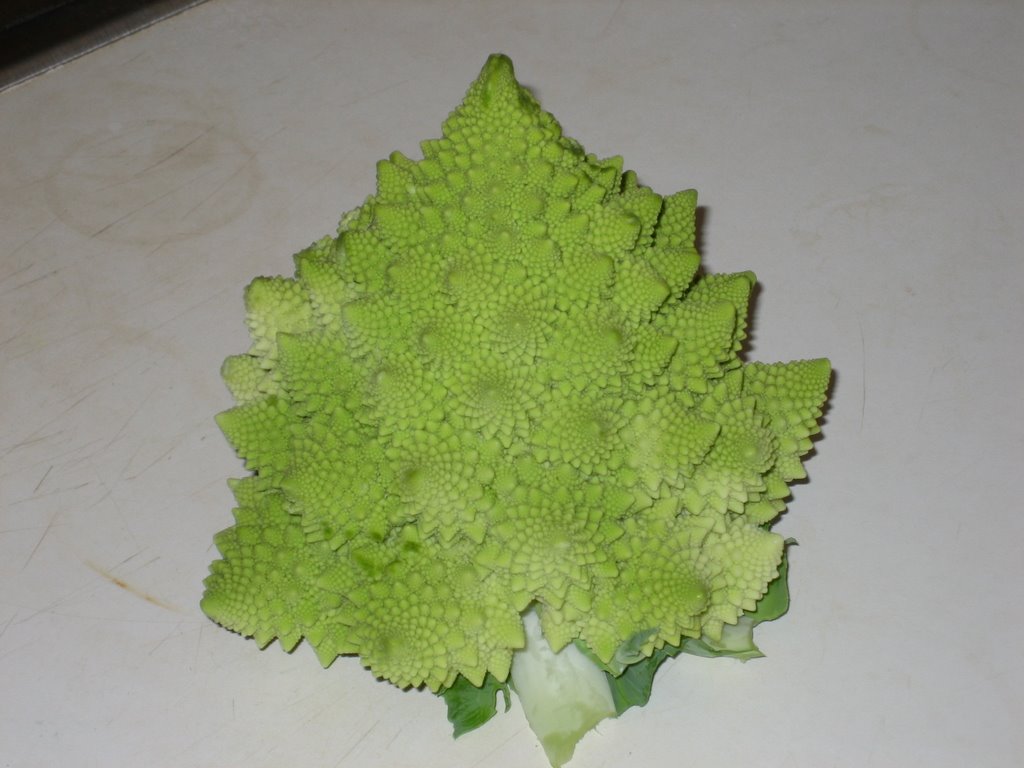
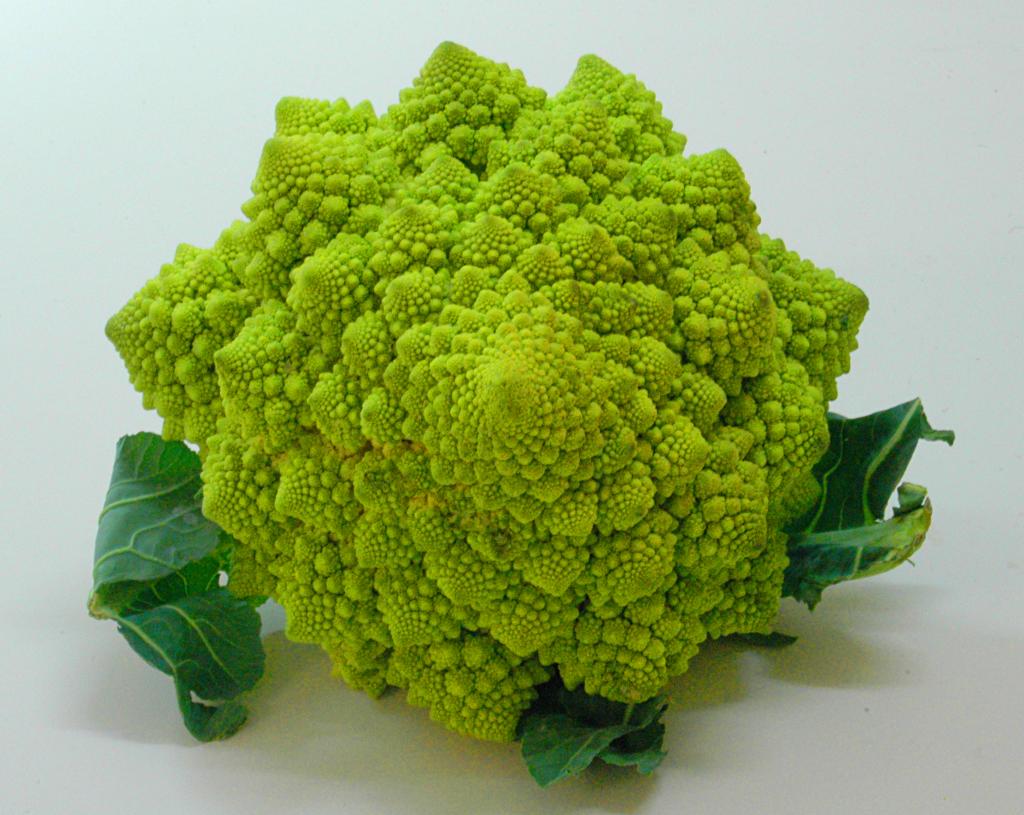
The cauliflower is a fractal as has been explored repeatedly on this blog.

Hold the thing upside down and slice into the florets at a 40° angle. The outside florets will fall off. Keep rotating and doing this.

Now, do this again to each large floret cluster. That's what fractal means!

Monday, July 5, 2010

Poached Scallops over Spinach Couscous

This is the ultimate weekday dish. You should be able to manage this even with your "busy schedules" and "heatwaves".

If you can't manage this, the CC suggests you keep all the local takeouts and deliveries on speed dial. Oh, and you are not fit material for this blog.

Heat some tomato broth in a pan. When it comes to a simmer, turn the heat down. Add salt, pepper, herbs of your choice -- the CC added rosemary and/or thyme -- pop in the scallops and poach gently until they are barely set.

In parallel, the CC heated some water. Use the nuker. Drop in a bouillon cube (go on! don't be so uppity.) Pour it over the couscous. Cover. Let the couscous do its thing.

Remove the scallops from the pan using a slotted spoon. Turn the heat for the sauce on high, and reduce.

Plate as below. Not exactly rocket surgery but a perfectly balanced delicious meal.


This is a fairly general idea. You can poach squid, or shrimp, or even a fish fillet (for which you will need a larger amount of broth.)

You could even poach an egg.

You can use whatever herbs you have at hand. Sage, rosemary, thyme, oregano. You can bung in a chilli pepper or two for some heat. Or an anchovy for some umami.

The variations are endless. This is a meta-recipe.

As the CC said, it's the ultimate weekday dish.

Sunday, November 8, 2009

Meta-dishes

The Indians do it, the Chinese do it; even the propah-Viennese do it.

The CC has featured meta-recipes before like this one but he should feature more. These are the lifeblood of the "I-need-good-food-but-I-have-a-crazy-job"-crowd.

Y'all can all thank the CC later!*

* not that you do, you lousy bastards!

Tuesday, August 18, 2009

Feed your inner mathematician!


Yep, they're real! And they're named after Gottfried Wilhelm Leibniz, the co-founder (along with Isaac Newton) of the infinitesimal calculus.

Thursday, January 15, 2009

π

This is too geeky for words but the CC loves it!

Food, and books, and math, and edible books, and edible math, how could you possibly NOT love it?

Friday, October 19, 2007

French Classical Sauces

Escoffier may list hundreds but there are only 23.

W
O
W/S
O/W
S/W
(O + S)/W
(W/S)/W
O + (W/S)
(G + O)/W
(G + O + S)/W
(O + (W/S))/W
(S + (W/S))/W
((W + S)/O)/S
(O + S + (W/S))/W
((W/S) + (S ⊂ W))/W
(O + (W/S)/W)/S
((O + (W/S))/W)/S
(O/W) + ((G + O)/W)
(O + (W/S) + (S ⊂ W))/W
(S + (W/S) + (S ⊂ W))/W
(((W/S) + (S ⊂ W))/W)/S
(O + S +(W/S) + (S ⊂ W))/W
(O + S +((G + O)/W))/W


Key (letters): O = oil, W = water, G = gas, S = solid
Key (operators): + = mixed into, / = dispersed into, ⊂ = included into

For example, both broth or vinegar are just W, and butter is (W/O)/S.

Note that in a given formula, the multiple W's and S'es may be different.

This is the work of the magnificent Hervé This, co-inventor of the field of molecular gastronomy.

See if you can come up with examples of the above sauces, fellow gastronauts!

Friday, April 13, 2007

Sukke

This is an amazing Indian side-dish (from the west coast) but this is not a recipe. This is a meta-recipe.

Even the linguistics gives it away. It literally means "dry" but dry what exactly? Well, that's the meta- part!

Alas, they didn't have mathematical notation back in the day otherwise the CC would've begun the recipe as "∀V" (where V is a vegetable) do:

(Ignore the above. It's the CC's inner mathematician.)

For the record, the recipe varies up and down the coast. Towards the south, the recipe is as the CC records it. Up the coast, they start adding green chillies (Northern influence), and sugar (Gujarati influence.)

You may think, "What the hell? This doesn't look so special.", but rest assured, this stuff disappears the fastest every single time when the CC makes it.

Also, please don't make any substitutions. For starters, there's not a whole lot to substitute ergo you're looking at boiled V's minus the flavor.

Ingredients

2 tbsp mustard seeds
10-12 curry leaves
3 cups "vegetables"
3/8 cup grated coconut
salt to taste

Recipe

Heat some oil in a pan. When it's hot, add the mustard seeds, cover the pan, until they pop. Toss in the curry leaves and fry for 20 seconds. Add the vegetables, coconut, and salt.

You may need to add a couple of tablespoons of water but remember the "dry" part!

Cook until the vegetables are tender. (If you use a multitude, add the "toughest" ones first followed by... etc.)

Saturday, November 18, 2006

Cauliflowers : Part 1


Can you say fractal and Fibonacci series?

This amazing beauty is a Romanesco cauliflower.

The CC found it at his local farmers' market.

The CC is just about ecstatic at the wondrous combination of his two loves, food and mathematics!