Ever wonder why you have trouble reproducing that amazing dish featuring chili peppers that you had elsewhere? Ever wonder why there is such a proliferation of different kinds of peppers both spicy and sweet and everything in between?
The answer is actually quite complex.
Peppers which definitely came from South America are rather complex objects. They are incredibly sensitive to what the French might call terroir.
The soil matters; the amount of sunlight matters; the temperature of the warm day versus the cool night matters a lot. In short, they are rather fickle little things.
Take the same strain and plant it in two different places — warm Louisana as opposed to cooler Oregon, just to take two places at random and you will get diametrically opposing results from the same plant. Even the same strain in the same location will differ from year to year because the weather is variable.
That's just one of the problems.
They've also had a solid five centuries to spread all over the world. The different sub-species were pushed not only by natural selection but also cultural selection into the hundreds of varieties all over the globe. (Contrast with oranges which are completely ancient but there aren't that many sub-species of oranges out there even with all the human-controlled cross-pollination.)
This is the reason that some of the magnificent dishes of Sri Lanka really cannot be reproduced elsewhere. Even if you got the seeds, you don't have the weather.
It's the same reason that Hungary keeps a really tight lid on one of its products — Hungarian paprika. You will get arrested if you try to steal the seeds and smuggle them out. They did smuggle them successfully and tried to reproduce them in Oregon. All the efforts failed. The climates might be "similar" but they are not similar enough. The soil certainly isn't.
The same goes for the different varieties of Spanish paprika.
The story of Tabasco which is a product of Louisiana follows the same pattern. They've had a limited amount of success reproducing it in Mexico but it wasn't easy. (The story of Tabasco is rather fascinating since it has all the elements of a financial thriller — competitors, corruption, patent laws, politicians, bankruptcy, questionable tactics, possible illegality, etc.)
All to protect a brand that, truth be said, the CC is kinda fond of.
It's actually rather hard to get the truly great peppers of Peru. Even in New York. Only the dozen or two of so most-commonly used peppers actually proliferate. The most common ones are probably more "robust" than the other strains.
What it does mean though that if you want to eat truly great peppers, you'll just have to go to the source.
It's good to reminded from time to time that travel matters and that "variety truly is the spice of life."
Showing posts with label spanish. Show all posts
Showing posts with label spanish. Show all posts
Tuesday, March 21, 2017
Thursday, October 20, 2016
Watalappam
This dessert (also frequently transliterated as watalappan) is probably one of the CC's favorites even though the CC is not much of a dessert person to start with!
It's related functionally to the very Spanish flan which is another one of the CC's favorites.
The massive difference between the two is that the Sri Lankan dessert substitutes coconut milk for the cream and milk in the original. This changes the chemistry in a significant way. It also adds a ton of "sweet" spices that flourish on the island. The sugar is substituted by a very specific palm jaggery which adds a smoky flavor and brown color to the product.
Flan is notoriously hard to make. It's very finicky about the percentage of fat in the cream and the milk and the water content. Flubs are common and the act of making it requires real skill.
Almodóvar films an entire flan recipe in his movie Volver. It's both a love ode to the wonderful dessert and a character study in the great tradition of silent films. By eavesdropping on a character who's clearly very talented at making it, and watching her do the thing she loves, we learn more about her than could be inferred from mere dialog.
The chemistry of coconut milk is much simpler than that of cream plus milk. Some genius made the substitution historically and it's a knockout since the proportions in coconut milk are exactly right to get the correct consistency and hence, flubbing is kept to at a minimum.
The jaggery that needs to be used is a palm jaggery called kithul jaggery. It's a little hard to find but it has a characteristic flavor that's hard to reproduce. Regular jaggery simply doesn't have the smoky flavor and it's not sweet enough.
The CC found it in London of all places which led someone to remark, "What does the CC do in London? He buys Sri Lankan jaggery and hauls it back to New York." This has irony written all over it since the CC was in Sri Lanka earlier in the year and didn't haul it back then. However, the bottom line is "Globalization, baby!"
The dessert is traditionally steamed but you can easily make it in an oven with a water bath as long as you have large pans. It also scales effortlessly. Best of all, it needs to be made ahead of time and cooled so you will be able to impress your guests without much effort.
It's just pure magic.

Ingredients
(serves 4)
100 gram kithul jaggery
200 ml coconut milk
2 cloves
1 large stick cinnamon
1 vanilla pod
3 cardamom pods
nutmeg
5 large eggs (read notes!)
Note 1: The jaggery is conveniently sold in 100 gram units wrapped in the dried palm leaves.
Note 2: The amount of milk in a standard can of coconut milk is close to 200 ml. Good enough. This recipe is quite forgiving. Shake it well before opening.
Note 3: The CC has seen pandanus leaves (called rampe in Sinhalese) added to the coconut milk. Great taste if you have some. Can be found frozen and work like a charm.
Note 4: The jaggery is quite hard and tradition calls for shaving it. The CC smashed it with a hammer and used the pieces. It made no difference since it dissolves completely and you will filter the product anyway. Tradition frequently wastes time without asking the obvious questions.
Note 5: If you use regular jaggery, you will need 4-8 tbsp of brown sugar to get the right sweetness.
Note 6: There is no way to predict how many eggs will be needed. Firstly, the coconut milks have different amounts of liquid. Secondly, the eggs are of different sizes even within the same grade. Lastly, the yolks are of different sizes. The CC started with four and then was forced to add one more to get it right. Chances are you might need an extra egg or one less. Start with four and go from there.
Recipe
Remove the cardamom seeds from the pod. Crush the cloves and cardamom in a mortar and pestle.
In a saucepan, heat up the ground cardamom and cloves, vanilla pod, cinnamon and ground nutmeg with the coconut milk and the jaggery. Bring it to a boil and turn down the heat to very low. Stir until everything dissolves and the spices steep into the liquid. Roughly 12-15 minutes. This also has the advantage of removing some of the moisture from the coconut milk.
Taste it. It should be cloyingly sweet and the spices should be prominent. (Don't worry. The final product will be nowhere near as sweet. We still have the eggs, remember?)
Strain the liquid into a bowl and let it cool down to room temperature. (Stick it in a freezer if you're in a hurry.) Discard any spices or solids left behind. Make sure that the mixture is cold otherwise the eggs will scramble when you incorporate them.
Beat the eggs but not too much. Don't incorporate too much air into them.
Strain the egg mixture using a fine sieve into the cold coconut milk liquid above. You will need to use a whisk to get the egg mixture through the sieve.
This step is CRUCIAL. The final product will simply not work without it.
Mix the batter gently to incorporate it completely. It should be slightly dense and thick but still liquid.
Split the mixture evenly into four oven-proof bowls. Cover each of them tightly with aluminum foil.
Now, you have two choices.
Steaming: Steam the four bowls in a steamer for 40 minutes. Check at that mark. They should be jiggly. If not, steam for an extra 5 minutes.
Baking: You're not really baking. You will need a deep pan that can hold the bowls. Preheat the oven to 350°F for 10 minutes. Heat some water in a kettle. Place the bowls in the pan. When the oven is heated, and the water is boiling, pour it in the pan around the bowls. Cover the pan itself with a separate piece of aluminum foil and put it in the oven. Steam for 40 minutes. Check. If not jiggly enough, steam for an additional 5 minutes.
The trick with the water is that all the energy is going into vaporizing the water so that the egg mixture itself never goes above the boiling point of water. Very clever and this clearly scales effortlessly.
Let them cool down to room temperature. Chill in the refrigerator until ready to serve. They are frequently topped with more cashews and raisins but this is a bit of gilding the lily.
It's related functionally to the very Spanish flan which is another one of the CC's favorites.
The massive difference between the two is that the Sri Lankan dessert substitutes coconut milk for the cream and milk in the original. This changes the chemistry in a significant way. It also adds a ton of "sweet" spices that flourish on the island. The sugar is substituted by a very specific palm jaggery which adds a smoky flavor and brown color to the product.
Flan is notoriously hard to make. It's very finicky about the percentage of fat in the cream and the milk and the water content. Flubs are common and the act of making it requires real skill.
Almodóvar films an entire flan recipe in his movie Volver. It's both a love ode to the wonderful dessert and a character study in the great tradition of silent films. By eavesdropping on a character who's clearly very talented at making it, and watching her do the thing she loves, we learn more about her than could be inferred from mere dialog.
The chemistry of coconut milk is much simpler than that of cream plus milk. Some genius made the substitution historically and it's a knockout since the proportions in coconut milk are exactly right to get the correct consistency and hence, flubbing is kept to at a minimum.
The jaggery that needs to be used is a palm jaggery called kithul jaggery. It's a little hard to find but it has a characteristic flavor that's hard to reproduce. Regular jaggery simply doesn't have the smoky flavor and it's not sweet enough.
The CC found it in London of all places which led someone to remark, "What does the CC do in London? He buys Sri Lankan jaggery and hauls it back to New York." This has irony written all over it since the CC was in Sri Lanka earlier in the year and didn't haul it back then. However, the bottom line is "Globalization, baby!"
The dessert is traditionally steamed but you can easily make it in an oven with a water bath as long as you have large pans. It also scales effortlessly. Best of all, it needs to be made ahead of time and cooled so you will be able to impress your guests without much effort.
It's just pure magic.
Ingredients
(serves 4)
100 gram kithul jaggery
200 ml coconut milk
2 cloves
1 large stick cinnamon
1 vanilla pod
3 cardamom pods
nutmeg
5 large eggs (read notes!)
Note 1: The jaggery is conveniently sold in 100 gram units wrapped in the dried palm leaves.
Note 2: The amount of milk in a standard can of coconut milk is close to 200 ml. Good enough. This recipe is quite forgiving. Shake it well before opening.
Note 3: The CC has seen pandanus leaves (called rampe in Sinhalese) added to the coconut milk. Great taste if you have some. Can be found frozen and work like a charm.
Note 4: The jaggery is quite hard and tradition calls for shaving it. The CC smashed it with a hammer and used the pieces. It made no difference since it dissolves completely and you will filter the product anyway. Tradition frequently wastes time without asking the obvious questions.
Note 5: If you use regular jaggery, you will need 4-8 tbsp of brown sugar to get the right sweetness.
Note 6: There is no way to predict how many eggs will be needed. Firstly, the coconut milks have different amounts of liquid. Secondly, the eggs are of different sizes even within the same grade. Lastly, the yolks are of different sizes. The CC started with four and then was forced to add one more to get it right. Chances are you might need an extra egg or one less. Start with four and go from there.
Recipe
Remove the cardamom seeds from the pod. Crush the cloves and cardamom in a mortar and pestle.
In a saucepan, heat up the ground cardamom and cloves, vanilla pod, cinnamon and ground nutmeg with the coconut milk and the jaggery. Bring it to a boil and turn down the heat to very low. Stir until everything dissolves and the spices steep into the liquid. Roughly 12-15 minutes. This also has the advantage of removing some of the moisture from the coconut milk.
Taste it. It should be cloyingly sweet and the spices should be prominent. (Don't worry. The final product will be nowhere near as sweet. We still have the eggs, remember?)
Strain the liquid into a bowl and let it cool down to room temperature. (Stick it in a freezer if you're in a hurry.) Discard any spices or solids left behind. Make sure that the mixture is cold otherwise the eggs will scramble when you incorporate them.
Beat the eggs but not too much. Don't incorporate too much air into them.
Strain the egg mixture using a fine sieve into the cold coconut milk liquid above. You will need to use a whisk to get the egg mixture through the sieve.
This step is CRUCIAL. The final product will simply not work without it.
Mix the batter gently to incorporate it completely. It should be slightly dense and thick but still liquid.
Split the mixture evenly into four oven-proof bowls. Cover each of them tightly with aluminum foil.
Now, you have two choices.
Steaming: Steam the four bowls in a steamer for 40 minutes. Check at that mark. They should be jiggly. If not, steam for an extra 5 minutes.
Baking: You're not really baking. You will need a deep pan that can hold the bowls. Preheat the oven to 350°F for 10 minutes. Heat some water in a kettle. Place the bowls in the pan. When the oven is heated, and the water is boiling, pour it in the pan around the bowls. Cover the pan itself with a separate piece of aluminum foil and put it in the oven. Steam for 40 minutes. Check. If not jiggly enough, steam for an additional 5 minutes.
The trick with the water is that all the energy is going into vaporizing the water so that the egg mixture itself never goes above the boiling point of water. Very clever and this clearly scales effortlessly.
Let them cool down to room temperature. Chill in the refrigerator until ready to serve. They are frequently topped with more cashews and raisins but this is a bit of gilding the lily.
Tuesday, September 6, 2016
The Dark Side of Food
One of the most important concepts associated with food is that it is pretty much the only activity that we do daily. There's also shitting but that's the end result of eating.
We eat to live. Literally. Our bodies are just a mechanism by which food gets transformed into fuel for our brain.
Every other activity that we do daily is basically optional but not eating.
There are many consequences to this simple observation. We'll proceed from the relatively trivial to the relatively profound.
No, your mother's version of that dish is not the "best". It's not even "typical". It's probably even shit. Let's start with that.
It's just something you ate on a daily basis and hence established the basis on which you rest your (very shaky) foundation of food. You may even perpetuate that because it's the only thing that you know. If you want to break out of the arbitrariness of your birth, and it is extraordinarily hard to do so, then you must first accept this brutal fact.
Did you notice that the CC referred to your mother's cooking as "shit"?
Notice how the metaphor neatly connects to food. We work symbolically through food. Everything from "no free lunch" to "corny" to "sour grapes" to "dish fit for the gods" — Shakespeare made the last one up as he did also "salad days", "in a pickle" and "the milk of human kindness".
There are literally no languages that don't have wondrous phrases related to food. It's so elemental that it's taken for granted. Everything from "essere buono come il pane" ("to be as good as bread" = "as good as gold") to 羊頭狗肉 ("sheep's head, dog meat" = "false advertising".)
Since eating is literally the only mandatory activity that we do, it goes without surprise that it's the ideal mechanism of enforcing group conformity.
There are absolutely no religions in the world that don't have a mandatory taboo on some form of eating. Judaism has kosher laws, the various religions in India have strange forms of vegetarianism, Christianity imposed rules of eating on Fridays, etc.
Needless to say this is all bullshit. Humans are famously omnivore. What one group eschews another embraces. The Chinese would laugh at the Jews. The meat-eaters mock the vegetarians. Fish on Fridays? Please.
Notice the bullshit metaphor also works via food. The only thing worse than your own shit would be the shit of a bull.
These rules have nothing to do with food and everything to do with enforcing group identity. You define yourself not only by what you are but also but what you are not.
The group identity mechanism works via what the Japanese would call 内外 ("uchi-soto" = "inside-outside"). Follow the food rules and you're an insider. Don't and you will be brutally excommunicated.
Lest you think that this mechanism is "religious" in nature, the CC will be happy to pontificate.
Try arguing barbecue in the US. There's great barbecue everywhere from Virginia to South Carolina to Kentucky to Texas. However, none of these groups agree with each other. Everyone seems to think their own version is the "best" — an entirely laughable notion that any outsider (like the CC!) might care to disabuse them of. They're all great; they are just different.
So you see, your mother's version of that dish is not the "best". It's your own fierce form of enforcing identity. You are sticking by what little you know and even if your mother is a terrific cook, you are trying futilely to convince others that it is food fit for the gods.
The most famous example of this "food as identity" enforcement was the Spanish Reconquista — the re-establishment of Christian rule in Spain. The Arabs and the Jews were forced at sword-point to eat pork in public as proof of their "conversion" to Christianity. The Spanish then took their concept to the Philippines which had no particular ban on pork and hence turned the pig into a newly formed "religion".
The great ramen maker, Momofuku Ando, neatly also turned these religious identity rules to his advantage by casually observing that there was no religion in the world that didn't embrace the chicken. The first ramen noodle flavor was chicken. (He wasn't particularly interested in the vegetarians.)
Which brings us to the fact that vegetarianism is another example of an entirely post-facto-rationalized system erected on extraordinarily shaky foundations.
Humans are omnivorous. We will literally eat anything which you can plainly observe because what one country or ethnic group rejects, another will happily eat. Since they all can't be right and they're all equally human, it stands to reason that they all must be wrong.
Science backs it up in spades. We are omnivorous, and we definitely evolved because of our capacity to eat meat. Arthur Clarke famously points this out in 2001: A Space Odyssey and Kubrick gives this profound notion the utmost respect by filming it most memorably with a magnificent jump-cut.
We even have specialized meat receptors in our stomachs. Evolution at its finest. It gave us a powerful concentrated source of fuel and pushed our brains to much larger sizes.
Is there a point to this depressing discourse which is almost tailor-made to offend just about everyone? Why yes, there most certainly is.
If you really want to get to understand another culture, the ideal mechanism is through its food. Not only will you be wearing a different identity, it will make it far easier to discard your own. Discarding your identity is not for the weak. You will be left adrift and will be forced to fend on your own. The group enforcement mechanism will kick in dressed in full riot gear.
However, it's one of the few ways to throw off the arbitrariness of your birth (which you had no choice over) and get to enter into entirely new mindsets.
When phrased like that, you're looking at the greatest adventure in life. Needless to say, it's highly recommended.
Saturday, August 22, 2015
Huevos Rotos
After the insane tapas party, the CC needed to make something basic and elemental. He did some searching and, lo and behold, he had all the ingredients necessary for a nutritious and tasty breakfast.
This is not a "fast" dish. However, you don't need to do much. Set the timer and get away.
Best eggs ever. They combine the magic of "home fries" and poached eggs in one easy dish.
You need to serve them with jamon serrano, of course.
Ingredients
(serves 2)
1 large onion (chopped coarsely)
1 green pepper (chopped into matchsticks)
3 fingerling potatoes (chopped into thin rounds)
4 cloves garlic (minced fine)
4 eggs
1/4 cup parsley
1 tsp paprika (agridolce)
olive oil
salt
pepper
Recipe
You need a frying pan that has a lid.
Heat up some olive oil in a pan. When it shimmers, toss in the onion and the garlic. Fry for a bit. Add the peppers and let them fry for a bit. Add the potatoes, turn the heat down to the lowest possible setting and let them cook. Add the paprika, salt and pepper. Let the potatoes cook for at least 25 minutes. Add the parsley and let cook for an additional 5 minutes. (Total of 30 minutes.)
Keep stirring while the potatoes cook. Every 10 minutes is sufficient. No need to break them up.
You will be able to smell the potatoes being done. It's unmistakable.
Spread the mixture evenly over the pan. Crack the four eggs in the four corners. Cover the pan and let cook for 4 minutes. You may need an extra minute but take the pan off the heat once the whites are set.
Serve the poached eggs - two per person with the potatoes below. The yolk will be barely set but that's perfect when you crack it and it coats the potatoes. Enjoy with the jamon in tow.
Saturday, August 15, 2015
The Power of Positive Drinking
After all this time, the CC decided to throw a serious tapas party.
The goal is drinking but the little nibbles do help the drinks go down. There was amontillado (of course!), cava and assorted Spanish wines. The stars are the little tidbits naturally.
The idea was to have a Spanish party but with nods to the Japanese izakaya tradition (same idea, different country!) and some inflections to the CC's heritage.
Since it's summer and the produce is mind-blowingly amazing, the CC kept it local so the ideas are inspired by analogous tapas dishes that the CC has sampled rather than recreating them literally.
Experienced readers (and eaters) should be able to recognize the thematic patterns of the five sections below.
Banderillas (assorted)
Salted Almonds
Pickled Cauliflower
Sautéed Shishito Peppers
♦
Zucchini Carpaccio w/ Arbequina olive oil & pine nuts
Ensalada de "Cristianos y Moros"
(White & Black Bean Salad)
Karasumi with chives (Bottarga)
♦
Zebra tomatoes w/ fior di sale
Gazpacho
Pan con tomate (with Jamon Iberico)
♦
Chickpeas & Spinach
Clams in Green Sauce
Patatas Bravas
♦
Bitter Orange & Olive Oil Cake
The goal is drinking but the little nibbles do help the drinks go down. There was amontillado (of course!), cava and assorted Spanish wines. The stars are the little tidbits naturally.
The idea was to have a Spanish party but with nods to the Japanese izakaya tradition (same idea, different country!) and some inflections to the CC's heritage.
Since it's summer and the produce is mind-blowingly amazing, the CC kept it local so the ideas are inspired by analogous tapas dishes that the CC has sampled rather than recreating them literally.
Experienced readers (and eaters) should be able to recognize the thematic patterns of the five sections below.
Salted Almonds
Pickled Cauliflower
Sautéed Shishito Peppers
♦
Zucchini Carpaccio w/ Arbequina olive oil & pine nuts
Ensalada de "Cristianos y Moros"
(White & Black Bean Salad)
Karasumi with chives (Bottarga)
Gazpacho
Pan con tomate (with Jamon Iberico)
♦
♦
Bitter Orange & Olive Oil Cake
Thursday, July 30, 2015
Life's Ceviche, and Then You Die!
The empire of raw fish eating encompasses many realms but the basic idea is very clear. The freshness of the fish is paramount.
Even in older times, people were intuitively aware of the need to "sterilize" the surface of the flesh. They may not have not known about bacteria and clean workspaces but they had empirically figured out that the surfaces of the fish get contaminated quickly in a hot climate.
The solution was a quick bath of the fish in an acidic medium — lime, lemon or calamansi juice, various vinegars, etc.
Different cultures produced variants that lie along a spectrum — sashimi and sushi (Japanese), kinilaw (Filipino) and ceviche (South America and then transmitted further via the Spanish Empire.)
They range between raw and "cooked" via acid. There's also some form in pickling in the mix.
Sashimi for all its vaunted "heritage" is only possible thanks to modern-day fish processing. It's only modern freezers that allow fish to be consumed safely.
Sushi is an older idea where fish were placed with vinegared rice and allowed to partially ferment to develop intense umami flavors. This older style of sushi is seldom found any more. In fact, even slightly recent forms of sushi (Edo-sushi) are rarely found today. The modern-style involves raw fish placed over mildly vinegared rice. (A full treatment of all the sushi styles would take up a book not a blog post!)
Ceviche is widely known these days. Raw fish is mixed with lime juice, spices, peppers, cilantro and sometimes all kinds of incongruous ingredients (avocado?) — this idea from South America spread across the globe with the Spanish Empire. The idea is that the intense acid "cooks" the muscles of the fish. It's easy to prepare to keeps easy with modern refrigeration. No wonder it's a hit at restaurants since it can be made ahead of time.
Kinilaw (or kilawin sometimes) is an ancient style of Filipino cooking. Even though it's tempting to assume that the idea came with the Spanish Empire, the evidence overwhelmingly suggests it was an original ancient indigenous idea that the Spaniards encountered and recognized as being analogous to something they already knew.
In fact, for an ancient idea, kinilaw comes closest to the modern-day ideal of sashimi. The fish are bathed in an intensely acidic broth but they are consumed right away within seconds. Kinilaw connoisseurs can feel the toughening of the fish fibers as the minutes tick away.
It's served with rice. Rice is everywhere in the Philippines even for breakfast! The CC's passion for food has limits. More rice? Again?!? SIGH.
There are also added vegetables — radishes are classic but the CC bets that halved summer cherry tomatoes would be killer too from the umami. There is also lato but you can't find that outside the Philippines. SIGH.
As would the dried anchovies known as dilis in the Philippines although the idea of pairing dried and fresh fish would be looked upon as total heresy. The same idea with dried fish is a "separate" dish. SIGH.
A word about calamansi — these intensely flavored citrus limes the size of a small marble are unique. If you can't find them, the next best bet are the yuzu you find in the Japanese markets. If you can't find those, use a mixture of orange and lime juice but you will not reproduce the intensity and uniqueness of calamansi.
Kilawin is also made with cooked pork and goat. It's a pretty general idea and the general etymological difference between kilawin and kinilaw seems to be whether it's cooked meat or fresh fish. (This is a bit unresearched and sorta folksy, and the CC might be wrong.)
Given the sashimi nature of the dish, if you want great kinilaw, you must make it yourself. There is no other choice. At the CC's farmers' market, there is a local fisherman supplying two kinds of sashimi-grade seafood — tuna and scallops. Hence, the CC makes tuna and scallop kinilaw since that is what is possible outside of the absurdly magnificent "wet markets" of the Philippines.
Ingredients
1 shallot (diced fine)
1" ginger (cut into fine slivers)
2 garlic cloves (diced fine)
2 Thai bird-eye chillies (diced into very thin rounds — add more for spice)
1/2 cup coconut vinegar
6-8 calamansi (squeezed fresh)
salt (read below)
fresh black pepper
2 red radishes (cut into thin half-moons)
1/2 lb sashimi-grade tuna (diced)
6 scallops (cut into 4 half-moons each)
Recipe
Mix all the ingredients except the fish together. Taste. It should have an intensely sour taste but it should also be "rounded". This is hard to explain but easy to taste. You typically won't need salt but you might need a pinch. It should sit together for at least 30 minutes for the flavors to "blend".
Store the mixture and the diced fish in the fridge separately. Mix right before serving.
Tick tock, tick tock, tick tock. The clock is ticking. Eat right away if you want magic.
Wednesday, January 15, 2014
Fusion
The CC has never been against fusion. How could he?
We are nothing but the sum total of all our influences and that is true about all cuisines.
Indian food, both classically and modern, is an outgrowth of Persian cooking and New World foods. Japanese curry owes itself to British traders and an American commodore. New Orleans cuisine is based on French and African models with innovations (shrimp!) pushed by Filipino workers. Brazilian food grows out of Portuguese and African models and is reinforced by the importation of Japanese agricultural workers — the largest Japanese-speaking population outside of Japan.
Spanish cooking is based on Arabic models. In fact, most of the words for food substances have Arabic origins — aceituna (olive), azafran (saffron), naranja (orange). The word "lemon" comes from the Spanish limón which in turn comes from the Arabic laymoon which in turns come from the Chinese limung (modern-day Chinese: níngméng - 柠檬.)
Chinese food owes itself to Persian models with the extraordinarily heavy influence of Buddhism from India. Japanese food is an import of classical Chinese models. Even the language is an import of Chinese (kanji) and Indian phonetic models (Sanskrit - hiragana and katakana.)
Americans brought beef to Japan and its influence owes itself to the British Empire which in turn owes itself, ironically, to classical Persian models. The idea that meat was the food of the "rulers" not the "ruled" is based in ancient Persian hierarchical ideas about cuisine.
In the native Americas, Mexican cooking was heavily influenced by the Spanish invasion. Filipino food is based on Spanish and Mexican food because it was administered by Spain through Mexico.
If one wants to look at the truly ur-models then it would be the Babylonian and after that Persian models (wheat, barley) because that's where the crux of all political organization (and hence cooking) began.
So whither authenticity?
All food is ultimately fusion. It just matters how far you go back and look.
That's because humans have been trading with each other for millennia and good ideas have a way of germinating in other places and great ideas spread fast.
The traders were the original internet.
The Chinese traders taught the Indians how to steam circa the 10th century. The British brought curry powder to the Japanese and the French. The French brought classical technique to Haiti and New Orleans.
So anytime someone complains about "fusion", the CC just goes "Huh?!? What are you smokin'?"
For the record, even marijuana has Persian origins. Quelle surprise?
We are nothing but the sum total of all our influences and that is true about all cuisines.
Indian food, both classically and modern, is an outgrowth of Persian cooking and New World foods. Japanese curry owes itself to British traders and an American commodore. New Orleans cuisine is based on French and African models with innovations (shrimp!) pushed by Filipino workers. Brazilian food grows out of Portuguese and African models and is reinforced by the importation of Japanese agricultural workers — the largest Japanese-speaking population outside of Japan.
Spanish cooking is based on Arabic models. In fact, most of the words for food substances have Arabic origins — aceituna (olive), azafran (saffron), naranja (orange). The word "lemon" comes from the Spanish limón which in turn comes from the Arabic laymoon which in turns come from the Chinese limung (modern-day Chinese: níngméng - 柠檬.)
Chinese food owes itself to Persian models with the extraordinarily heavy influence of Buddhism from India. Japanese food is an import of classical Chinese models. Even the language is an import of Chinese (kanji) and Indian phonetic models (Sanskrit - hiragana and katakana.)
Americans brought beef to Japan and its influence owes itself to the British Empire which in turn owes itself, ironically, to classical Persian models. The idea that meat was the food of the "rulers" not the "ruled" is based in ancient Persian hierarchical ideas about cuisine.
In the native Americas, Mexican cooking was heavily influenced by the Spanish invasion. Filipino food is based on Spanish and Mexican food because it was administered by Spain through Mexico.
Ancient Greek and Egyptian cuisine grows out of Persian models and even ancient Roman cooking is unambiguously based on Greek and Egyptian models (thanks Cleopatra!)
The CC can go on forever.
The CC can go on forever.
If one wants to look at the truly ur-models then it would be the Babylonian and after that Persian models (wheat, barley) because that's where the crux of all political organization (and hence cooking) began.
So whither authenticity?
All food is ultimately fusion. It just matters how far you go back and look.
That's because humans have been trading with each other for millennia and good ideas have a way of germinating in other places and great ideas spread fast.
The traders were the original internet.
The Chinese traders taught the Indians how to steam circa the 10th century. The British brought curry powder to the Japanese and the French. The French brought classical technique to Haiti and New Orleans.
So anytime someone complains about "fusion", the CC just goes "Huh?!? What are you smokin'?"
For the record, even marijuana has Persian origins. Quelle surprise?
Monday, February 27, 2012
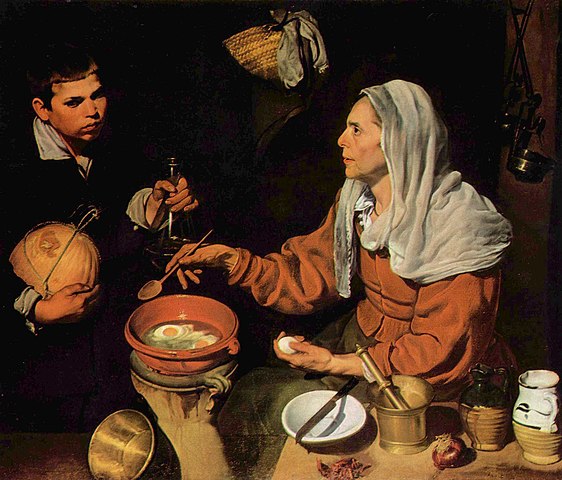
An Old Woman Fries Eggs
One of the great paintings by Velázquez is that of an old woman frying eggs while a young boy looks on and helps her.
The wonderful chiaroscuro is a joy to behold with the light appearing to come from the left. It was painted during his Seville period.
 (Source of painting: Wikipedia.)
But what is she doing?
She is making huevos fritos con puntilla. These are eggs fried in hot olive oil where the oil is flicked around the edge of the egg to achieve a delicate lacey frill like that of a traje de Sevillana.
The evidence is the hot oil that she should be flicking over the edges of the egg whites with her wooden spoon. This is a reasonably high-risk procedure with the chance of hot droplets of oil splashing all over. Her right sleeve covers her hand to protect it but not her left. Most importantly, since this procedure can easily make the egg whites overcooked without the yolk having set, she seems instructing the boy to add a slug of olive oil to the earthenware cooking pot to cool down the oil.
She seems to be about to speak to him but his interest seems to have wandered. He just wants his abuela to make the damned eggs, and enough with the instruction already.
The eternal drama of youth and old age captured in a succint way!
The wonderful chiaroscuro is a joy to behold with the light appearing to come from the left. It was painted during his Seville period.
 (Source of painting: Wikipedia.)
But what is she doing?
She is making huevos fritos con puntilla. These are eggs fried in hot olive oil where the oil is flicked around the edge of the egg to achieve a delicate lacey frill like that of a traje de Sevillana.
The evidence is the hot oil that she should be flicking over the edges of the egg whites with her wooden spoon. This is a reasonably high-risk procedure with the chance of hot droplets of oil splashing all over. Her right sleeve covers her hand to protect it but not her left. Most importantly, since this procedure can easily make the egg whites overcooked without the yolk having set, she seems instructing the boy to add a slug of olive oil to the earthenware cooking pot to cool down the oil.
She seems to be about to speak to him but his interest seems to have wandered. He just wants his abuela to make the damned eggs, and enough with the instruction already.
The eternal drama of youth and old age captured in a succint way!
Thursday, February 23, 2012
Arroz caldoso con sepia y coliflor
This is an entirely unusual recipe in that it sounds positively weird on paper but is absolutely delicious in practice.
Arroz caldoso is the ultimate comfort food. Rice, protein and seasonings in a soupy broth that is absolutely perfect when the weather gets cold.
Best of all, it reheats wonderfully (attn: office dwellers) and the taste improves with time.
It's Valencian in origin, and originally features cuttlefish (sepia) but lacking that, the CC used squid.
You will notice below that the technique is entirely unusual. Instead of the onions and garlic being sautéed first, the squid is. There is logic here. Squid needs to be either cooked very little, or a long time otherwise you get a rubbery unappetizing texture. This recipe uses the latter method.

Ingredients
2 cups Valencian short-grain rice (substitute by Arborio)
6 cups fish broth
1/2 lb tomatoes (passed through a food mill)
1 lb cauliflower florets
1 lb cuttlefish (or squid) cut into 1/2 inch slices
4 large garlic cloves, minced
1 large onion, coarsely grated
4 tbsp olive oil
1/2 tsp saffron
1 tsp sweet paprika (preferably Spanish smoked)
4 tbsp fresh parsley (chopped fine)
sea salt
Recipe
Combine the broth and saffron in a pot and keep warm over a very low flame.
Preheat the oven to 400°F.
In an oven-proof casserole, heat the olive oil, and sauté the squid. Sprinkle with the sea salt while this is happening. Stir in the cauliflower, garlic and grated onion and sauté for 5 minutes. Add the tomatoes, parsley and cook for 3 minutes. Turn the heat to low and let cook for 10 minutes.
Stir in the paprika, rice, and sauté until the rice is well coated with the mixture. Pour in the broth and boil for 5-8 minutes until the rice is slightly done. Transfer to the oven and cook for 10 minutes, uncovered until the rice is still al dente.
The mixture should be still soupy at this point.
Remove from the oven and let sit for 5 minutes. Serve.
Sunday, August 28, 2011
The Syncretic Culture
If there is a a single word that could be used to sum up Filipino culture, the word would be "syncretism".
Over the millenia, the islands that now comprise the Philippine nation have encountered a myriad of cultures and synthesized them into a coherent whole. The influences range from Malay, China, Indonesia and Japan (geography), to India and the Arab world (trade routes and conquest), to Spain and America (colonial.)
In an increasingly post-modern world — "Sushi and Coca-Cola" — as a friend of the CC's so memorably put it; it is extraordinarily surprising that a syncretic food culture should not just be unknown but invisible to the point of surprise when it is mentioned.
There are primarily three reasons for this.
The first that hits the tongue directly is that Filipino food lacks a sharp flavor profile. There is nothing that "hits" you in the way that, say, Thai food does. Instead, the emphasis is on extraordinarily fresh ingredients prepared simply.
This makes it doubly ironic since the phrase "extraordinarily fresh ingredients prepared simply" could equally well be attached to Italian food which has been the subject of food fetishization for the last twenty years.
In an increasingly super-marketized world, it is simply not possible to experience the absolute wondrous nature of this food. In fact, one could argue that in large cities like Manila, this nature has been lost for a very long time.
The CC ate the most magical pork grilled with nothing but salt in the rural Philippines. The pig had been freshly slaughtered. Two days later, it was prepared again on the CC's request but it was nowhere near as good.
The explanation?
My sister prepared it. She doesn't know how to do it. She washed the meat but it's the blood that gives it the taste."
You can absolutely forget about eating stuff like this in a super-market world. In short, you are unlikely to have a "Filipino food experience" unless you actually use the absolutely best ingredients that money can buy. When done right, it should rightfully blow your brains out even lacking the afore-mentioned sharp flavor profile.
The second reason, and this comes from the simple fact that almost any great food culture is the food of poverty. Not only is there an extraordinary "waste-not, want-not" attitude to food but that there is positive celebration of offal.
(Incidentally, the Spaniards amped up this already ingrained agrarian logic, particularly the love of pork, to unprecedented levels.)
Given conventional food mores towards the "nasty bits" then, there seems to be this ick-factor that a lot of people will have to overcome.
(You can read Fuchsia Dunlop talk about the same phenomenon in the context of traditional Chinese cuisines.)
In Filipino culture, every organ is not just eaten but celebrated. Tuna jaw, tuna ovaries, pig lungs, pig offal in pig's blood, you name it. There's a dish. When mentioned, there's almost always a wistful sigh, "Oh, I miss that." (which has its own sentimental ick-factor, "Didn't we just eat that last night? How can you miss it?")
Since we live in a world of increasing offal-fetishization, this argument is going to become increasingly irrelevant. In five years when offal goes mainstream, that will be the time when the hoi-polloi "discover" Filipino food.
The third and very likely, the dominant reason of the invisibility of Filipino food, is that they have never had in the entirety of their history, a firm royalty. Sure, there have been local rulers and chieftains but there has never been an Emperor.
It may come as a surprise that an accident of history like that would have profound consequences on how we eat today but it does. Cultures that have had a firm sense of royalty and there are many -- French, Thai, Italian, Japanese, Indian, Chinese -- have not only a history of "fine dining" but an entire cadre of dishes that effectively migrated "top-down". From the Emperor downwards to the royal classes and then downwards to the middle-classes. Additionally, there is a very strong sense of what constitutes "fine dining", and a sense of how to go about it.
Modern restaurant culture at the highest end is nothing more than a generalization of royal cuisine. In short, you are still a slave to the whimsies of an emperor of a country that you have never visited and whose name you still don't know.
The pursuit of food as an active object of desire, discussion, detail has always been something that could only be pursued by the relatively well-off. That it even shows up in mass culture (TV shows, food porn!) is based on the fact that we are extraordinarily more economically productive than people in the 16th century. The average person can afford to waste their time in a pursuit that goes beyond daily sustenance. The Industrial Revolution has done its job, and extraordinarily well to boot.
If you were not particularly flush with money in older times, and wanted to eat great food, presentation and all, the only mechanism open to you would have to know someone a member of the elite, and be invited to dine at their table. The elite, after all, have always had their servants to make their food. Excellence was expected as a routine matter of course. If they were bored of the ordinary excellence that came out of their own kitchen, they would just finagle an invitation to dine at their friends' places where they would encounter an ordinary excellence that was totally different from their routine ordinary excellence.
(On a side note, that's why great artists with patrons have always eaten well. They may not be from the elite themselves but the influence rubbed off.)
In the Philippines, this sense of "older times" would be a scant twenty or thirty years ago. The food culture is still evolving because of the absence of a strong sense of royalty and a mechanism of presenting the cuisine. Thankfully, the modern world via its restaurant culture is doing its job, and increasingly in the places where money is flush, you see Filipino cuisine presented in all its glory.
The aging conservative Rimsky-Korsakov once warned his budding student, Stravinsky, about the strange delightful harmonies in Debussy's music -- "Better not listen to him, otherwise you risk getting accustomed to it, and you might even like it."
"Better not eat Filipino food, otherwise you risk getting accustomed to it, and you might even like it."
Tuesday, October 5, 2010
Fideua in Barcelona
This was a magnificent meal. The CC had the fideua negra (black noodles with cuttlefish in its ink.)
The second dish, pan con tomate (bread rubbed with olive oil, garlic and tomatoes) is deceptively simple. Make it right, and it's so heavenly that you could just eat it all day long. (Once again, pictures do not do it justice.)

Anchovies with olive oil and sherry vinegar

Pan con tomate

Fideua negra

The second dish, pan con tomate (bread rubbed with olive oil, garlic and tomatoes) is deceptively simple. Make it right, and it's so heavenly that you could just eat it all day long. (Once again, pictures do not do it justice.)


Wednesday, September 29, 2010

Sunday, September 26, 2010
A Spectacular Meal in Córdoba!
This is one of those epic meals that you only encounter once in your life. Naturally, the CC disdains such absurdly romantic notions so he went there for lunch two days later, and experienced it twice!
The picture of tomatoes below is deceptive. A picture cannot do it justice; it was poetry on a plate.
They were "only" tomatoes, sprinkled with fleur de sel (fiori di sale), and drizzled with olive oil. However, the tomatoes had quite literally been picked minutes before from the garden. They were still warm from the heat of the sun, and smelled like TOMATOES.
When years from now, the CC has his "madeleine"-moment, these tomatoes will be it!

Salmorejo, Gazpacho

Ajo blanco (Gazpacho with almonds)

Tomatoes with fleur de sel and olive oil

Frituras de verduras (Fried vegetables)

Rabo del toro (Braised oxtail)

Flan

Espresso
The picture of tomatoes below is deceptive. A picture cannot do it justice; it was poetry on a plate.
They were "only" tomatoes, sprinkled with fleur de sel (fiori di sale), and drizzled with olive oil. However, the tomatoes had quite literally been picked minutes before from the garden. They were still warm from the heat of the sun, and smelled like TOMATOES.
When years from now, the CC has his "madeleine"-moment, these tomatoes will be it!


Monday, August 30, 2010
Globalización
You scour India looking for real asafoetida (= resinous form) and you find it in ... Spain?
Por qué no?
Por qué no?
Sunday, August 15, 2010


Saturday, August 14, 2010
Tapas en España : Part 4


Friday, August 13, 2010


Thursday, August 12, 2010


Wednesday, August 11, 2010


Thursday, August 5, 2010
Subscribe to:
Posts (Atom)

