Well, the CC loves sprouts, and many a year ago, he was presented with a sprouter by one of his aunts.
It's one of these plastic trays where you can place the sprouting beans in the top two trays, and a tiny amount of water in the lowest tray, and the whole thing is supposed to work out.
Except it doesn't.
It's warm enough in New York in the summer but the CC's apartment doesn't get enough direct sunlight for the whole thing to work out. If the CC lived in Italy, or India, or Mexico, it would work out but it doesn't.
So the CC has come up with an alternate plan. Unsurprisingly, this is modern take on a classic method which brings the CC to ask the eternal question, "Why on earth do we fuck with perfection?"
Soak the beans overnight. Wash them again. Put them in a cheese cloth, and lay them where they get plenty of sunlight. Every 12 hours or whenever the cheese cloth gets dry, mist it, drain it again, and leave it well alone. Different beans will sprout in different cycles. Some take 36 hours, and others 60 hours from start to finish.
The cheese cloth is cloth enough to stay wet, and porous enough to not retain enough water to allow it to get moldy. (The classic technique was to use a linen cloth. Same idea.)
You'll get perfect sprouts each time. No plastics need apply.
Saturday, July 28, 2007
Friday, July 6, 2007
Rules for buying cookbooks
- Never ever buy a cookbook for the pictures. Never, ever!
- Remember that techniques and culture count more than specific recipes.
- Never buy a book with too broad a mandate (World Cuisine, Fish & Shellfish), or too narrow a one (Oysters, Dum Pukht).
- Never buy "celebrity" books unless they offer technique, and even in that case be cynical, very cynical!
- Remember that most cookbook authors like amateur novelists only have one book in them.
Wednesday, July 4, 2007
Ramps
They are not garlic. They are not spring garlic. They are not leeks. They are not even wild onions.
Capiche?!?

They are very hard to get but the CC desperately wants some. Anyone here wanna hook the CC up?
Capiche?!?

They are very hard to get but the CC desperately wants some. Anyone here wanna hook the CC up?
Tuesday, July 3, 2007
Farmers' Market Sweep (Part 2)
The recipe for your delectable pleasure:
Ingredients
Pesto
basil leaves
spring garlic
walnuts (yep! it's more traditional)
olive oil
salt
peeled fava beans (prepped as described here.)
linguini or spaghetti (cooked al dente)
Recipe
Should be obvious but here goes nothing.
Grind the pesto.
Mix. Serve. Slurp. Enjoy.
Ingredients
Pesto
basil leaves
spring garlic
walnuts (yep! it's more traditional)
olive oil
salt
peeled fava beans (prepped as described here.)
linguini or spaghetti (cooked al dente)
Recipe
Should be obvious but here goes nothing.
Grind the pesto.
Mix. Serve. Slurp. Enjoy.
Sunday, July 1, 2007
An Immodest Apologia
As the years have evolved, and the CC looks back upon earlier post entries (and before that, emails), he notes that some of the recipes are surprisingly jejune.
"Did I really used to make that?"
As the CC's knowledge of food, and particularly technique deepens, it goes without saying earlier blog entries start looking either insubstantial, or incorrect, or horrors! horribly wrong.
But that's how knowledge works. We wish we were born knowing this information but we are not, and hence, no surprise O surprises, we must learn the hard way.
What's surprising is that, in looking back, you find that a surprising amount of emotional energy and psychological history is tied up to food.
"Remember the time ... was made? And for X!"
The CC has entire dishes that he seldom revisits because of evenings that went horribly wrong (for reasons that seldom involve food.)
Food and cooking form a strange personal trajectory of discovery and knowledge. Certain pasts are best not revisited, just as other pasts are to be rightly celebrated.
Perhaps it's best to not apologize for our juvenilia.
"Did I really used to make that?"
As the CC's knowledge of food, and particularly technique deepens, it goes without saying earlier blog entries start looking either insubstantial, or incorrect, or horrors! horribly wrong.
But that's how knowledge works. We wish we were born knowing this information but we are not, and hence, no surprise O surprises, we must learn the hard way.
What's surprising is that, in looking back, you find that a surprising amount of emotional energy and psychological history is tied up to food.
"Remember the time ... was made? And for X!"
The CC has entire dishes that he seldom revisits because of evenings that went horribly wrong (for reasons that seldom involve food.)
Food and cooking form a strange personal trajectory of discovery and knowledge. Certain pasts are best not revisited, just as other pasts are to be rightly celebrated.
Perhaps it's best to not apologize for our juvenilia.
Saturday, June 30, 2007
Book Blitz
Well, the CC was taken by his friend to this wonderful store uptown in Manhattan which is devoted solely to books on food.
It was like leading a diabetic into a pastry shop. Within the first five minutes, the CC had mentally spent his quarterly salary, and after 20 minutes, he was contemplating the prospect of bankruptcy.
Thankfully, cooler heads prevailed, and the CC escaped with only a dent to his wallet. (The rest of the books were a present from the friend to the CC.)
(For those of you familiar with Chicago, this is the Seminary Co-op of food books. For those of you who don't understand, your lives are the poorer for it.)
Those of you not passing through Manhattan may want to check out the online store.
It was like leading a diabetic into a pastry shop. Within the first five minutes, the CC had mentally spent his quarterly salary, and after 20 minutes, he was contemplating the prospect of bankruptcy.
Thankfully, cooler heads prevailed, and the CC escaped with only a dent to his wallet. (The rest of the books were a present from the friend to the CC.)
(For those of you familiar with Chicago, this is the Seminary Co-op of food books. For those of you who don't understand, your lives are the poorer for it.)
Those of you not passing through Manhattan may want to check out the online store.
Saturday, June 23, 2007
Farmers' Market Sweep (Part 1)
Waking up is hard to do. Waking up really early is harder to do. Waking up to go to the farmers' market when you're cooking just for yourself is hardest to do.
Well, the CC hied himself to the market, but today the food gods were scowling.
Oh well! Sometimes you're the windshield, and sometimes you're the bug. Sometimes you're even the guy who gets to clean off the splat of the bug off the windshield.
Inventory of Haul
spring garlic (bought 3, and the guy said, "Take one more! It's $5 for 4.")
basil (very good!!!)
applemint
fava beans
yellow zucchini
Everything else kinda sucked.
"You call this a swiss chard? I've seen terminally-ill great-grandmothers with more life in them!", etc. etc.
Anyway, it was back to the apartment, and dinner decisions had to be made sans desperation.
Basil and spring garlic suggested pesto, and the fava beans suggested themselves. The rest of the items suggested nothing.
Well, it was hey-ho-off-we-go, and what do we have here?
Linguini con pesto e fave
Recipe to follow.
Well, the CC hied himself to the market, but today the food gods were scowling.
Oh well! Sometimes you're the windshield, and sometimes you're the bug. Sometimes you're even the guy who gets to clean off the splat of the bug off the windshield.
Inventory of Haul
spring garlic (bought 3, and the guy said, "Take one more! It's $5 for 4.")
basil (very good!!!)
applemint
fava beans
yellow zucchini
Everything else kinda sucked.
"You call this a swiss chard? I've seen terminally-ill great-grandmothers with more life in them!", etc. etc.
Anyway, it was back to the apartment, and dinner decisions had to be made sans desperation.
Basil and spring garlic suggested pesto, and the fava beans suggested themselves. The rest of the items suggested nothing.
Well, it was hey-ho-off-we-go, and what do we have here?
Linguini con pesto e fave
Recipe to follow.
Friday, June 22, 2007
Thackeray on Curry
William Makepeace Thackeray, whose grandfather (of identical name) earned all of his fortune in India (in the elephant trade), was so enamored by "curry" that a wrote a "Poem to Curry" in the literary (and satirical) magazine "Punch".
Incidentally, the recipe is "accurate" inasmuch as it depicts the stereotypical view of "curry" that was marketed to the British in the 18th and 19th century.
Yep, "curry" in England was a product of marketing! (and predictably, around the time of Queen Victoria becoming "Empress of India", the British went nuts about all things Indian.)
Once you understand this, the concept of Jubilee Chicken and Coronation Chicken will no longer seem that mysterious.
Three pounds of veal my darling girl prepares,
And chops it nicely into little squares;
Five onions next prures the little minx
(The biggest are the best, her Samiwel thinks),
And Epping butter nearly half a pound,
And stews them in a pan until they’re brown’d.
What’s next my dexterous little girl will do?
She pops the meat into the savoury stew,
With curry-powder table-spoonfuls three,
And milk a pint (the richest that may be),
And, when the dish has stewed for half an hour,
A lemon’s ready juice she’ll o’er it pour.
Then, bless her! Then she gives the luscious pot
A very gentle boil - and serves quite hot.
PS - Beef, mutton, rabbit, if you wish,
Lobsters, or prawns, or any kind fish,
Are fit to make a CURRY. ‘Tis, when done,
A dish for Emperors to feed upon.
Incidentally, the recipe is "accurate" inasmuch as it depicts the stereotypical view of "curry" that was marketed to the British in the 18th and 19th century.
Yep, "curry" in England was a product of marketing! (and predictably, around the time of Queen Victoria becoming "Empress of India", the British went nuts about all things Indian.)
Once you understand this, the concept of Jubilee Chicken and Coronation Chicken will no longer seem that mysterious.
Three pounds of veal my darling girl prepares,
And chops it nicely into little squares;
Five onions next prures the little minx
(The biggest are the best, her Samiwel thinks),
And Epping butter nearly half a pound,
And stews them in a pan until they’re brown’d.
What’s next my dexterous little girl will do?
She pops the meat into the savoury stew,
With curry-powder table-spoonfuls three,
And milk a pint (the richest that may be),
And, when the dish has stewed for half an hour,
A lemon’s ready juice she’ll o’er it pour.
Then, bless her! Then she gives the luscious pot
A very gentle boil - and serves quite hot.
PS - Beef, mutton, rabbit, if you wish,
Lobsters, or prawns, or any kind fish,
Are fit to make a CURRY. ‘Tis, when done,
A dish for Emperors to feed upon.
Thursday, June 21, 2007
Preparing Fresh Fava Beans
The CC simply loves fava beans, and can eat them fresh or dried all day long.
In the summer, of course, there's no substitute for the fresh variety.
In the interest of perfectionism in the culinary arts, here's how to prepare them. Perhaps this is obvious to every child in the Mediterranean but the CC didn't grow up there.
These are definitely demanding beans but they are worth it!
Firstly, understand the scale. Five pounds of fresh fava beans will barely yield enough for a "green" risotto. This is because the pods are heavy, and the skin over the fava bean (which is also discarded) is also heavy.
Peal the beans off the pods. Yes, this is boring. Deal!
In a pot of salted boiling water, dump the beans. If they are small, boil for less than 3 minutes; for larger ones, no more than 5 minutes. (These times are crucial!)
Drain, and immediately dump them in a bowl of heavily iced water. When they are cool (less than a minute); immediately drain the water (otherwise they will get soggy. Try and dry them as best you can.
At this point, you can just pop the beans out of the skin. They will be slimy, so wash them once more, and dry immediately (otherwise they will get soggy too!)
Fresh fava beans!
In the summer, of course, there's no substitute for the fresh variety.
In the interest of perfectionism in the culinary arts, here's how to prepare them. Perhaps this is obvious to every child in the Mediterranean but the CC didn't grow up there.
These are definitely demanding beans but they are worth it!
Firstly, understand the scale. Five pounds of fresh fava beans will barely yield enough for a "green" risotto. This is because the pods are heavy, and the skin over the fava bean (which is also discarded) is also heavy.
Peal the beans off the pods. Yes, this is boring. Deal!
In a pot of salted boiling water, dump the beans. If they are small, boil for less than 3 minutes; for larger ones, no more than 5 minutes. (These times are crucial!)
Drain, and immediately dump them in a bowl of heavily iced water. When they are cool (less than a minute); immediately drain the water (otherwise they will get soggy. Try and dry them as best you can.
At this point, you can just pop the beans out of the skin. They will be slimy, so wash them once more, and dry immediately (otherwise they will get soggy too!)
Fresh fava beans!
Saturday, June 16, 2007
Bloomsday
Without a doubt, this is the CC's favorite description of food in literature. It's from Joyce's "Ulysses":
Mr Leopold Bloom ate with relish the inner organs of beasts and fowls. He liked thick giblet soup, nutty gizzards, a stuffed roast heart, liver slices fried with crustcrumbs, fried hencod's roes. Most of all he liked grilled mutton kidneys which gave to his palate a fine tang of faintly scented urine.
Mr Leopold Bloom ate with relish the inner organs of beasts and fowls. He liked thick giblet soup, nutty gizzards, a stuffed roast heart, liver slices fried with crustcrumbs, fried hencod's roes. Most of all he liked grilled mutton kidneys which gave to his palate a fine tang of faintly scented urine.
Friday, June 8, 2007
The Form of Cookbooks
We have already noted the tendency of cookbook writers to be optimists. They also tend to be deeply romantic with a tendency towards the pastoral.
Their imaginations are filled with villages and farmers living off the land; cows and herdmen; folk foraging for herbs in the wild; a mythical sort of Arcadia harking back to some unstated golden age of food making.
Reality is seldom so kind.
Where they have you visualize the gentle mooing of cows in a grass-spread expanse, is really earth-shattering methane-laden farts for anyone who has actually visited a farm. Where they would have you picking herbs along Mediterranean coasts should be counter-indicated with the brutal and vicious poverty that lines those lands, along with a deep distrust of strange foreigners who invade wanting to talk about food.
Recipes too are not just procedural. They contain obvious and hidden metaphors, as much about tantalizing the reader's sense of space ("Ah, Firenze!"), light ("sunrise over the Adriatic"), time ("once when we were young"), and sense ("wafting aroma from a colorful melange"), as they are about the actual execution ("try it! you know you want to!")
It is this romanticization that partly explains why certain meals tend to linger in our imagination.
Sentiment here freely mixes with nostalgia ("my mother's recipe"), transports us ("eating mangoes with juices dripping"), allows us to live vicariously in both space and time ("the royal chef prepared..."), and allows wild optimism to turn into outright absurdity.
Jane Grigson tried to imagine a neo-pastoral world: "Now we might extend the picture to include high-rise blocks, patched with vegetation on every balcony - Marmande and plum tomatoes in pots, herbs in window-boxes, courgettes and squashes trailing round the doors. Inside, there could be aubergine, pepper, chilli and basil plants on the window sill, jars of sprouting seeds, dishes of mustard and cress, with mushroom buckets and blanching chicory in the dark broom and airing cupboards."
The CC thinks we can safely say, in retrospect, that the problems of inner-cities do not emanate from the lovely odors of freshly growing herbs (a different kind of herb, maybe!)
Escapism also plays a role.
How many can truly afford a life of leisure traipsing along the Mediterranean, stopping for an omelette and a glass of wine here, and sampling onion jam there? And wouldn't it get boring after the first few weeks?
Elizabeth David freely admits this about her books written just after World War II with rationing in effect. The chances that her readers could even obtain a handful of those ingredients was negligible. The books are explicit escapist fantasies in a troubled world (however excellent the recipes might be.)
The seduction of this mythical past where food was unadulterated by chemicals, and presented without sham or pretentiousness is a heady mix, and hardly anyone is immune from the potency of the image.
These books are truly the last gasp of the Romantic movement. They provide a concentrated sense of drama in a short space (a recipe is as brief as a sonnet,) and the allure of heaven.
If only we too had the right ingredients, and the right company in the right setting, then we too could be gambolling around like fox cubs in dappled sunlight.
Their imaginations are filled with villages and farmers living off the land; cows and herdmen; folk foraging for herbs in the wild; a mythical sort of Arcadia harking back to some unstated golden age of food making.
Reality is seldom so kind.
Where they have you visualize the gentle mooing of cows in a grass-spread expanse, is really earth-shattering methane-laden farts for anyone who has actually visited a farm. Where they would have you picking herbs along Mediterranean coasts should be counter-indicated with the brutal and vicious poverty that lines those lands, along with a deep distrust of strange foreigners who invade wanting to talk about food.
Recipes too are not just procedural. They contain obvious and hidden metaphors, as much about tantalizing the reader's sense of space ("Ah, Firenze!"), light ("sunrise over the Adriatic"), time ("once when we were young"), and sense ("wafting aroma from a colorful melange"), as they are about the actual execution ("try it! you know you want to!")
It is this romanticization that partly explains why certain meals tend to linger in our imagination.
Sentiment here freely mixes with nostalgia ("my mother's recipe"), transports us ("eating mangoes with juices dripping"), allows us to live vicariously in both space and time ("the royal chef prepared..."), and allows wild optimism to turn into outright absurdity.
Jane Grigson tried to imagine a neo-pastoral world: "Now we might extend the picture to include high-rise blocks, patched with vegetation on every balcony - Marmande and plum tomatoes in pots, herbs in window-boxes, courgettes and squashes trailing round the doors. Inside, there could be aubergine, pepper, chilli and basil plants on the window sill, jars of sprouting seeds, dishes of mustard and cress, with mushroom buckets and blanching chicory in the dark broom and airing cupboards."
The CC thinks we can safely say, in retrospect, that the problems of inner-cities do not emanate from the lovely odors of freshly growing herbs (a different kind of herb, maybe!)
Escapism also plays a role.
How many can truly afford a life of leisure traipsing along the Mediterranean, stopping for an omelette and a glass of wine here, and sampling onion jam there? And wouldn't it get boring after the first few weeks?
Elizabeth David freely admits this about her books written just after World War II with rationing in effect. The chances that her readers could even obtain a handful of those ingredients was negligible. The books are explicit escapist fantasies in a troubled world (however excellent the recipes might be.)
The seduction of this mythical past where food was unadulterated by chemicals, and presented without sham or pretentiousness is a heady mix, and hardly anyone is immune from the potency of the image.
These books are truly the last gasp of the Romantic movement. They provide a concentrated sense of drama in a short space (a recipe is as brief as a sonnet,) and the allure of heaven.
If only we too had the right ingredients, and the right company in the right setting, then we too could be gambolling around like fox cubs in dappled sunlight.
Thursday, June 7, 2007
Why Carrots are Orange?
Carrots in ancient times used to be white, yellow or purple.
The orange carrot is a relatively recent phenomenon. Dutch growers bred the orange carrot in the 1500's to be sweeter and less bitter than the yellow varieties. They were trying to "nationalize" the carrot by cross-breeding yellow carrots with the purple variety.
All of this was done to impress the House of Orange which returned the honor by adopting the carrot as the Royal vegetable.
This sweet orange carrot is now the dominant species across the globe although one does run into the other kinds in farmers' markets.
The orange carrot is a relatively recent phenomenon. Dutch growers bred the orange carrot in the 1500's to be sweeter and less bitter than the yellow varieties. They were trying to "nationalize" the carrot by cross-breeding yellow carrots with the purple variety.
All of this was done to impress the House of Orange which returned the honor by adopting the carrot as the Royal vegetable.
This sweet orange carrot is now the dominant species across the globe although one does run into the other kinds in farmers' markets.
Tuesday, June 5, 2007
Adventurous (fictitious) Eating
Captain Nemo from Jules Verne's 20,000 Leagues Under the Sea, as a response to Prof. Aronnax's queries:
What you believe to be red meat, Professor, is nothing other than loin of sea turtle. Similarly, here are some dolphin livers you might mistake for stewed pork. My chef is a skilful food processor who excels at pickling and preserving these various exhibits from the ocean. Feel free to sample all of these foods. Here are some preserves of sea cucumber that a Malaysian would declare to be unrivaled in the entire world, here's cream from milk furnished by the udders of cetaceans, and sugar from the huge fucus plants in the North Sea; and finally, allow me to offer you some marmalade of sea anemone, equal to that from the tastiest fruits.
What you believe to be red meat, Professor, is nothing other than loin of sea turtle. Similarly, here are some dolphin livers you might mistake for stewed pork. My chef is a skilful food processor who excels at pickling and preserving these various exhibits from the ocean. Feel free to sample all of these foods. Here are some preserves of sea cucumber that a Malaysian would declare to be unrivaled in the entire world, here's cream from milk furnished by the udders of cetaceans, and sugar from the huge fucus plants in the North Sea; and finally, allow me to offer you some marmalade of sea anemone, equal to that from the tastiest fruits.
Monday, June 4, 2007
More Musings on Umami
There are three sources of umami known.
The ones that were first discovered historically were glutamates (present in konbu, parmesan, sun-dried tomatoes, tomato paste.) Others found in short order were various isosinates (present in broths made of dried bonito flakes,) and guanylates (found in high concentrations amongst shiitake mushrooms.)
The key idea here seems to be a sort of synergy. A small amount of any of them enhances the small quantities of natural umami substances already found in hundreds of foods, and the most important point is that when glutamates and isosinates are combined, they have a powerful multiplier effect, which enhances the umami-ness of the underlying food.
This pretty much explains a huge number of historical phenomena, from all over the world.
Consider the Japanese dashi. It's made from both konbu, and dried bonito flakes (katsuobushi.) You're getting a potent mix of glutamates, and isosinates. Sometimes, they add shiitake mushrooms to further enhance the mix.
Same goes for the simple pasta sauce recipe of fried pancetta, tomatoes, and dried porcini mushrooms. Talk about a triple whammy!
We can also explain the powerful spread of the tomato. In a few hundred years, it radically transformed ancient cuisines (Italy and India.) The point is that the local recipes were already very attractive before the tomato, but the addition of the tomato unleashed more of the umami qualities that were already present in minute quantities in the underlying substances.
It also explains certain truths that chefs hold dear -- young peas over older ones, ripe tomatoes over fresh ones, aged cheeses over unaged ones, and oysters in winter over summer (the latter has a health component but one that has been irrelevant for at least half a century.) Same with aged hams, and dry-aged beef, and sun-dried tomatoes (even when fresh ones are available.) Your palate is selecting for the more powerfully concentrated glutamates (and drying is just one way of achieving that.)
It should be clear why fermented fish sauces (garum/liquamen in Roman times, nahm pla in Thai food, nuoc mam in Vietnamese food), fish pastes (allec in Roman times, gkapi in Thai food), dried shrimp, and intense meat products have been popular for millenia. Likewise meat extracts (Bovril), and autolyzed yeast extracts.
This is why pizza (tomato paste and parmesan), and hamburgers, french fries, and ketchup practically constitute two religions in and of themselves.
Free glutamates are most commonly found in vegetables. Isosinic acid most commonly in meat, and animal products. This is responsible for the strong intensification when meat and vegetables are cooked together.
This is why certain Italian recipes start with "fry the pancetta, or the prosciutto" even when the ingredients are all vegetarian, and the instructions call for the pancetta to be fished out after the frying. Even a relatively poor family could afford the modest amount of meat required, but the combination of meat and vegetables is a powerful one.
That's why anchovies have been popular through the millenia, and why Thai curries and pastes can never truly be approximated in vegetarian terms. They are too dependent on the grammar of seafood and its umami. There is simply no mechanism to substitute the intense mouthfulness (= umami-ness) of gkapi (shrimp paste.)
The ones that were first discovered historically were glutamates (present in konbu, parmesan, sun-dried tomatoes, tomato paste.) Others found in short order were various isosinates (present in broths made of dried bonito flakes,) and guanylates (found in high concentrations amongst shiitake mushrooms.)
The key idea here seems to be a sort of synergy. A small amount of any of them enhances the small quantities of natural umami substances already found in hundreds of foods, and the most important point is that when glutamates and isosinates are combined, they have a powerful multiplier effect, which enhances the umami-ness of the underlying food.
This pretty much explains a huge number of historical phenomena, from all over the world.
Consider the Japanese dashi. It's made from both konbu, and dried bonito flakes (katsuobushi.) You're getting a potent mix of glutamates, and isosinates. Sometimes, they add shiitake mushrooms to further enhance the mix.
Same goes for the simple pasta sauce recipe of fried pancetta, tomatoes, and dried porcini mushrooms. Talk about a triple whammy!
We can also explain the powerful spread of the tomato. In a few hundred years, it radically transformed ancient cuisines (Italy and India.) The point is that the local recipes were already very attractive before the tomato, but the addition of the tomato unleashed more of the umami qualities that were already present in minute quantities in the underlying substances.
It also explains certain truths that chefs hold dear -- young peas over older ones, ripe tomatoes over fresh ones, aged cheeses over unaged ones, and oysters in winter over summer (the latter has a health component but one that has been irrelevant for at least half a century.) Same with aged hams, and dry-aged beef, and sun-dried tomatoes (even when fresh ones are available.) Your palate is selecting for the more powerfully concentrated glutamates (and drying is just one way of achieving that.)
It should be clear why fermented fish sauces (garum/liquamen in Roman times, nahm pla in Thai food, nuoc mam in Vietnamese food), fish pastes (allec in Roman times, gkapi in Thai food), dried shrimp, and intense meat products have been popular for millenia. Likewise meat extracts (Bovril), and autolyzed yeast extracts.
This is why pizza (tomato paste and parmesan), and hamburgers, french fries, and ketchup practically constitute two religions in and of themselves.
Free glutamates are most commonly found in vegetables. Isosinic acid most commonly in meat, and animal products. This is responsible for the strong intensification when meat and vegetables are cooked together.
This is why certain Italian recipes start with "fry the pancetta, or the prosciutto" even when the ingredients are all vegetarian, and the instructions call for the pancetta to be fished out after the frying. Even a relatively poor family could afford the modest amount of meat required, but the combination of meat and vegetables is a powerful one.
That's why anchovies have been popular through the millenia, and why Thai curries and pastes can never truly be approximated in vegetarian terms. They are too dependent on the grammar of seafood and its umami. There is simply no mechanism to substitute the intense mouthfulness (= umami-ness) of gkapi (shrimp paste.)
Friday, June 1, 2007
The Paradox of Simplicity
One of the most difficult dishes to make is a Roman classic, spaghetti aio e oio (you'll also see it spelled spaghettia aglio e olio.)
The CC will make this perfectly some day, or else he will die trying.
On the surface, the recipe is as simple as it gets. Fry lots of chopped garlic in olive oil, add in parsley and red pepper flakes, some salt and lots of pepper, toss in spaghetti, mix and serve.
So you're probably thinking, what's the freakin' holdup? Just do it!
The problem is the Platonic Ideal.
The dish has to be just so: flavored but not overwhelming, slippery but neither greasy nor wet, intense but not over-powering; the spaghetti must be just under al dente so that when it is tossed, it is still cooking and will become al dente; the garlic must not burn; timing needs to be perfect etc., etc., etc.
Additionally, the problem is that there are so few ingredients that errors cannot be reversed. It is relatively easy to hide things in a large stew; a dish which is so naked has no room for error.
Hence, the paradox of simplicity.
This recipe is as simple as it gets, and yet the CC will never ever serve it in front of an audience. Murphy's Law prevails in those situations, and the CC has both impossibly high standards, and every once in a while, severe stage-fright.
"So enough about the theorizing, O CC; when you make it for yourself, how does it turn out?"
Fuckin' delicious!
"So what's the freakin' holdup?"
The Platonic Ideal still awaits. Sigh!
The CC will make this perfectly some day, or else he will die trying.
On the surface, the recipe is as simple as it gets. Fry lots of chopped garlic in olive oil, add in parsley and red pepper flakes, some salt and lots of pepper, toss in spaghetti, mix and serve.
So you're probably thinking, what's the freakin' holdup? Just do it!
The problem is the Platonic Ideal.
The dish has to be just so: flavored but not overwhelming, slippery but neither greasy nor wet, intense but not over-powering; the spaghetti must be just under al dente so that when it is tossed, it is still cooking and will become al dente; the garlic must not burn; timing needs to be perfect etc., etc., etc.
Additionally, the problem is that there are so few ingredients that errors cannot be reversed. It is relatively easy to hide things in a large stew; a dish which is so naked has no room for error.
Hence, the paradox of simplicity.
This recipe is as simple as it gets, and yet the CC will never ever serve it in front of an audience. Murphy's Law prevails in those situations, and the CC has both impossibly high standards, and every once in a while, severe stage-fright.
"So enough about the theorizing, O CC; when you make it for yourself, how does it turn out?"
Fuckin' delicious!
"So what's the freakin' holdup?"
The Platonic Ideal still awaits. Sigh!
Monday, May 28, 2007
Food and Celebrities
Celebrities of all ages have always had food made in their honor. After all, they were the ones who could always afford it, and blew inordinate amounts on it.
More interesting are the cases when chefs were so moved so as to name dishes after their supposed inspirers.
Opera singers used to be the Hollywood celebrities of their day and age. Escoffier goes crazy over a soprano, and we are lucky to have two dishes -- "Melba Toast", and "Peach Melba". Next century, a San Francisco restauranteur goes ga-ga, and thus was born "Turkey Tetrazzini", and more recently, "Lamb Kallas".
Movie stars are the next order of business, and hence the "Shirley Temple".
Financiers, in their own way, were celebrities of their time. Hence, "Oysters Rockefeller", and "Eggs Benedict" (the latter a hangover cure after the kind of drunken debauchery that only Wall Streeters are capable of.)
Kings and their mistresses have been naturals for scandal long before the current pileup at Windsor Castle. Thank them for the existence of "Crêpes Suzette".
And every once in a while, an artist makes his way into the culinary vocabulary -- "Beef Carpaccio". The conversion of the latter word into an adjective borders on the absurd, as it specifically refers to the pale pinks in his paintings.
The Rossini roster ("Tournedos Rossini", "Maccheroni Rossini") seems to have waned from the culinary catalog just as his music seems to have waned from the standard operatic repertoire. Perhaps shift of contemporary tastes away from foie gras also had something to do with it.
Somehow, a "Hilton Hoagie" or a "Anna's Banana" doesn't quite cut it.
They may have the scandal but they lack the sizzle and the sex appeal. Why bother to symbolically consume something when you can get it on YouTube?
And now that chefs are celebrities in their own right, a few narcissistic names may come along. Maybe, "Puck Pockets" or "Natto à la Nobu".
The CC doubts it'll catch on though.
Tuesday, May 22, 2007
On Naivete
Chefs and food lovers, by their very nature, are born optimists. After all, the thought, "I'll cook you a meal but it will probably be lousy" is not very likely to sit well with an audience, either public or private. The idea of making a commercial career out of the same sentiment can safely be consigned to the failed ideas of history.
The article that set the CC off on this reverie was a recent one in the New York Times where it was revealed with a grand flourish that "truffle oil" was far from natural; in fact, most commercial truffle oils were just "concocted by mixing olive oil with one or more compounds like 2,4-dithiapentane (the most prominent of the hundreds of aromatic molecules that make the flavor of white truffles so exciting.)"
Well, to invoke the vernacular, "DUH!"
The world doesn't produce enough truffles to satisfy the ongoing craze of "truffle oil", and most importantly, since truffles are near impossible to produce commercially (although a few entrepreneurs in Australia are trying), the logical conceit should be that it would be near impossible to ensure a steady supply year after year.
No, no, the CC was distinctly NOT shocked by that particular revelation. What took him by surprise was the surprising naivete of chefs (whom he would've expected to know better.)
“I thought that it was made from dried bits and pieces of truffles steeped in olive oil,” said Vincent Nargi of Cafe Cluny in Manhattan."
Pauvre petite!
The naivete extends to other domains.
Witness the rise of "organic" food. Or as a French friend of the CC's once said in a delightful accent, "Ze French word ees equally stoopide. Biologique! Az oppozed to what? Metallique?!?"
Stare at a label in the marketplace.
"Natural? As opposed to what? Unnatural?!?"
The CC pines to have the first taste of "unnatural" food (perhaps Twinkies qualify?) and has a similar opinion on "unnatural" thoughts (How unnatural could they be if the CC actually thought about them? They could be illegal, distasteful, or even immoral but "unnatural"? The CC thinks not!)
No, no, the CC knows that food is both natural and unnatural.
Take raw ingredients whose sole aim was Darwinian survival from predators, carry out the afore-mentioned predation (this applies to vegetables as well), subject them too all kinds of processes (boiling, baking, braising), and produce an article that ensures both survival of the species and a tickling of the senses.
What could be more unnatural than that?
Cooking, mes pauvres petites, is a deeply unnatural act.
However, there is still something distasteful about the "truffle oil".
The article that set the CC off on this reverie was a recent one in the New York Times where it was revealed with a grand flourish that "truffle oil" was far from natural; in fact, most commercial truffle oils were just "concocted by mixing olive oil with one or more compounds like 2,4-dithiapentane (the most prominent of the hundreds of aromatic molecules that make the flavor of white truffles so exciting.)"
Well, to invoke the vernacular, "DUH!"
The world doesn't produce enough truffles to satisfy the ongoing craze of "truffle oil", and most importantly, since truffles are near impossible to produce commercially (although a few entrepreneurs in Australia are trying), the logical conceit should be that it would be near impossible to ensure a steady supply year after year.
No, no, the CC was distinctly NOT shocked by that particular revelation. What took him by surprise was the surprising naivete of chefs (whom he would've expected to know better.)
“I thought that it was made from dried bits and pieces of truffles steeped in olive oil,” said Vincent Nargi of Cafe Cluny in Manhattan."
Pauvre petite!
The naivete extends to other domains.
Witness the rise of "organic" food. Or as a French friend of the CC's once said in a delightful accent, "Ze French word ees equally stoopide. Biologique! Az oppozed to what? Metallique?!?"
Stare at a label in the marketplace.
"Natural? As opposed to what? Unnatural?!?"
The CC pines to have the first taste of "unnatural" food (perhaps Twinkies qualify?) and has a similar opinion on "unnatural" thoughts (How unnatural could they be if the CC actually thought about them? They could be illegal, distasteful, or even immoral but "unnatural"? The CC thinks not!)
No, no, the CC knows that food is both natural and unnatural.
Take raw ingredients whose sole aim was Darwinian survival from predators, carry out the afore-mentioned predation (this applies to vegetables as well), subject them too all kinds of processes (boiling, baking, braising), and produce an article that ensures both survival of the species and a tickling of the senses.
What could be more unnatural than that?
Cooking, mes pauvres petites, is a deeply unnatural act.
However, there is still something distasteful about the "truffle oil".
Monday, May 21, 2007
Social Consquences of Truth
In case, anyone has not noticed, the CC is sort of obsessed with this semi-fluid line between authenticity, and the lack thereof.
All identities are constructed, and there are tremendous, and powerful social mechanisms in place trying to propagate these constructs. This could hardly be considered a revelation.
However, the social consequences of uncovering people's deeply held beliefs as inauthentic can prove to be problematic.
A few years ago, the CC was having dinner with an aunt, and a friend.
Over Oaxacan food, the conversation veered hither and thither to nopales, and chillies, and how the New World had invaded the Old (foodwise.)
The CC having had a margarita (or two) steered the conversation to how chillies never really existed in Indian cooking (just black pepper), and how tomatoes were a "recent" import to Italy, and from there on to India, and how most of the things that Indians considered "Indian", and Italians considered "Italian" were just New World constructs, and since the New World hadn't been discovered for all that long, how authentic could they possibly be?
Well, the CC was greeted with the same response he would've had, had he just mentioned that he had spent the last evening sodomizing his dead grandmother.
Short moral: talking about food can be dangerous.
All identities are constructed, and there are tremendous, and powerful social mechanisms in place trying to propagate these constructs. This could hardly be considered a revelation.
However, the social consequences of uncovering people's deeply held beliefs as inauthentic can prove to be problematic.
A few years ago, the CC was having dinner with an aunt, and a friend.
Over Oaxacan food, the conversation veered hither and thither to nopales, and chillies, and how the New World had invaded the Old (foodwise.)
The CC having had a margarita (or two) steered the conversation to how chillies never really existed in Indian cooking (just black pepper), and how tomatoes were a "recent" import to Italy, and from there on to India, and how most of the things that Indians considered "Indian", and Italians considered "Italian" were just New World constructs, and since the New World hadn't been discovered for all that long, how authentic could they possibly be?
Well, the CC was greeted with the same response he would've had, had he just mentioned that he had spent the last evening sodomizing his dead grandmother.
Short moral: talking about food can be dangerous.
Thursday, May 17, 2007
Authenticity (or the lack thereof)
Ever wondered what ingredients made their way into Indian cuisine after the discovery of the New World?
Most Indians would consider these "native" but they don't exist in 16th century cookbooks. They are all New World imports.
maize
cocoa
guavas
chillies
tapioca
peaches
walnuts
papayas
peanuts
almonds
potatoes
tomatoes
avocados
sunflower
pistachios
pineapples
cashewnuts
passion fruits
custard apples (sitaphal)
bullock's heart (ramphal)
Whither authenticity?
Most Indians would consider these "native" but they don't exist in 16th century cookbooks. They are all New World imports.
maize
cocoa
guavas
chillies
tapioca
peaches
walnuts
papayas
peanuts
almonds
potatoes
tomatoes
avocados
sunflower
pistachios
pineapples
cashewnuts
passion fruits
custard apples (sitaphal)
bullock's heart (ramphal)
Whither authenticity?
Wednesday, May 16, 2007
A True Scholar

Ever wondered what Indians ate before New World food arrived? Ever wonder how it arrived? (answer: two completely distinct routes.)
All of this is based on the scholarly work of K. T. Achaya: "Indian Food : A Historical Companion" (published by Oxford India.)
The book is obsessively researched, and requires a substantial knowledge of linguistics, history (both culinary and otherwise,) and food. There are twenty pages of two-column 8-point references, and an index which requires the full knowledge of Indo-European (and then some!)
It's far from dry; it's funny, witty, engaging, in short, thoroughly entertaining. However, it's a very taxing read. the CC could barely read more than ten pages a day (and the book is 250+ pages.) The CC literally has tens of pages of detailed notes on ideas/references to chase down.
Even the very few facts that are wrong are due to the fact that the research was done after the author died. This is a staggeringly brilliant piece of research. (It clearly is the magnum opus of a lifetime of work.)
(Incidentally, he published a separate book called, "A Historical
Dictionary of Indian Food" just to guide people trying to read this
book.)
The book is completely out of control -- it has in-depth discussion of 16th century Gujarati dishes (what is the formal distinction between naashto and farsan?), documented evidence of what is claimed to be the Buddha's last dinner (and what it really consisted of,) what food terms made their way into Sanskrit from older Munda languages (answer: most of them,) and what chandala really means (answer: dog-eater.)
Anyone who's interested in Indian food simply must read this book!
Tuesday, May 15, 2007
On Champagne
Madame Lily Bollinger (heir of the Bollinger estate) on champagne:
I drink it when I'm happy and when I'm sad.
Sometimes I drink it when I'm alone.
When I have company I consider it obligatory.
I trifle with it if I'm not hungry and I drink it when I am.
Otherwise I never touch it, unless I'm thirsty.
Sometimes I drink it when I'm alone.
When I have company I consider it obligatory.
I trifle with it if I'm not hungry and I drink it when I am.
Otherwise I never touch it, unless I'm thirsty.
Monday, May 14, 2007
Shopping with the Stars
The CC is most emphatically not a starfucker.
However, he was tickled pink when he found himself at Kalustyan's, and right behind Zarela Martinez (her of authentic Mexican cooking fame.)
For the record, Ms. Martinez was buying all the classic ingredients of Italian cooking (dried chanterelles, etc.)
Hah! even the stars eat differently than what they're good at.
However, he was tickled pink when he found himself at Kalustyan's, and right behind Zarela Martinez (her of authentic Mexican cooking fame.)
For the record, Ms. Martinez was buying all the classic ingredients of Italian cooking (dried chanterelles, etc.)
Hah! even the stars eat differently than what they're good at.
Sunday, May 13, 2007
Asparagus Odors
The CC loves it, but the aftermath is well-known. The body metabolizes it, and the sulphur-containing compounds (thiols and thioesters) are excreted in the urine.
The funny part is that even though everyone metabolizes the product the same way, only 40% of the population have the genes to actually smell it.
Put it differently -- everyone stinks, but only 40% recognize that they stink.
The CC will make the obvious warning about eating asparagus before an energetic bout of oral sex.
The funny part is that even though everyone metabolizes the product the same way, only 40% of the population have the genes to actually smell it.
Put it differently -- everyone stinks, but only 40% recognize that they stink.
The CC will make the obvious warning about eating asparagus before an energetic bout of oral sex.
Saturday, May 12, 2007
Penne with Tomato and Nutmeg
Well, summer is fast approaching so the CC thought he would write up his absolutely favorite recipe ahead of time.
The CC hopes that at least one reader will implement it, and send "fan mail" (or "hate mail".)
Mail is like publicity; bad mail is better than no mail; a stony silence is just boring.
Ingredients
4 lbs cherry tomatoes (quartered)
5-6 cloves garlic (finely minced)
2 tbsp ground nutmeg (fresh obviously!)
olive oil
salt
pepper (lots)
basil (shredded into pieces by hand)
penne (cooked al dente)
Recipe
The recipe is simplicity itself. Your guests will think you worked hard while all you did is be utterly patient while enjoying a dry martini.
Fry the garlic soffrito. The garlic should be a pale golden but NOT burn.
Add the tomatoes; turn down the heat to a very low heat; add in the salt and fresh pepper, and let simmer for at least 40 minutes. (You may need to add a little water towards the end.)
Toss in the nutmeg, and basil right at the end. Serve over the penne.
The CC hopes that at least one reader will implement it, and send "fan mail" (or "hate mail".)
Mail is like publicity; bad mail is better than no mail; a stony silence is just boring.
Ingredients
4 lbs cherry tomatoes (quartered)
5-6 cloves garlic (finely minced)
2 tbsp ground nutmeg (fresh obviously!)
olive oil
salt
pepper (lots)
basil (shredded into pieces by hand)
penne (cooked al dente)
Recipe
The recipe is simplicity itself. Your guests will think you worked hard while all you did is be utterly patient while enjoying a dry martini.
Fry the garlic soffrito. The garlic should be a pale golden but NOT burn.
Add the tomatoes; turn down the heat to a very low heat; add in the salt and fresh pepper, and let simmer for at least 40 minutes. (You may need to add a little water towards the end.)
Toss in the nutmeg, and basil right at the end. Serve over the penne.
Thursday, May 10, 2007
Food, Sex, and Professionalism
Julian Barnes talks about constructing recipes from cookbooks by famous chefs:
Lesson Two: that the relationship between professional and domestic chef has similarities to a sexual encounter. One party is normally more experienced than the other; and either party should have the right, at any moment, to say, "No, I'm not going to do that."
Precisely!
Lesson Two: that the relationship between professional and domestic chef has similarities to a sexual encounter. One party is normally more experienced than the other; and either party should have the right, at any moment, to say, "No, I'm not going to do that."
Precisely!
Wednesday, May 9, 2007
Parmesan Crisps
Last weekend, the CC and a friend had lunch al fresco up in the northern parts of Manhattan.
The CC encountered an unusual item with his ravioli, a "parmesan crisp". The CC is reasonably sure that this was first invented by Thomas Keller (he of French Laundry fame -- for his "deconstructed" Caesar salad, actually.)
It's quite amazing that this invention has entered the conventional vocabulary of modest (albeit upscale) cafés.
So the CC was curious enough to see how it's made (expect to be experimented upon, ye who eat at the CC's!) Readers, you will either need parchment paper or silpat.
Ingredients
parmigiano-reggiano (grated by hand)
Recipe
Lay the grated cheese in 2-2.5" heaped rounds upon parchment paper.

Bake 8-10 mins at 275F.

Cool for 30 seconds, and lift off with a spatula.
The CC encountered an unusual item with his ravioli, a "parmesan crisp". The CC is reasonably sure that this was first invented by Thomas Keller (he of French Laundry fame -- for his "deconstructed" Caesar salad, actually.)
It's quite amazing that this invention has entered the conventional vocabulary of modest (albeit upscale) cafés.
So the CC was curious enough to see how it's made (expect to be experimented upon, ye who eat at the CC's!) Readers, you will either need parchment paper or silpat.
Ingredients
parmigiano-reggiano (grated by hand)
Recipe
Lay the grated cheese in 2-2.5" heaped rounds upon parchment paper.

Bake 8-10 mins at 275F.

Cool for 30 seconds, and lift off with a spatula.
Tuesday, May 8, 2007
Dirty Tricks
The investigation of umami leads you inevitably into the dirty, dark world of commercial, haut cuisine trickery.
It turns out (and the reason is obvious) that many a fancy chef "brighten up" or "tangify" the flavors by adding a dash of fish sauce (or the vegetarian equivalent, diluted strained miso.)
Nobu's black cod with miso no longer looks very impressive to the CC.
Consider this the haut cuisine equivalent of the average Chinese takeout adding MSG (same scientific principle at stake except MSG is an industrial product.)
Hmmm... the CC seems to have started at a food principle, and ended up opening a can of worms!
It turns out (and the reason is obvious) that many a fancy chef "brighten up" or "tangify" the flavors by adding a dash of fish sauce (or the vegetarian equivalent, diluted strained miso.)
Nobu's black cod with miso no longer looks very impressive to the CC.
Consider this the haut cuisine equivalent of the average Chinese takeout adding MSG (same scientific principle at stake except MSG is an industrial product.)
Hmmm... the CC seems to have started at a food principle, and ended up opening a can of worms!
The Economics of Food
There was an excellent article on the economics of food by Michael Pollan in the New York Times Magazine a little while ago.
He has provided the entire article on his website: link.
The article asks the correct question (ed: rephrasing is mine)
How can it be that an processed product with 39 ingredients, packaging, shipping, and a marketing budget be cheaper than a bunch of carrots (which are, basically, nothing more than roots pulled out of the ground?)
The article is bang on target, and it pretty much explains why there's such a strong negative correlation between income and obesity.
He has provided the entire article on his website: link.
The article asks the correct question (ed: rephrasing is mine)
How can it be that an processed product with 39 ingredients, packaging, shipping, and a marketing budget be cheaper than a bunch of carrots (which are, basically, nothing more than roots pulled out of the ground?)
The article is bang on target, and it pretty much explains why there's such a strong negative correlation between income and obesity.
Monday, May 7, 2007
Gelato outside Italy
This blog has never done an endorsement but the CC is going to make an extreme exception for this company.
They make, hands down, the best gelatos and granitas the CC has eaten either inside or outside Italy, and this Italian boutique just opened a chain up the street from the CC.
Yes, it's super pricy (but cheaper than a flight to Italy,) and it's packed with a line of yuppies out the door (but you get the same yuppies in Milan!)
They are called GROM.
They make, hands down, the best gelatos and granitas the CC has eaten either inside or outside Italy, and this Italian boutique just opened a chain up the street from the CC.
Yes, it's super pricy (but cheaper than a flight to Italy,) and it's packed with a line of yuppies out the door (but you get the same yuppies in Milan!)
They are called GROM.
Sunday, May 6, 2007
Tomato Risotto with Saffron and Vegetables
Well, the early summer vegetables looked gorgeous, and the weather called for a early summer risotto so the CC complied.
(A conversation with a reader of this blog about this resulted in the reader exclaiming, "umami-rich" about this recipe, and while the CC didn't quite plan that, the astute observation of the reader is both appreciated and commended.)
Ingredients
1 lb shallots (diced finely, or just use the food processor)
4 lbs tomatoes (dunked in boiling water, passed through a food mill)
1 tbsp homemade tomato paste
2 cups Carnaroli or Arborio rice (the CC used the former)
1/2 lb asparagus (tips separated, cut into thin rounds)
1/2 lb young carrots (cut into thin rounds)
1/2 cup tender peas
1 large pinch saffron
olive oil
parmigiano-reggiano
black pepper
dry vermouth (optional)
Recipe
Dilute the tomato pulp with water, and keep it simmering on a low flame in a separate vessel.
Fry the shallots in olive oil soffrito. Fry the tomato paste until the oil separates. Toss in the asparagus rounds, and carrot rounds and fry for a bit. Fry the rice till it is fully coated with the mixture, and the white kernel is clearly visible. Toss in the saffron and then do the risotto thing.
Add a ladleful of boiling tomato broth while stirring. When absorbed, add more, and repeat until the rice is tender.
The asparagus tips and the peas should go in near the end. The CC also adds a dash of dry vermouth towards the end.
The CC couldn't find good basil so he did without it, but ideally he would've garnished it with torn basil leaves.
Serve, with freshly grated parmigiano-reggiano, and black pepper.
(A conversation with a reader of this blog about this resulted in the reader exclaiming, "umami-rich" about this recipe, and while the CC didn't quite plan that, the astute observation of the reader is both appreciated and commended.)
Ingredients
1 lb shallots (diced finely, or just use the food processor)
4 lbs tomatoes (dunked in boiling water, passed through a food mill)
1 tbsp homemade tomato paste
2 cups Carnaroli or Arborio rice (the CC used the former)
1/2 lb asparagus (tips separated, cut into thin rounds)
1/2 lb young carrots (cut into thin rounds)
1/2 cup tender peas
1 large pinch saffron
olive oil
parmigiano-reggiano
black pepper
dry vermouth (optional)
Recipe
Dilute the tomato pulp with water, and keep it simmering on a low flame in a separate vessel.
Fry the shallots in olive oil soffrito. Fry the tomato paste until the oil separates. Toss in the asparagus rounds, and carrot rounds and fry for a bit. Fry the rice till it is fully coated with the mixture, and the white kernel is clearly visible. Toss in the saffron and then do the risotto thing.
Add a ladleful of boiling tomato broth while stirring. When absorbed, add more, and repeat until the rice is tender.
The asparagus tips and the peas should go in near the end. The CC also adds a dash of dry vermouth towards the end.
The CC couldn't find good basil so he did without it, but ideally he would've garnished it with torn basil leaves.
Serve, with freshly grated parmigiano-reggiano, and black pepper.
Salsify
No, the CC is not further enriching the English language by turning nouns into verbs (a tendency that is as old as English itself.)
The CC came across while browsing through some Southern oyster recipes, and since the CC has turned blasé and so seldom runs across new stuff in cookbooks, he hied himself to the net to find out what this was?
Surprise! It's a plant with roots.

The root supposedly has the texture of carrots, and the taste of oysters (which probably means umami, and now the CC wants to find it!)
The CC came across while browsing through some Southern oyster recipes, and since the CC has turned blasé and so seldom runs across new stuff in cookbooks, he hied himself to the net to find out what this was?
Surprise! It's a plant with roots.

The root supposedly has the texture of carrots, and the taste of oysters (which probably means umami, and now the CC wants to find it!)
Friday, May 4, 2007
Buñuel's Martini
Anyone who knows the CC knows that he loves his martinis, and anybody who knows the CC knows that the CC loves the movies of the surrealist, Buñuel.
This then is Luis Buñuel's martini. The CC is convinced that Buñuel wasn't just a perfectionist in his movies.
To provoke, or sustain, a reverie in a bar, you have to drink English gin, especially in the form of the dry martini. To be frank, given the primordial role in my life played by the dry martini, I think I really ought to give it at least a page. Like all cocktails, the martini, composed essentially of gin and a few drops of Noilly Prat, seems to have been an American invention. Connoisseurs who like their martinis very dry suggest simply allowing a ray of sunlight to shine through a bottle of Noilly Prat before it hits the bottle of gin. At a certain period in America it was said that the making of a dry martini should resemble the Immaculate Conception, for, as Saint Thomas Aquinas once noted, the generative power of the Holy Ghost pierced the Virgin's hymen "like a ray of sunlight through a window-leaving it unbroken."
Another crucial recommendation is that the ice be so cold and hard that it won't melt, since nothing's worse than a watery martini. For those who are still with me, let me give you my personal recipe, the fruit of long experimentation and guaranteed to produce perfect results. The day before your guests arrive, put all the ingredients -- glasses, gin, and shaker -- in the refrigerator. Use a thermometer to make sure the ice is about twenty degrees below zero (centigrade). Don't take anything out until your friends arrive; then pour a few drops of Noilly Prat and half a demitasse spoon of Angostura bitters over the ice. Stir it, then pour it out, keeping only the ice, which retains a faint taste of both. Then pour straight gin over the ice, stir it again, and serve.
This then is Luis Buñuel's martini. The CC is convinced that Buñuel wasn't just a perfectionist in his movies.
To provoke, or sustain, a reverie in a bar, you have to drink English gin, especially in the form of the dry martini. To be frank, given the primordial role in my life played by the dry martini, I think I really ought to give it at least a page. Like all cocktails, the martini, composed essentially of gin and a few drops of Noilly Prat, seems to have been an American invention. Connoisseurs who like their martinis very dry suggest simply allowing a ray of sunlight to shine through a bottle of Noilly Prat before it hits the bottle of gin. At a certain period in America it was said that the making of a dry martini should resemble the Immaculate Conception, for, as Saint Thomas Aquinas once noted, the generative power of the Holy Ghost pierced the Virgin's hymen "like a ray of sunlight through a window-leaving it unbroken."
Another crucial recommendation is that the ice be so cold and hard that it won't melt, since nothing's worse than a watery martini. For those who are still with me, let me give you my personal recipe, the fruit of long experimentation and guaranteed to produce perfect results. The day before your guests arrive, put all the ingredients -- glasses, gin, and shaker -- in the refrigerator. Use a thermometer to make sure the ice is about twenty degrees below zero (centigrade). Don't take anything out until your friends arrive; then pour a few drops of Noilly Prat and half a demitasse spoon of Angostura bitters over the ice. Stir it, then pour it out, keeping only the ice, which retains a faint taste of both. Then pour straight gin over the ice, stir it again, and serve.
Tuesday, May 1, 2007
Dum
"Dum" or "dum pukht" is a style of Awadhi cooking.
Patience is not just expected; it is demanded. This is slow cooking, and by slow, the CC means very, very slow.
Hours are expected; half-days are demanded; and real connoisseurs (not that there are many left) scoff at the very notion of time.
We are talking "Americans-need-not-apply"-slow, "screw-making-money-let's-be-hedonistic-bastards"-slow, "life-is-sex-food-games-and-music-preferably-in-excess"-slow.
The CC hopes that the lack of subtlety is being felt in rather unsubtle ways.
Which brings us to the second point -- the spices. This is not a "subtle" cuisine; this is a cuisine of kings where excess is celebrated. More is actually too little, and a hell-of-a-lot-more is barely getting your foot in the door.
If there were a cuisine that were to be diametrically opposed to classical French cuisine, this would be it. The irony, of course, is they share far too many of the grammatical and functional traits that make cooking a science (except subtlety.)
Well, the two traits of "slow cooking" and "over-the-top spices" cannot interact, right?
The art of spices is in the smell, and long cooking would dissipate the volatile aromatic compounds that make up what's so desirable about them.
That brings us to the technique.
There is a pot; the pot is filled with stuff (spices and all); the pot is sealed with dough (more on this later,) and put over a very, very low flame (or alternately in an oven at a very low heat.) Ideally, it would be buried in coals, but us moderns, must do as best we can with our pathetic little kitchens.
(On a side note, these modern kitchens are considered progress? By whom exactly?)
Hours/days later, the pot is brought (with the seal) to the table; the king had the pleasure of breaking the dough, which brings us to the "dum" (literally, the "breath" but figuratively, the "first smell".)
Why use dough?
Dough is flexible but impermeable. If made correctly, it will expand but not break; nor will it release the volatile smells that make up the "dum" until the seal is broken.
(You can approximate this with aluminum foil in a pinch but the CC considers it cheating. The CC has cheated before but the CC is aware that he is cheating, and is not exactly proud of himself.)
Well, as for the recipes, you'll just have to keep reading the blog.
Patience is not just expected; it is demanded. This is slow cooking, and by slow, the CC means very, very slow.
Hours are expected; half-days are demanded; and real connoisseurs (not that there are many left) scoff at the very notion of time.
We are talking "Americans-need-not-apply"-slow, "screw-making-money-let's-be-hedonistic-bastards"-slow, "life-is-sex-food-games-and-music-preferably-in-excess"-slow.
The CC hopes that the lack of subtlety is being felt in rather unsubtle ways.
Which brings us to the second point -- the spices. This is not a "subtle" cuisine; this is a cuisine of kings where excess is celebrated. More is actually too little, and a hell-of-a-lot-more is barely getting your foot in the door.
If there were a cuisine that were to be diametrically opposed to classical French cuisine, this would be it. The irony, of course, is they share far too many of the grammatical and functional traits that make cooking a science (except subtlety.)
Well, the two traits of "slow cooking" and "over-the-top spices" cannot interact, right?
The art of spices is in the smell, and long cooking would dissipate the volatile aromatic compounds that make up what's so desirable about them.
That brings us to the technique.
There is a pot; the pot is filled with stuff (spices and all); the pot is sealed with dough (more on this later,) and put over a very, very low flame (or alternately in an oven at a very low heat.) Ideally, it would be buried in coals, but us moderns, must do as best we can with our pathetic little kitchens.
(On a side note, these modern kitchens are considered progress? By whom exactly?)
Hours/days later, the pot is brought (with the seal) to the table; the king had the pleasure of breaking the dough, which brings us to the "dum" (literally, the "breath" but figuratively, the "first smell".)
Why use dough?
Dough is flexible but impermeable. If made correctly, it will expand but not break; nor will it release the volatile smells that make up the "dum" until the seal is broken.
(You can approximate this with aluminum foil in a pinch but the CC considers it cheating. The CC has cheated before but the CC is aware that he is cheating, and is not exactly proud of himself.)
Well, as for the recipes, you'll just have to keep reading the blog.
Umami
The fifth flavor; it is sensed by specialized receptor cells on the tongue which detect the presence of glutamates.
The best way to describe it is "savory" or "meaty", and it is a major part of virtually every world cuisine except it took till 1908 to identify it conclusively.
Here's a brief list of foods high in "umami":
aged Parmigiano-Reggiano (off the charts, actually!)
aged blue cheese (in general)
anchovies
nam pla (Thai fish sauce)
fresh tomatoes
tomato sauce (with salt -- read below)
boiled potatoes
mushrooms (particularly shiitake)
fresh oysters
fresh clams
dry-aged steak (the only kind the CC will eat)
kelp (konbu -- which is where this was first detected.)
katsuobushi
soy sauce
The flavor is particularly enhanced in the presence of salt, the glutamate ions, and the Na+ ions work in conjunction.
Hmmm... looks like the CC's taste buds are particularly zoomed in on this taste.
The best way to describe it is "savory" or "meaty", and it is a major part of virtually every world cuisine except it took till 1908 to identify it conclusively.
Here's a brief list of foods high in "umami":
aged Parmigiano-Reggiano (off the charts, actually!)
aged blue cheese (in general)
anchovies
nam pla (Thai fish sauce)
fresh tomatoes
tomato sauce (with salt -- read below)
boiled potatoes
mushrooms (particularly shiitake)
fresh oysters
fresh clams
dry-aged steak (the only kind the CC will eat)
kelp (konbu -- which is where this was first detected.)
katsuobushi
soy sauce
The flavor is particularly enhanced in the presence of salt, the glutamate ions, and the Na+ ions work in conjunction.
Hmmm... looks like the CC's taste buds are particularly zoomed in on this taste.
Sunday, April 22, 2007
Oysters
Traditionally, they are only supposed to be eaten in months containing an "R".
The CC being a traditionalist complies, and only eats them in:
April, September, Jrune, January, November, Raugust, February, October, Jurly, March, December, and Mray.
The CC being a traditionalist complies, and only eats them in:
April, September, Jrune, January, November, Raugust, February, October, Jurly, March, December, and Mray.
Saturday, April 21, 2007
Cookbooks and personality
One of the genuine pleasures of reading cookbooks is when the personality of the author shines through from beneath what, after all, is a manual.
Here's Marcella Hazan talking about her kitchen instruments:
Nearly all the kitchens I have seen, mine included, have more tools and pots and gadgets than are strictly needed.
The "mine included" -- succint, delicately placed, and gently ironic -- creating a perfect bond of complicity between author and reader. She knows what you're thinking, and she sympathises. She's here to help.
And she's responsive to our whims, our love of convenience and short-cuts like a lovable grandmother.
There is not the slightest justification for preferring homemade pasta to the factory-made. Those who do deprive themselves of some of the most flavorful dishes in the Italian repertory.
When you are unable to get good fresh tomatoes, rather than cook with watery, tasteless ones, it's best to turn to the dependable canned variety.
Even when fresh porcini -- wild boletus edulis mushrooms -- are available, the dried version compels consideration ...
But not too indulgent, of course.
She has tried, "again and again", to reconcile the use of the microwave with the principles of Italian cooking, and "happily, she has failed."
How can you not be tickled? When was the last time you heard someone say, "Happily, I have failed"?
On "instant" polenta (as opposed to the real deal):
It is so easy and takes such little time to make polenta using the instant product, that I wish I could regard it more favorably.
Isn't the last turn of phrase just heart-breakingly delightful?
Here's Marcella Hazan talking about her kitchen instruments:
Nearly all the kitchens I have seen, mine included, have more tools and pots and gadgets than are strictly needed.
The "mine included" -- succint, delicately placed, and gently ironic -- creating a perfect bond of complicity between author and reader. She knows what you're thinking, and she sympathises. She's here to help.
And she's responsive to our whims, our love of convenience and short-cuts like a lovable grandmother.
There is not the slightest justification for preferring homemade pasta to the factory-made. Those who do deprive themselves of some of the most flavorful dishes in the Italian repertory.
When you are unable to get good fresh tomatoes, rather than cook with watery, tasteless ones, it's best to turn to the dependable canned variety.
Even when fresh porcini -- wild boletus edulis mushrooms -- are available, the dried version compels consideration ...
But not too indulgent, of course.
She has tried, "again and again", to reconcile the use of the microwave with the principles of Italian cooking, and "happily, she has failed."
How can you not be tickled? When was the last time you heard someone say, "Happily, I have failed"?
On "instant" polenta (as opposed to the real deal):
It is so easy and takes such little time to make polenta using the instant product, that I wish I could regard it more favorably.
Isn't the last turn of phrase just heart-breakingly delightful?
Anchovies
The world separates out into two categories: those who hate anchovies, and those who can't get enough. Unsurprisingly, the CC falls into the latter category.
If all you've had is the godawful stuff they put on pizzas (except a few good places,) you really owe it to yourself to give it another try.
The combination of garlic, olive oil, and anchovies is heavenly. When cooked, the anchovies "dissolve", and the dish takes on a surprising complexity. If you've ever had a well-made Caesar salad, rest assured that the "tanginess" of the salad dressing is due to the anchovies in it.
This recipe is simplicity itself. Perfect for an evening when you're tired.
Ingredients
olive oil
10 cloves garlic (whole)
2 dried red chillies (go easy here!)
20 anchovy fillets
2 cups cherry tomatoes (halved)
fresh black pepper (lots!)
salt (to taste)
flat parsley (chopped)
tubular pasta like penne (cooked al dente.)
Recipe
Fry the whole garlic (+ dried chillies) till the garlic is golden (and slightly bloated.) Toss in the anchovies, and cook till they are just falling apart. Add the tomatoes, salt and black pepper, lower the heat, and cook for 7-8 minutes till the mixture becomes "saucy".
Toss with the pasta and parsley and serve.
If all you've had is the godawful stuff they put on pizzas (except a few good places,) you really owe it to yourself to give it another try.
The combination of garlic, olive oil, and anchovies is heavenly. When cooked, the anchovies "dissolve", and the dish takes on a surprising complexity. If you've ever had a well-made Caesar salad, rest assured that the "tanginess" of the salad dressing is due to the anchovies in it.
This recipe is simplicity itself. Perfect for an evening when you're tired.
Ingredients
olive oil
10 cloves garlic (whole)
2 dried red chillies (go easy here!)
20 anchovy fillets
2 cups cherry tomatoes (halved)
fresh black pepper (lots!)
salt (to taste)
flat parsley (chopped)
tubular pasta like penne (cooked al dente.)
Recipe
Fry the whole garlic (+ dried chillies) till the garlic is golden (and slightly bloated.) Toss in the anchovies, and cook till they are just falling apart. Add the tomatoes, salt and black pepper, lower the heat, and cook for 7-8 minutes till the mixture becomes "saucy".
Toss with the pasta and parsley and serve.
Wednesday, April 18, 2007
Crab Masala
This recipe has a relatively large number of ingredients, and is a bit of work, but if the CC can cook it on a weekday night with an injured thumb then so can you. This is truly lip-smackingly good.
Put on some music, and start chopping!
(This would also work with prawns, or mussels.)
Ingredients
crab meat (cleaned)
1 large onion (diced finely)
1 large potato (diced coarsely)
4 small tomatoes (cut into quarter-rounds)
8 cloves garlic (ground into a paste)
1 inch ginger (ground into a paste)
5 Thai green chillies (slitted vertically)
1 tbsp cumin seeds
4 tbsp coriander powder (roasted and ground)
1/2 tsp freshly ground black pepper
1/2 tsp turmeric powder
1 tsp Indian red chilli powder
1/2 cup fresh grated coconut (frozen is fine)
15-20 fresh curry leaves
3 tbsp tamarind paste (or a little more to taste)
1/4 cup cilantro leaves (chopped finely)
salt to taste
Recipe
Fry the onions till they are golden. Add the ginger-garlic paste, green chillies, black pepper, cumin, coriander, red chilli powder, turmeric, curry leaves, and salt; fry for a minute or so.
Add the diced potatoes, and fry for 2-3 minutes, followed by the tomatoes. Cover, and let simmer till the potatoes are slightly tender. Add the crab meat, and cook for 8 minutes or so. Add the tamarind paste, and the grated coconut, and cook uncovered for a minute or so.
Toss in the chopped cilantro right before serving.
Put on some music, and start chopping!
(This would also work with prawns, or mussels.)
Ingredients
crab meat (cleaned)
1 large onion (diced finely)
1 large potato (diced coarsely)
4 small tomatoes (cut into quarter-rounds)
8 cloves garlic (ground into a paste)
1 inch ginger (ground into a paste)
5 Thai green chillies (slitted vertically)
1 tbsp cumin seeds
4 tbsp coriander powder (roasted and ground)
1/2 tsp freshly ground black pepper
1/2 tsp turmeric powder
1 tsp Indian red chilli powder
1/2 cup fresh grated coconut (frozen is fine)
15-20 fresh curry leaves
3 tbsp tamarind paste (or a little more to taste)
1/4 cup cilantro leaves (chopped finely)
salt to taste
Recipe
Fry the onions till they are golden. Add the ginger-garlic paste, green chillies, black pepper, cumin, coriander, red chilli powder, turmeric, curry leaves, and salt; fry for a minute or so.
Add the diced potatoes, and fry for 2-3 minutes, followed by the tomatoes. Cover, and let simmer till the potatoes are slightly tender. Add the crab meat, and cook for 8 minutes or so. Add the tamarind paste, and the grated coconut, and cook uncovered for a minute or so.
Toss in the chopped cilantro right before serving.
Friday, April 13, 2007
Pepe's (in New Haven)

The original "New Haven" pizza with a coal-fired oven!
The CC (and his friends) had a clam pizza, and the crust is absolutely divine. For once, reality lives up to the hype.
Better believe it!
Sukke
This is an amazing Indian side-dish (from the west coast) but this is not a recipe. This is a meta-recipe.
Even the linguistics gives it away. It literally means "dry" but dry what exactly? Well, that's the meta- part!
Alas, they didn't have mathematical notation back in the day otherwise the CC would've begun the recipe as "∀V" (where V is a vegetable) do:
(Ignore the above. It's the CC's inner mathematician.)
For the record, the recipe varies up and down the coast. Towards the south, the recipe is as the CC records it. Up the coast, they start adding green chillies (Northern influence), and sugar (Gujarati influence.)
You may think, "What the hell? This doesn't look so special.", but rest assured, this stuff disappears the fastest every single time when the CC makes it.
Also, please don't make any substitutions. For starters, there's not a whole lot to substitute ergo you're looking at boiled V's minus the flavor.
Ingredients
2 tbsp mustard seeds
10-12 curry leaves
3 cups "vegetables"
3/8 cup grated coconut
salt to taste
Recipe
Heat some oil in a pan. When it's hot, add the mustard seeds, cover the pan, until they pop. Toss in the curry leaves and fry for 20 seconds. Add the vegetables, coconut, and salt.
You may need to add a couple of tablespoons of water but remember the "dry" part!
Cook until the vegetables are tender. (If you use a multitude, add the "toughest" ones first followed by... etc.)
Even the linguistics gives it away. It literally means "dry" but dry what exactly? Well, that's the meta- part!
Alas, they didn't have mathematical notation back in the day otherwise the CC would've begun the recipe as "∀V" (where V is a vegetable) do:
(Ignore the above. It's the CC's inner mathematician.)
For the record, the recipe varies up and down the coast. Towards the south, the recipe is as the CC records it. Up the coast, they start adding green chillies (Northern influence), and sugar (Gujarati influence.)
You may think, "What the hell? This doesn't look so special.", but rest assured, this stuff disappears the fastest every single time when the CC makes it.
Also, please don't make any substitutions. For starters, there's not a whole lot to substitute ergo you're looking at boiled V's minus the flavor.
Ingredients
2 tbsp mustard seeds
10-12 curry leaves
3 cups "vegetables"
3/8 cup grated coconut
salt to taste
Recipe
Heat some oil in a pan. When it's hot, add the mustard seeds, cover the pan, until they pop. Toss in the curry leaves and fry for 20 seconds. Add the vegetables, coconut, and salt.
You may need to add a couple of tablespoons of water but remember the "dry" part!
Cook until the vegetables are tender. (If you use a multitude, add the "toughest" ones first followed by... etc.)
Tuesday, April 10, 2007
Conch (in New York)
So the CC has actually gotten off his ass, and wended his way to find conch in New York.
It's frozen but that doesn't affect the texture so it's great! Also expensive but worth it.
It's frozen but that doesn't affect the texture so it's great! Also expensive but worth it.
Fried Toor Daal
The ultimate comfort food when the world gets you down. Serve with basmati rice, or fresh parathas.
Ingredients
2 cups toor daal (pigeon peas)
1 tbsp cumin seeds
1 large red onion diced
5-7 Thai green chillies (substitute by serranos)
salt to taste
Recipe
Cook the daal in 3 cups of water (+ salt.) Alternately, just pressure cook it until it is soft (but not mushy.)
When that's done, in a separate vessel, heat some oil. Toss in the cumin and stir; add the onions and chillies and fry for a few mintues; add in the daal, and cook for 5-6 minutes.
That's it!
Ingredients
2 cups toor daal (pigeon peas)
1 tbsp cumin seeds
1 large red onion diced
5-7 Thai green chillies (substitute by serranos)
salt to taste
Recipe
Cook the daal in 3 cups of water (+ salt.) Alternately, just pressure cook it until it is soft (but not mushy.)
When that's done, in a separate vessel, heat some oil. Toss in the cumin and stir; add the onions and chillies and fry for a few mintues; add in the daal, and cook for 5-6 minutes.
That's it!
Sunday, March 18, 2007
Edible Indispensability
So the CC is going to make a (partial) list of things he finds indispensable around the house.
Paranoia reigns so these are staples chez le CC (running out of these makes the CC very upset.)
The CC is not talking about staples like salt, pepper, and olive oil. Nor is he talking about dried stuff like lentils. These are semi-fresh/perishables that must be maintained in continuous supply.
And we're talking ingredients that invoke pure desperation (a.k.a. panic attack,) not something that you can easily live without.
Garlic (There have only been two days in the last 10 years minus garlic in the house. Those two days were the worst of the CC's cooking life. Never again!)
Homemade tomato-paste.
Dried porcini mushrooms.
Rices: (basmati, and arborio.)
Frozen grated coconut, frozen peas, frozen corn.
ginger, green chillies, fresh curry leaves.
So gentle readers, is there anything you find indispensable?
C'mon folks! It's feedback time.
Paranoia reigns so these are staples chez le CC (running out of these makes the CC very upset.)
The CC is not talking about staples like salt, pepper, and olive oil. Nor is he talking about dried stuff like lentils. These are semi-fresh/perishables that must be maintained in continuous supply.
And we're talking ingredients that invoke pure desperation (a.k.a. panic attack,) not something that you can easily live without.
So gentle readers, is there anything you find indispensable?
C'mon folks! It's feedback time.
Friday, March 16, 2007
Sichuan Food
Last night, the CC had dinner at the most amazing Sichuan restaurant. They were told not to dumb down the food for the foreigner (the CC was the only non-Chinese person at the restaurant) but they did a slight dumbdown anyway. Oh well!
Vegetarians definitely need not apply here (or in general, for traditional Chinese food.)
For cold appetizers (traditional), we had seaweed, jellyfish and pig skin (three dishes.)
For the main course, we had carp.
Vegetarians definitely need not apply here (or in general, for traditional Chinese food.)
For cold appetizers (traditional), we had seaweed, jellyfish and pig skin (three dishes.)
For the main course, we had carp.
Friday, February 16, 2007
Buttermilk (South-Indian style)
Well, the CC has been working a lot from home, and he's been making this in large quantities to have some with lunch, etc.
It's amazingly simple.
Buttermilk in India doesn't refer to the same thing as here. It's basically 1 part yogurt blended with 2/3-1 part water (depends on whether you like it thick or watery.)
You need to good "Greek-style" yogurt for this. Most of the yogurt in this country sucks, and if the CC may say so in the pop-vernacular, "it sucks ass!"
The difference in this recipe is the addition of mustard seeds, and curry leaves.
Recipe
Fry some mustard seeds, add the curry leaves and fry for a bit. Toss it in with the yogurt, and water in the blender, and blend it.
It'll last as long as yogurt lasts so you can make quite a bit of it, and store it.
It's amazingly simple.
Buttermilk in India doesn't refer to the same thing as here. It's basically 1 part yogurt blended with 2/3-1 part water (depends on whether you like it thick or watery.)
You need to good "Greek-style" yogurt for this. Most of the yogurt in this country sucks, and if the CC may say so in the pop-vernacular, "it sucks ass!"
The difference in this recipe is the addition of mustard seeds, and curry leaves.
Recipe
Fry some mustard seeds, add the curry leaves and fry for a bit. Toss it in with the yogurt, and water in the blender, and blend it.
It'll last as long as yogurt lasts so you can make quite a bit of it, and store it.
Saturday, February 10, 2007
The Science of Skimming
The CC would like to talk a little bit about the science of immiscible liquids, and how it applies to cooking.
Basically, oil and water are immiscible. Also, oil is far less dense that water which means that if you slowly pour oil into water, and wait for a while, all the oil will rise to the surface.
This is precisely what makes vinaigrettes so unstable. Over time, the oil and the vinegar separate out.
(And no, the CC is not going to talk about the theory of statistical mechanics that makes this happen. Not unless he is drunk in which case he bears the right to pontificate about all kinds of scientific and cooking topics.)
Suffice to say, that a gentle heat speeds up this process of separation (more molecular kinetic energy for the science types.) However, extreme heat (in the form of boiling,) or extreme shaking (which is the same thing science-wise) breaks up the two liquids into small drops which then appear to mix (emulsification.)
Please note that the two liquids haven't really mixed. They are giving the appearance of having mixed, and will separate out once again if left alone (again, think vinaigrette.)
So a very slow heat that prevents boiling will allow all the fat to come to the surface from which it may be skimmed off.
A reader of this blog was very surprised when she clearly saw the two liquids separate when the CC made dinner, but it's elementary science not magic.
However, the trick, as always, is very very low heat, and patience. Sadly enough, in the modern world, the latter seems to be in short supply.
Basically, oil and water are immiscible. Also, oil is far less dense that water which means that if you slowly pour oil into water, and wait for a while, all the oil will rise to the surface.
This is precisely what makes vinaigrettes so unstable. Over time, the oil and the vinegar separate out.
(And no, the CC is not going to talk about the theory of statistical mechanics that makes this happen. Not unless he is drunk in which case he bears the right to pontificate about all kinds of scientific and cooking topics.)
Suffice to say, that a gentle heat speeds up this process of separation (more molecular kinetic energy for the science types.) However, extreme heat (in the form of boiling,) or extreme shaking (which is the same thing science-wise) breaks up the two liquids into small drops which then appear to mix (emulsification.)
Please note that the two liquids haven't really mixed. They are giving the appearance of having mixed, and will separate out once again if left alone (again, think vinaigrette.)
So a very slow heat that prevents boiling will allow all the fat to come to the surface from which it may be skimmed off.
A reader of this blog was very surprised when she clearly saw the two liquids separate when the CC made dinner, but it's elementary science not magic.
However, the trick, as always, is very very low heat, and patience. Sadly enough, in the modern world, the latter seems to be in short supply.
Asparagus and Leek Soup
A very classic recipe. A tad early but they somehow had good early spring asparagus at my grocery store.
Ingredients
6 leek tops (cut in rounds)
3 pounds asparagus (you're only going to use the tips)
2 cups broth (use "neutral" broths like a light vegetable broth, or a chicken broth)
2 cups water
1/4 cup coarse parmigiano-reggiano (you can use stuff that's slightly past its prime)
rosemary
salt
pepper
lemon juice (?)
Recipe
Fry the leeks, until they are soffrito. Add the asparagus tips, and fry until it turns bright green. Add the rest of the ingredients, and simmer on extremely low heat for 20-25 minutes or so.
Skim, baby, skim!
Dump the stuff in a blender, and pass through a sieve if you want a smooth soup.
Sometimes I add a little lemon juice to brighten up the flavors.
Serve with a crusty baguette.
Ingredients
6 leek tops (cut in rounds)
3 pounds asparagus (you're only going to use the tips)
2 cups broth (use "neutral" broths like a light vegetable broth, or a chicken broth)
2 cups water
1/4 cup coarse parmigiano-reggiano (you can use stuff that's slightly past its prime)
rosemary
salt
pepper
lemon juice (?)
Recipe
Fry the leeks, until they are soffrito. Add the asparagus tips, and fry until it turns bright green. Add the rest of the ingredients, and simmer on extremely low heat for 20-25 minutes or so.
Skim, baby, skim!
Dump the stuff in a blender, and pass through a sieve if you want a smooth soup.
Sometimes I add a little lemon juice to brighten up the flavors.
Serve with a crusty baguette.
Saturday, January 27, 2007
Undhiyu
This is perhaps "the" Gujarati dish. A delicious medley of spring vegetables slow-cooked to perfection.
On a personal note, the CC never liked this as a kid, but age even if it doesn't bring wisdom, does indeed bring more things to eat. Hurrah!
The dish quite literally means "upside down". A whole slew of delicious vegetables, spices, and prepared foods were tossed into a clay pot, the whole ensemble was sealed; the pot was placed upside down in a pit, and a fire was built on top of it. The embers surrounded the entire pot, and the dish was slow-cooked.
Needless to say, this is quite literally impossible in the modern kitchen (although if anyone is willing to do the work, the CC will fly to anywhere within the 48 states with the ingredients.)
The dish crucially relies upon "green garlic" (a.k.a. "spring garlic",) and no! substitutions may not be made.
Most of the ingredients listed below are reasonably exotic in the US (although one can easily get them in Indian grocery markets in spring and summer.) Thankfully, someone has had the wisdom to provide them in frozen form which while not quite ideal, is not bad.
The whole recipe is going to take the better part of half a day to cook (if you want to do it right, and the CC knows you do!)
The uncommitted need not apply.
There are many parts to this recipe so the CC is going to present the recipe sectionally. Commentary is added in italics for your delectation.
Please don't forget the final goal. Dump the entire melange into a pot, and slow cook.
Recipe
Methi muthiya
1 bunch fenugreek leaves finely chopped(methi)
1/4 cup whole wheat flour (the Indian fine-ground kind not the supermarket one.)
3/4 cup chickpea flour (besan)
1 tbsp green chilli-ginger paste
1/2 tsp turmeric powder
juice of 1 lime
salt to taste
Mix all the above, and knead into a soft dough. Add some water if needed.
Divide the mixture into 20-25 portions, and shape each like miniature American footballs.
It's a joy to watch experienced cooks shape these balls. They work so fast that it's hard to believe!
These need to be fried. Pan-fried is fine with a thin layer of oil as long as you keep rotating them. Drain on a paper towel, and keep aside.
The Spices
1/2-3/4 cup fresh green garlic (chopped)
4 tbsp dhanajeeru (roasted cumin-coriander seeds powdered)
2-3 tbsp green chilli-ginger paste
3/4 cup cilantro (finely chopped)
1/4 cup fresh coconut grated
2 tsp chilli powder
1 tbsp carom seeds (ajwain)
1 tbsp lime juice
salt to taste
You can just use the food processor for this. And, "frozen grated coconut" is available in Indian grocery stores. This is the ultimate modern convenience since freezing doesn't affect the texture.
The Vegetables
2 cups surti papdi
2 cups purple yam (kand), diced into cubes
2 cups yellow yam (suran), diced into cubes
2 cups "new" potatoes
1 cup sweet potatoes, diced into cubes
4-5 small eggplants (the tiny, round Indian ones)
3 plaintains
1/4 tbsp asafoetida
4-5 tbsp green chilli-ginger paste
Here are some of the ingredients:

green garlic

kand

surati papdi
The eggplants and the plaintains need to be cut in a special way since they are going to be stuffed with the spices above.
Some pictures are worth a thousand words:


See the slits? That's where the spices from section 2 are going to get stuffed into.
Heat 8 tbsp oil in a pan. Add the asafoetida, followed by the green chilli-ginger paste and fry for a bit. Add the eggplants, and the plaintains, and fry till the eggplant is just slightly tender.
Add all the stuff to the pot, and seal the pot. Traditionally, this is done using dough but foil will do in a pinch.
Reduce the heat to the lowest setting, and cook for roughly 40-50 minutes. Don't open it!
(Alternately, you could just put the whole thing in the oven at 400F for about an hour.)
On a personal note, the CC never liked this as a kid, but age even if it doesn't bring wisdom, does indeed bring more things to eat. Hurrah!
The dish quite literally means "upside down". A whole slew of delicious vegetables, spices, and prepared foods were tossed into a clay pot, the whole ensemble was sealed; the pot was placed upside down in a pit, and a fire was built on top of it. The embers surrounded the entire pot, and the dish was slow-cooked.
Needless to say, this is quite literally impossible in the modern kitchen (although if anyone is willing to do the work, the CC will fly to anywhere within the 48 states with the ingredients.)
The dish crucially relies upon "green garlic" (a.k.a. "spring garlic",) and no! substitutions may not be made.
Most of the ingredients listed below are reasonably exotic in the US (although one can easily get them in Indian grocery markets in spring and summer.) Thankfully, someone has had the wisdom to provide them in frozen form which while not quite ideal, is not bad.
The whole recipe is going to take the better part of half a day to cook (if you want to do it right, and the CC knows you do!)
The uncommitted need not apply.
There are many parts to this recipe so the CC is going to present the recipe sectionally. Commentary is added in italics for your delectation.
Please don't forget the final goal. Dump the entire melange into a pot, and slow cook.
Recipe
Methi muthiya
1 bunch fenugreek leaves finely chopped(methi)
1/4 cup whole wheat flour (the Indian fine-ground kind not the supermarket one.)
3/4 cup chickpea flour (besan)
1 tbsp green chilli-ginger paste
1/2 tsp turmeric powder
juice of 1 lime
salt to taste
Mix all the above, and knead into a soft dough. Add some water if needed.
Divide the mixture into 20-25 portions, and shape each like miniature American footballs.
It's a joy to watch experienced cooks shape these balls. They work so fast that it's hard to believe!
These need to be fried. Pan-fried is fine with a thin layer of oil as long as you keep rotating them. Drain on a paper towel, and keep aside.
The Spices
1/2-3/4 cup fresh green garlic (chopped)
4 tbsp dhanajeeru (roasted cumin-coriander seeds powdered)
2-3 tbsp green chilli-ginger paste
3/4 cup cilantro (finely chopped)
1/4 cup fresh coconut grated
2 tsp chilli powder
1 tbsp carom seeds (ajwain)
1 tbsp lime juice
salt to taste
You can just use the food processor for this. And, "frozen grated coconut" is available in Indian grocery stores. This is the ultimate modern convenience since freezing doesn't affect the texture.
The Vegetables
2 cups surti papdi
2 cups purple yam (kand), diced into cubes
2 cups yellow yam (suran), diced into cubes
2 cups "new" potatoes
1 cup sweet potatoes, diced into cubes
4-5 small eggplants (the tiny, round Indian ones)
3 plaintains
1/4 tbsp asafoetida
4-5 tbsp green chilli-ginger paste
Here are some of the ingredients:


The eggplants and the plaintains need to be cut in a special way since they are going to be stuffed with the spices above.
Some pictures are worth a thousand words:


See the slits? That's where the spices from section 2 are going to get stuffed into.
Heat 8 tbsp oil in a pan. Add the asafoetida, followed by the green chilli-ginger paste and fry for a bit. Add the eggplants, and the plaintains, and fry till the eggplant is just slightly tender.
Add all the stuff to the pot, and seal the pot. Traditionally, this is done using dough but foil will do in a pinch.
Reduce the heat to the lowest setting, and cook for roughly 40-50 minutes. Don't open it!
(Alternately, you could just put the whole thing in the oven at 400F for about an hour.)
Tuesday, January 23, 2007
Don't prejudge the chef!
Frequently, the CC is asked what kind of food he enjoys cooking, and the answer is all kinds. For those, you have visited the CC, you're aware that the shelves are groaning with cook books, and technique manuals.
In fact, the CC would argue that technique (or the science of food) is far more useful than just reading recipes because one can extract the key idea rather than the specifics of a culinary tradition (which does not mean that the latter is not important -- it is supremely so, as well!)
There was a recent article in the New York Times that sums this up: A Yankee Chef With a Mexican Flavor.
ON a train from Dublin to Shannon recently, I struck up a conversation with an elderly man sitting across from me.
“What do you do?” he asked, recognizing my American accent.
“I’m a chef.”
“What kind of food.”
“Mexican,” I replied.
“Mexican?”
He chewed on that for a few seconds. A Yankee making Mexican food? How could I pretend to know about Mexican food?
Sure, Americans traveling abroad expect to be treated like pariahs these days. But I get more than my fair share because I’m the ultimate outsider: a Yankee who prepares Mexican food. And who also happens to have a Swedish surname.
Mexicans are particularly suspicious. I was recently asked to judge a competition for young chefs in Mexico City, the Joven Chef Mexicano. Oddly, they hadn’t scheduled me for any of the sessions, so I just wandered around the competition, trying to make conversation with the other chefs.
But no one would talk to me. They just looked at me as if to say, “What’s this Yankee doing here?” I felt like an interloper.
Then Guillermo González Beristain, one of the most reputable chefs in Mexico, greeted me. Guillermo had also attended my alma mater, the Culinary Institute of America, and within a few minutes, we were having an animated conversation. Suddenly, everyone else warmed up to me, too. I felt as if I was surrounded by friends.
Why do I specialize in Mexican cuisine? Because it’s some of the most diverse food on the planet. It’s complex, it’s often a challenge to prepare, and it’s delicious. Being an outcast is a small price to pay for that kind of culinary calling.
I’m even willing to sustain some friendly fire. At the annual Hispanic Children and Families fund-raiser, which benefits underprivileged Hispanic children, I set up a table for our restaurant. There’s an elite group of Latin American chefs that also participate in the event. I’m always cast as the outsider by them.
Last year, I made cochinita pibil, a traditional pork dish from Yucatán, with plantains, pickled onions, habanero chiles and tortillas. The chefs would come by the table, help themselves to the samples, whisper something to each other and leave. But at least they were eating.
Mexicans are perplexed that anyone would want to develop an expertise in cooking their food. South of the border, the chefs usually specialize in Spanish or French food, although lately, Mexican cuisine has been getting a lot more respect.
On a recent visit to the Vendimia Wine Festival in Ensenada, I met several Mexicans who didn’t get it. Unfortunately, they were border guards in Tijuana. I was trying to bring supplies across the border to cook a trio of ceviche — marinated raw fish in lime — and duck carnitas with mole coloradito, for the festival’s gala dinner. When the guards saw the food, they turned me back.
“Please,” I begged them, “It’s for an important dinner.”
But the idea of an American preparing Mexican food was so odd that they figured we had to be up to no good. Seeing the impasse, I tried a last-ditch effort. I dropped a name.
“The governor of Baja California will be there,” I said.
The guards conferred with one another. An American cooking Mexican food — for the governor? It sounded so preposterous, it had to be true.
“Señor,” said the guard. “You may go.”
In fact, the CC would argue that technique (or the science of food) is far more useful than just reading recipes because one can extract the key idea rather than the specifics of a culinary tradition (which does not mean that the latter is not important -- it is supremely so, as well!)
There was a recent article in the New York Times that sums this up: A Yankee Chef With a Mexican Flavor.
ON a train from Dublin to Shannon recently, I struck up a conversation with an elderly man sitting across from me.
“What do you do?” he asked, recognizing my American accent.
“I’m a chef.”
“What kind of food.”
“Mexican,” I replied.
“Mexican?”
He chewed on that for a few seconds. A Yankee making Mexican food? How could I pretend to know about Mexican food?
Sure, Americans traveling abroad expect to be treated like pariahs these days. But I get more than my fair share because I’m the ultimate outsider: a Yankee who prepares Mexican food. And who also happens to have a Swedish surname.
Mexicans are particularly suspicious. I was recently asked to judge a competition for young chefs in Mexico City, the Joven Chef Mexicano. Oddly, they hadn’t scheduled me for any of the sessions, so I just wandered around the competition, trying to make conversation with the other chefs.
But no one would talk to me. They just looked at me as if to say, “What’s this Yankee doing here?” I felt like an interloper.
Then Guillermo González Beristain, one of the most reputable chefs in Mexico, greeted me. Guillermo had also attended my alma mater, the Culinary Institute of America, and within a few minutes, we were having an animated conversation. Suddenly, everyone else warmed up to me, too. I felt as if I was surrounded by friends.
Why do I specialize in Mexican cuisine? Because it’s some of the most diverse food on the planet. It’s complex, it’s often a challenge to prepare, and it’s delicious. Being an outcast is a small price to pay for that kind of culinary calling.
I’m even willing to sustain some friendly fire. At the annual Hispanic Children and Families fund-raiser, which benefits underprivileged Hispanic children, I set up a table for our restaurant. There’s an elite group of Latin American chefs that also participate in the event. I’m always cast as the outsider by them.
Last year, I made cochinita pibil, a traditional pork dish from Yucatán, with plantains, pickled onions, habanero chiles and tortillas. The chefs would come by the table, help themselves to the samples, whisper something to each other and leave. But at least they were eating.
Mexicans are perplexed that anyone would want to develop an expertise in cooking their food. South of the border, the chefs usually specialize in Spanish or French food, although lately, Mexican cuisine has been getting a lot more respect.
On a recent visit to the Vendimia Wine Festival in Ensenada, I met several Mexicans who didn’t get it. Unfortunately, they were border guards in Tijuana. I was trying to bring supplies across the border to cook a trio of ceviche — marinated raw fish in lime — and duck carnitas with mole coloradito, for the festival’s gala dinner. When the guards saw the food, they turned me back.
“Please,” I begged them, “It’s for an important dinner.”
But the idea of an American preparing Mexican food was so odd that they figured we had to be up to no good. Seeing the impasse, I tried a last-ditch effort. I dropped a name.
“The governor of Baja California will be there,” I said.
The guards conferred with one another. An American cooking Mexican food — for the governor? It sounded so preposterous, it had to be true.
“Señor,” said the guard. “You may go.”
Monday, January 15, 2007
Cilantro Chutney
Simple, straightforward with modern technology, and tasty (unless you're one of those wierdo's to whom cilantro tastes soapy.)
Nothing like fresh bread lathered with this stuff.
Ingredients
3 bunches cilantro tops washed clean
1/2 cup peanuts
1/4 cup lime juice
6 birds-eye chillies, chopped into rounds (substitute with serranos)
salt to taste
Recipe
Dump in a blender, and grind to a thick paste by adding water only if necessary.
Nothing like fresh bread lathered with this stuff.
Ingredients
3 bunches cilantro tops washed clean
1/2 cup peanuts
1/4 cup lime juice
6 birds-eye chillies, chopped into rounds (substitute with serranos)
salt to taste
Recipe
Dump in a blender, and grind to a thick paste by adding water only if necessary.
Salsa : Corn with chipotles en adobo
The CC has forgotten where he came across this recipe but it is so simple that it should appeal to both your senses, and your love of having good food without too much bother.
No matter what quantity the CC makes of this one, it always disappears! Always!
The CC once doubled up thinking he could get some for later but no! it was gone by the end of the evening.
Ingredients
8 cups corn (frozen is fine, just thaw it.)
1/4 cup sun-dried tomatoes
1 can chipotles en adobo
Recipe
Heat the oven to 350F. Spread the corn in a flat tray, and let it dry out for 30 minutes or so. It needs to be fairly dry but watch carefully since the stuff burns easily.
Reconstitue the sun-dried tomatoes in hot water. Dice them into very fine pieces.
Toss the corn, the sun-dried tomatoes, some of the water from the tomatoes, and diced chipotles en adobo with some of the adobo sauce to taste.
No matter what quantity the CC makes of this one, it always disappears! Always!
The CC once doubled up thinking he could get some for later but no! it was gone by the end of the evening.
Ingredients
8 cups corn (frozen is fine, just thaw it.)
1/4 cup sun-dried tomatoes
1 can chipotles en adobo
Recipe
Heat the oven to 350F. Spread the corn in a flat tray, and let it dry out for 30 minutes or so. It needs to be fairly dry but watch carefully since the stuff burns easily.
Reconstitue the sun-dried tomatoes in hot water. Dice them into very fine pieces.
Toss the corn, the sun-dried tomatoes, some of the water from the tomatoes, and diced chipotles en adobo with some of the adobo sauce to taste.
Bitter Gourds
This is the proverbial line-in-the-sand.
On one side, are the I-like-Indian-food-if-its-not-too-spicy types, on the other, are the true connoisseurs of regional Indian cuisine.
The karela is the dividing line. It separates the women from the girls.
A couple of tricks to make it slightly less bitter. If you cut it into fine rounds, soak it in heavily salted water for at least an hour (longer is better.) This is just simple osmosis at play.
If you plan to stuff it, slit it lengthwise, remove the seeds, and sprinkle with coarse salt (a.k.a. "kosher salt".) Don't worry about the salt, you can always wash it away later. More is good.
Right before you prepare it, you need to squeeze the fruit to further remove the bitter juices.
Fried Karela with Cashews and Raisins
Ingredients
5 small karelas, cut into rounds, debittered (as above)
1/3 cup peas (frozen is fine.)
1/3 cup cashews (broken)
1/3 cup raisins
1/2 tsp asafoetida
2 tsp cumin seeds
2 tsp coriander seeds
1/2 tsp chilli powder
1/4 tsp turmeric (optional)
4-5 tbsp brown sugar
1 tsp poppy seeds
salt to taste
Recipe
Roast the cumin and coriander seeds in a skillet for a bit. Don't allow them to burn. Put them in the coffee grinder, and make a fine powder. You will see this referred to frequently as dhanajeeru (dhana = coriander seeds, jeeru = cumin seeds.)
Heat 2 tbsp oil in a skillet. Add the bitter melon, and fry for a while. Add the sugar and let the sugar caramelize over the bitter melon. (You may need more sugar.) Take the stuff out of the pan, and dry pat with a paper towel.
Heat 1 tbsp oil in a skillet. Add the asafoetida, followed by the dhanajeeru, the chilli powder, and the cashews. Fry for a bit, add in all the ingredients, and let it cook till the peas are cooked.
On one side, are the I-like-Indian-food-if-its-not-too-spicy types, on the other, are the true connoisseurs of regional Indian cuisine.
The karela is the dividing line. It separates the women from the girls.
A couple of tricks to make it slightly less bitter. If you cut it into fine rounds, soak it in heavily salted water for at least an hour (longer is better.) This is just simple osmosis at play.
If you plan to stuff it, slit it lengthwise, remove the seeds, and sprinkle with coarse salt (a.k.a. "kosher salt".) Don't worry about the salt, you can always wash it away later. More is good.
Right before you prepare it, you need to squeeze the fruit to further remove the bitter juices.
Fried Karela with Cashews and Raisins
Ingredients
5 small karelas, cut into rounds, debittered (as above)
1/3 cup peas (frozen is fine.)
1/3 cup cashews (broken)
1/3 cup raisins
1/2 tsp asafoetida
2 tsp cumin seeds
2 tsp coriander seeds
1/2 tsp chilli powder
1/4 tsp turmeric (optional)
4-5 tbsp brown sugar
1 tsp poppy seeds
salt to taste
Recipe
Roast the cumin and coriander seeds in a skillet for a bit. Don't allow them to burn. Put them in the coffee grinder, and make a fine powder. You will see this referred to frequently as dhanajeeru (dhana = coriander seeds, jeeru = cumin seeds.)
Heat 2 tbsp oil in a skillet. Add the bitter melon, and fry for a while. Add the sugar and let the sugar caramelize over the bitter melon. (You may need more sugar.) Take the stuff out of the pan, and dry pat with a paper towel.
Heat 1 tbsp oil in a skillet. Add the asafoetida, followed by the dhanajeeru, the chilli powder, and the cashews. Fry for a bit, add in all the ingredients, and let it cook till the peas are cooked.
Wednesday, January 10, 2007
Mea Culpa
It has been a few months but the CC has been extremely busy so he is just getting around to editing and posting various half-written articles over the last few weeks or so.
Coming up soon in technicolor: the CC's Thanksgiving Dinner, and other assorted high-jinks.
Coming up soon in technicolor: the CC's Thanksgiving Dinner, and other assorted high-jinks.
He Invented What?
College students everywhere must be in mourning!
The inventor of "Ramen noodles", Momofuku Ando has passed on.
The inventor of "Ramen noodles", Momofuku Ando has passed on.
Sunday, December 24, 2006
The Rules of the Game
When you're faced with a recipe that has an unknown quantity of various spices, here's the CC's meta-interpretation of the recipe:
Add a lot of the spices you like; a "reasonable" amount of what you're neutral to; and very little of what you don't.
Not exactly Julia Child but the CC has never gone wrong with it.
Happy Holidays!
Add a lot of the spices you like; a "reasonable" amount of what you're neutral to; and very little of what you don't.
Not exactly Julia Child but the CC has never gone wrong with it.
Happy Holidays!
Sunday, December 3, 2006
The "No-Knead" Bread : An Update
So the CC has been making this bread on a fairly regular basis, and has a few comments to share.
Firstly, this bread is very forgiving in terms of quantities, timings, etc. Traditionally, baking is not known for being forgiving. It's the perfect sport for the "anal-retentive control-freak" types (except that "rises" are outside their control so they make up for it by trying to control everything else.)
If you've never handled truly slack dough before, I still urge you to try this one out. The results are so consistently spectacular that it's hard to believe. Even my failures are really good, and the CC is getting very used to even slacker dough than this recipe. (Yes, ladies and gentlemen, the CC is still learning on the job.)
If you've never made bread before, please realize that the "cooling down" is part of the process, and it may not be hurried. The bread is still "baking" on the rack as it cools down. In fact, if you've made the bread well, you should hear wonderful crackling sounds (that can be quite loud) while the bread cools down.
The CC is aware that the temptation of cutting it too soon is always going to be with us, but patience pays off.
Happy baking!
Firstly, this bread is very forgiving in terms of quantities, timings, etc. Traditionally, baking is not known for being forgiving. It's the perfect sport for the "anal-retentive control-freak" types (except that "rises" are outside their control so they make up for it by trying to control everything else.)
If you've never handled truly slack dough before, I still urge you to try this one out. The results are so consistently spectacular that it's hard to believe. Even my failures are really good, and the CC is getting very used to even slacker dough than this recipe. (Yes, ladies and gentlemen, the CC is still learning on the job.)
If you've never made bread before, please realize that the "cooling down" is part of the process, and it may not be hurried. The bread is still "baking" on the rack as it cools down. In fact, if you've made the bread well, you should hear wonderful crackling sounds (that can be quite loud) while the bread cools down.
The CC is aware that the temptation of cutting it too soon is always going to be with us, but patience pays off.
Happy baking!
Wednesday, November 22, 2006
Thanksgiving Traditions
Well, turkey is conventional but we all have our own little traditions.
The CC always features pomegranates at his Thanksgiving dinner.
How did it start? Many a moon ago, the CC's friends and the CC decided that they liked pomegranates better than cranberries, and so it began.
The CC tries to vary it up each year, featuring it in totally different ways, everything from pomegranate juice and champagne to dessert made with pomegranates.
One year, the CC was being helped by a "cooking virgin". Needless to say, the CC could hardly resist handing him the task of plucking the pomegranate seeds.
The poor boy plucked out each seed one by one not knowing how to pluck a pomegranate. After half an hour, the CC showed him how to invert the peel, and brush off the seeds. His jaw dropped, some choice words were bandied about the CC's heritage, he hastily retreated in a sulky mood to the boudoir, beer in hand, and proceeded to yell at the television until the rest of the guests arrived.
Whee! What fun we have together!
So readers, what are your traditions for Thanksgiving?
The CC always features pomegranates at his Thanksgiving dinner.
How did it start? Many a moon ago, the CC's friends and the CC decided that they liked pomegranates better than cranberries, and so it began.
The CC tries to vary it up each year, featuring it in totally different ways, everything from pomegranate juice and champagne to dessert made with pomegranates.
One year, the CC was being helped by a "cooking virgin". Needless to say, the CC could hardly resist handing him the task of plucking the pomegranate seeds.
The poor boy plucked out each seed one by one not knowing how to pluck a pomegranate. After half an hour, the CC showed him how to invert the peel, and brush off the seeds. His jaw dropped, some choice words were bandied about the CC's heritage, he hastily retreated in a sulky mood to the boudoir, beer in hand, and proceeded to yell at the television until the rest of the guests arrived.
Whee! What fun we have together!
So readers, what are your traditions for Thanksgiving?
Tuesday, November 21, 2006
No-Knead Bread (from the NYT)
The CC is not in the habit of other people's recipes verbatim, but this thing is so fucking amazing that you might as well blow out the CC's brains with a 2x4.
The internet forums have been buzzing about this for the last week or so. You might've thought that Elvis was making a reappearance or something from the buzz that this thing got.
Warning: this dough is absurdly slack (roughly 72% baker's hydration,) so you need a little bit of experience working with this kinda dough. However, this recipe is so fool-proof (rare in the bread world!) that you can hardly go wrong.
You will need a "baker scraper" which is a steel thing with a super blunt edge so that you can scrape the dough off a flat surface.

This bread is absolutely amazing. Here are some pictures of the CC's effort.
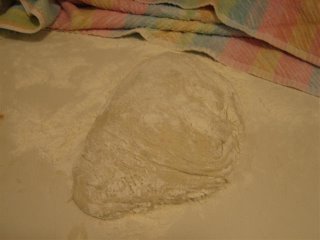

November 8, 2006 New York Times
Recipe: No-Knead Bread
Adapted from Jim Lahey, Sullivan Street Bakery
Time: About 1 1/2 hours plus 14 to 20 hours' rising
3 cups all-purpose or bread flour, more for dusting
1/4 teaspoon instant yeast
1 1/4 teaspoons salt
Cornmeal or wheat bran as needed.
1. In a large bowl combine flour, yeast and salt. Add 1 1/2 cups water, and stir until blended; dough will be shaggy and sticky. Cover bowl with plastic wrap. Let dough rest at least 12 hours, preferably about 18, at warm room temperature, about 70 degrees.
2. Dough is ready when its surface is dotted with bubbles. Lightly flour a work surface and place dough on it; sprinkle it with a little more flour and fold it over on itself once or twice. Cover loosely with plastic wrap and let rest about 15 minutes.
3. Using just enough flour to keep dough from sticking to work surface or to your fingers, gently and quickly shape dough into a ball. Generously coat a cotton towel (not terry cloth) with flour, wheat bran or cornmeal; put dough seam side down on towel and dust with more flour, bran or cornmeal. Cover with another cotton towel and let rise for about 2 hours. When it is ready, dough will be more than double in size and will not readily spring back when poked with a finger.
4. At least a half-hour before dough is ready, heat oven to 450 degrees. Put a 6- to 8-quart heavy covered pot (cast iron, enamel, Pyrex or ceramic) in oven as it heats. When dough is ready, carefully remove pot from oven. Slide your hand under towel and turn dough over into pot, seam side up; it may look like a mess, but that is O.K. Shake pan once or twice if dough is unevenly distributed; it will straighten out as it bakes. Cover with lid and bake 30 minutes, then remove lid and bake another 15 to 30 minutes, until loaf is beautifully browned. Cool on a rack.
Yield: One 1 1/2-pound loaf.
The internet forums have been buzzing about this for the last week or so. You might've thought that Elvis was making a reappearance or something from the buzz that this thing got.
Warning: this dough is absurdly slack (roughly 72% baker's hydration,) so you need a little bit of experience working with this kinda dough. However, this recipe is so fool-proof (rare in the bread world!) that you can hardly go wrong.
You will need a "baker scraper" which is a steel thing with a super blunt edge so that you can scrape the dough off a flat surface.
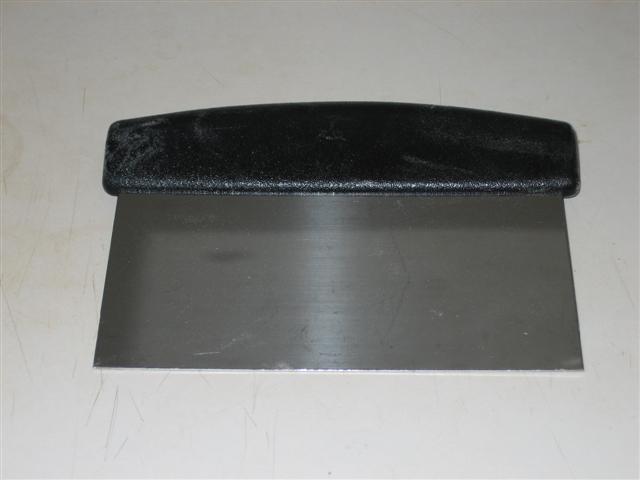
This bread is absolutely amazing. Here are some pictures of the CC's effort.
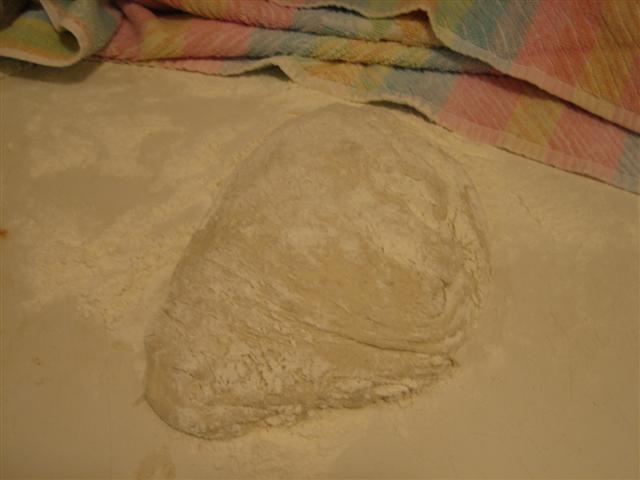

November 8, 2006 New York Times
Recipe: No-Knead Bread
Adapted from Jim Lahey, Sullivan Street Bakery
Time: About 1 1/2 hours plus 14 to 20 hours' rising
3 cups all-purpose or bread flour, more for dusting
1/4 teaspoon instant yeast
1 1/4 teaspoons salt
Cornmeal or wheat bran as needed.
1. In a large bowl combine flour, yeast and salt. Add 1 1/2 cups water, and stir until blended; dough will be shaggy and sticky. Cover bowl with plastic wrap. Let dough rest at least 12 hours, preferably about 18, at warm room temperature, about 70 degrees.
2. Dough is ready when its surface is dotted with bubbles. Lightly flour a work surface and place dough on it; sprinkle it with a little more flour and fold it over on itself once or twice. Cover loosely with plastic wrap and let rest about 15 minutes.
3. Using just enough flour to keep dough from sticking to work surface or to your fingers, gently and quickly shape dough into a ball. Generously coat a cotton towel (not terry cloth) with flour, wheat bran or cornmeal; put dough seam side down on towel and dust with more flour, bran or cornmeal. Cover with another cotton towel and let rise for about 2 hours. When it is ready, dough will be more than double in size and will not readily spring back when poked with a finger.
4. At least a half-hour before dough is ready, heat oven to 450 degrees. Put a 6- to 8-quart heavy covered pot (cast iron, enamel, Pyrex or ceramic) in oven as it heats. When dough is ready, carefully remove pot from oven. Slide your hand under towel and turn dough over into pot, seam side up; it may look like a mess, but that is O.K. Shake pan once or twice if dough is unevenly distributed; it will straighten out as it bakes. Cover with lid and bake 30 minutes, then remove lid and bake another 15 to 30 minutes, until loaf is beautifully browned. Cool on a rack.
Yield: One 1 1/2-pound loaf.
Saturday, November 18, 2006

Cauliflowers : Part 1
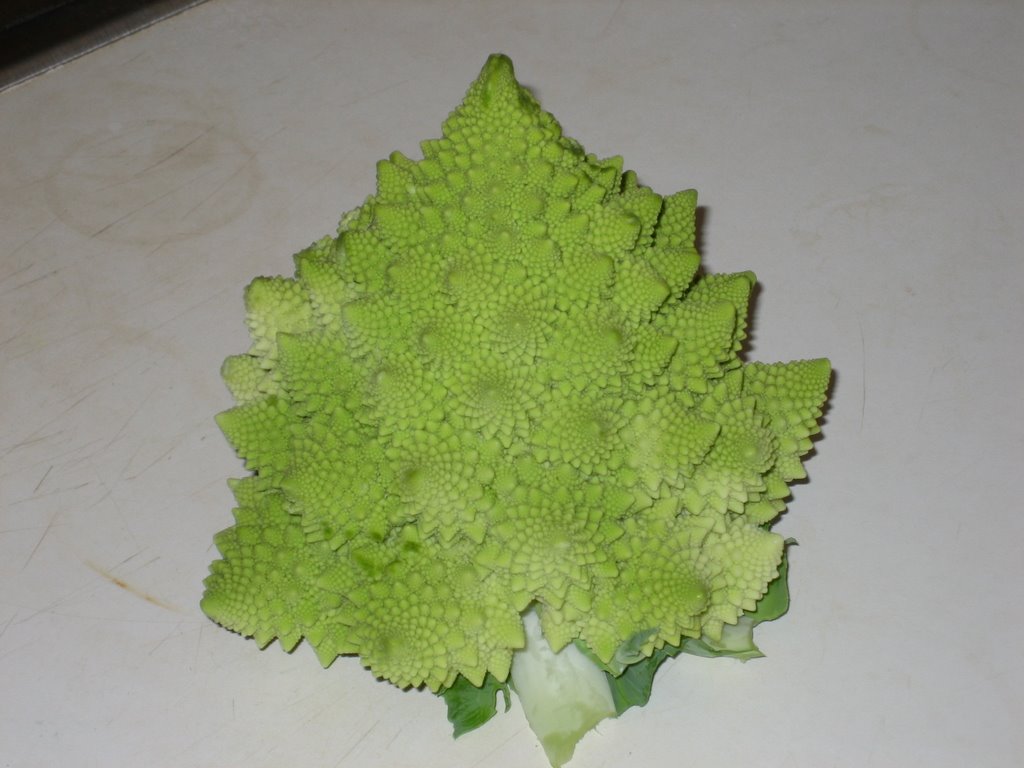
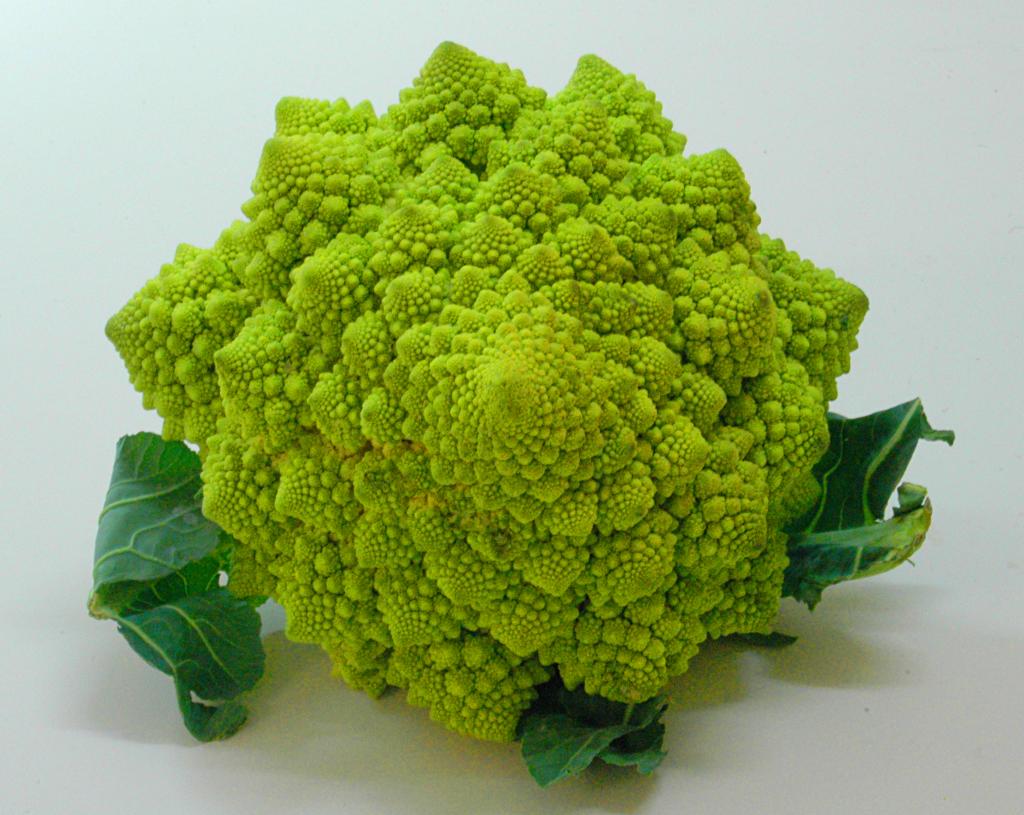
Can you say fractal and Fibonacci series?
This amazing beauty is a Romanesco cauliflower.
The CC found it at his local farmers' market.
The CC is just about ecstatic at the wondrous combination of his two loves, food and mathematics!
Monday, November 13, 2006
"Lemon" Rice
The "lemon" in the recipe actually refers to "lime" as the CC has discussed in the Hindenburg of culinary disasters!.
This is a basic everyday kinda recipe from the South of India, and like basic everyday kinda recipes, you have to make it just so, otherwise you'll be left wondering what the fuss was all about.
Made right, this is the ultimate comfort food.
Theoretically speaking, this is no different from a risotto except with different flavoring, and the rice is slightly firmer, and less "wet".
The CC will grant that the ingredients "seem" a bit a exotic. They're not exotic in India (duh!) nor are they particularly exotic in any city that the CC has lived in or visited (which means both coasts, and Chicago.)
In fact, minus one ingredient, they are downright pedestrian.
This must be served with yogurt. Good yogurt, the Greek kind, not the pasteurized garbage that passes for food in this country.
Guess what the CC is eating for dinner tonight!
Ingredients
6-8 curry leaves (this is the exotic one! try dried if you can't get fresh)
1 tbsp mustard seeds
2 tbsp "urad" daal (lentils, easy to get at your local Indian store.)
1 medium red onion, diced (optional)
3-5 serranos (cut into very fine rounds)
1/4 cup peanuts
1 cup basmati rice (no other will do!)
1/4 tsp turmeric
juice of 4 limes
salt
Recipe
Fry some oil, and add the mustard. Cover, and wait till the mustard "pops". Add the urad, fry for a bit, add the onion, fry for a bit (till pale), add the serranos, fry for a bit, add the curry leaves, fry for a bit, add the peanuts, fry for a bit, add the rice, fry till the rice is coated with the oil.
Add the turmeric and salt, and roughly 1.5 cups of water. Turn to a low simmer, and let it cook uncovered till the rice is nearly cooked. Add the lime juice towards the end.
Serve hot with yogurt!
This is a basic everyday kinda recipe from the South of India, and like basic everyday kinda recipes, you have to make it just so, otherwise you'll be left wondering what the fuss was all about.
Made right, this is the ultimate comfort food.
Theoretically speaking, this is no different from a risotto except with different flavoring, and the rice is slightly firmer, and less "wet".
The CC will grant that the ingredients "seem" a bit a exotic. They're not exotic in India (duh!) nor are they particularly exotic in any city that the CC has lived in or visited (which means both coasts, and Chicago.)
In fact, minus one ingredient, they are downright pedestrian.
This must be served with yogurt. Good yogurt, the Greek kind, not the pasteurized garbage that passes for food in this country.
Guess what the CC is eating for dinner tonight!
Ingredients
6-8 curry leaves (this is the exotic one! try dried if you can't get fresh)
1 tbsp mustard seeds
2 tbsp "urad" daal (lentils, easy to get at your local Indian store.)
1 medium red onion, diced (optional)
3-5 serranos (cut into very fine rounds)
1/4 cup peanuts
1 cup basmati rice (no other will do!)
1/4 tsp turmeric
juice of 4 limes
salt
Recipe
Fry some oil, and add the mustard. Cover, and wait till the mustard "pops". Add the urad, fry for a bit, add the onion, fry for a bit (till pale), add the serranos, fry for a bit, add the curry leaves, fry for a bit, add the peanuts, fry for a bit, add the rice, fry till the rice is coated with the oil.
Add the turmeric and salt, and roughly 1.5 cups of water. Turn to a low simmer, and let it cook uncovered till the rice is nearly cooked. Add the lime juice towards the end.
Serve hot with yogurt!
Sunday, November 12, 2006
Harlem Renaissance
Who would've guessed, say a few years ago, that Harlem would turn into a foodie powerhouse?
In hindsight (always a dangerous game,) it's not unreasonable.
Over the last few weeks, I've been to two amazing places in Harlem, one Haitian, and the other Ethiopian. There's also the French-Senegalese place that I can't sing enough praises of (and which the CC has dragged people to over their objections -- you know exactly who you are, and you were wrong, and the CC was right, and that's all that counts in the end!)
Think of this blog entry as a "teaser trailer". Call me if you actually want to go to these places.
You know you want it!
In hindsight (always a dangerous game,) it's not unreasonable.
Over the last few weeks, I've been to two amazing places in Harlem, one Haitian, and the other Ethiopian. There's also the French-Senegalese place that I can't sing enough praises of (and which the CC has dragged people to over their objections -- you know exactly who you are, and you were wrong, and the CC was right, and that's all that counts in the end!)
Think of this blog entry as a "teaser trailer". Call me if you actually want to go to these places.
You know you want it!
Friday, November 10, 2006
Controversial Recipes
Who knew that this bipartisan blog would draw controversy?
The recipe that seems to have generated much finger-waving, and hand-pointing is the recent recipe for Chocolate-covered garlic.
Comments (all private!) have ranged from, "Really?" to "I don't believe you!".
Thankfully, nobody so far has run a campaign to trash the CC's character on televison.
So let's understand why this recipe works from a scientific point of view. Out comes Harold McGee's tome, On Food and Cooking, which the CC will note is both exhaustive and exhausting.
Like the sunchoke family and its relatives, the onion family accumulates energy stores not in starch, but in chains of fructose sugars, which long, slow cooking breaks down to produce a marked sweetness.
Incidentally, these fructose sugars are not directly digestible by humans explaining the "gas" produced when eating raw onions, garlic, shallots, etc. Both the sulphurous content, and the indigestibility are Darwinian "defense mechanisms" against mammals eating the food store. (Hence also, the "sting" of sharp onions.)
But, we humans figured out a way.
Roasting garlic (and the whole onion family) is a time-honored way of changing its aggressive sulphurous character into a much sweeter one. In this particular case, the recipe is really braising (along with a ton of sugar) which will turn the garlic both soft and sweet while eliminating the volatile sulphurous molecules that make it "garlicky".
Hopefully, this intellectual argument will detract some of the objectors, but really, the best way is to just experience it first-hand!
The recipe that seems to have generated much finger-waving, and hand-pointing is the recent recipe for Chocolate-covered garlic.
Comments (all private!) have ranged from, "Really?" to "I don't believe you!".
Thankfully, nobody so far has run a campaign to trash the CC's character on televison.
So let's understand why this recipe works from a scientific point of view. Out comes Harold McGee's tome, On Food and Cooking, which the CC will note is both exhaustive and exhausting.
Like the sunchoke family and its relatives, the onion family accumulates energy stores not in starch, but in chains of fructose sugars, which long, slow cooking breaks down to produce a marked sweetness.
Incidentally, these fructose sugars are not directly digestible by humans explaining the "gas" produced when eating raw onions, garlic, shallots, etc. Both the sulphurous content, and the indigestibility are Darwinian "defense mechanisms" against mammals eating the food store. (Hence also, the "sting" of sharp onions.)
But, we humans figured out a way.
Roasting garlic (and the whole onion family) is a time-honored way of changing its aggressive sulphurous character into a much sweeter one. In this particular case, the recipe is really braising (along with a ton of sugar) which will turn the garlic both soft and sweet while eliminating the volatile sulphurous molecules that make it "garlicky".
Hopefully, this intellectual argument will detract some of the objectors, but really, the best way is to just experience it first-hand!
Tuesday, November 7, 2006
Simple French Food
One of the words in the title of Richard Olney's book is like a time-release bomb waiting to go off.
The CC will not be providing hints as to which one.
After a six page discussion on the definition of "simplicity" (uh oh!), we are informed that "simplicity is a complicated thing", and that "If food is not good, it is not simple."
By this definition, everything from a hard-boiled egg to beef bourgignon is "simple" but only if it is "good".
The CC is not making this up, you know!
However, this is a wonderful book which everyone should have. It is simply too brilliant for words.
He does give a great way of poaching eggs perfectly each time - boil water, turn off heat, crack an egg, cover, leave it alone, repeat for more.
Now, that is in the ordinary sense of the word, simple.
The purpose of this post is to warn the reader so that, unlike the CC, they will neither be scarred for life nor need therapy.
The CC will not be providing hints as to which one.
After a six page discussion on the definition of "simplicity" (uh oh!), we are informed that "simplicity is a complicated thing", and that "If food is not good, it is not simple."
By this definition, everything from a hard-boiled egg to beef bourgignon is "simple" but only if it is "good".
The CC is not making this up, you know!
However, this is a wonderful book which everyone should have. It is simply too brilliant for words.
He does give a great way of poaching eggs perfectly each time - boil water, turn off heat, crack an egg, cover, leave it alone, repeat for more.
Now, that is in the ordinary sense of the word, simple.
The purpose of this post is to warn the reader so that, unlike the CC, they will neither be scarred for life nor need therapy.
Monday, November 6, 2006
Chocolate-covered garlic
This recipe sounds downright stupid at first but it's actually really really good.
Ingredients
24 cloves of garlic (peeled)
1/2 cup red wine
1/4 cup sugar
4 tbsp lemon zest
1 bar "high" cacao chocolate
Recipe
Bring the first four ingredients to a boil. Cook on very low heat uncovered for 25-30 minutes (stirring occasionally.) Let it cool for a bit. The cloves should be quite sticky.
Melt the chocolate (you can either microwave at a low heat, or dip a glass bowl in boiling water.)
Dip each clove in the melted chocolate, and place them on a piece of foil. Transfer to the refrigerator and let it cool for at least an hour.
Best eaten fresh.
Ingredients
24 cloves of garlic (peeled)
1/2 cup red wine
1/4 cup sugar
4 tbsp lemon zest
1 bar "high" cacao chocolate
Recipe
Bring the first four ingredients to a boil. Cook on very low heat uncovered for 25-30 minutes (stirring occasionally.) Let it cool for a bit. The cloves should be quite sticky.
Melt the chocolate (you can either microwave at a low heat, or dip a glass bowl in boiling water.)
Dip each clove in the melted chocolate, and place them on a piece of foil. Transfer to the refrigerator and let it cool for at least an hour.
Best eaten fresh.
Sunday, November 5, 2006
Kalustyan's
It's the temple of food.
You readers in New York should already know it. If not, you might as well move to Kansas.
For the rest of you, name an exotic rice, spice, flour, or lentil, and this place has it. It's even alphabetized because there's no Dewey Decimal System or ISBN system for food (particularly when it comes from all around the globe.)
Regional conflicts need not apply!
However, the CC dreads going there because each time he goes there he ends up dropping more than he rationally should. Oh well! At least he and his friends eat well.
What's more they ship around the world. Give it a whirl!
You readers in New York should already know it. If not, you might as well move to Kansas.
For the rest of you, name an exotic rice, spice, flour, or lentil, and this place has it. It's even alphabetized because there's no Dewey Decimal System or ISBN system for food (particularly when it comes from all around the globe.)
Regional conflicts need not apply!
However, the CC dreads going there because each time he goes there he ends up dropping more than he rationally should. Oh well! At least he and his friends eat well.
What's more they ship around the world. Give it a whirl!
Raw Beef (Ethiopian style)
The way to judge an Ethiopian restaurant is how well they make kitfo which is raw ground beef mixed with mit' mita (finely ground "hot" spices), and nit' ir kibbeh (also spelt qibe which is clarified butter cooked with spices.)
Vegetarians, and food-phobes need not apply!
The first time the CC went to a restaurant that specialized in it, the staff came out twice to ask if we were sure of what we were getting.
"We are", cried the CC and his good friend.
Then the chef came out to make doubly sure that we knew of what we wanted. Not only were we not disappointed but we had a magnificent evening because the staff loved us for ordering their specialty.
Last night, the CC ate at a lovely place in South Harlem that had excellent kitfo. The waitress positively glowed when the CC praised the kitfo.
Try it! You may even get addicted to it. (Watch this space for a recipe.)
Vegetarians, and food-phobes need not apply!
The first time the CC went to a restaurant that specialized in it, the staff came out twice to ask if we were sure of what we were getting.
"We are", cried the CC and his good friend.
Then the chef came out to make doubly sure that we knew of what we wanted. Not only were we not disappointed but we had a magnificent evening because the staff loved us for ordering their specialty.
Last night, the CC ate at a lovely place in South Harlem that had excellent kitfo. The waitress positively glowed when the CC praised the kitfo.
Try it! You may even get addicted to it. (Watch this space for a recipe.)
Wednesday, November 1, 2006
The Role of Illusions
Every once in a while, we are called upon to make dishes with constraints in mind. This is truly the mark of a good chef.
Cooking is like magic. Sometimes you need to create an illusion.
The CC was called upon to make a classic French Onion Soup minus the beef.
"Impossible, you say?"
"Hard work," says the CC.
The CC made a traditional beef broth side by side with a mushroom broth more than a few times till even the most discerning audience could not tell the difference. In fact, he served it with impunity to an audience (who loved it,) and then revealed the truth.
The CC presents a mushroom broth quite specifically made for classic French Onion Soup (recipe to follow.)
Ingredients
1 large red onion (diced)
1 lb crimini mushrooms (quartered)
2 large portabella mushrooms (diced)
2 carrots (diced)
1/2 cup celery (diced)
3 bay leaves
1 sprig rosemary
10-12 peppercorns
salt to taste
olive oil
10-12 cups of water (approximate - just fill the pot.)
Recipe
Saute the onions in olive oil until pale pink/slightly brown. Add the peppercorns, and saute for a bit. Add the carrots and celery and saute for a bit till soft. Add the mushrooms, and saute for a bit. Add the cold water (it's important that it be cold.) and bring to a very low simmer.
Simmer for 70-90 minutes while skimming periodically.
Over a bowl, strain the broth from the vegetables using a sieve lined with several layers of a cheesecloth. Let the vegetables cool for a while. Take the cheesecloth and squeeze the vegetables to extract more of the juice into the bowl until no more comes out. Discard the pulp.
You may freeze this for a long time.
Cooking is like magic. Sometimes you need to create an illusion.
The CC was called upon to make a classic French Onion Soup minus the beef.
"Impossible, you say?"
"Hard work," says the CC.
The CC made a traditional beef broth side by side with a mushroom broth more than a few times till even the most discerning audience could not tell the difference. In fact, he served it with impunity to an audience (who loved it,) and then revealed the truth.
The CC presents a mushroom broth quite specifically made for classic French Onion Soup (recipe to follow.)
Ingredients
1 large red onion (diced)
1 lb crimini mushrooms (quartered)
2 large portabella mushrooms (diced)
2 carrots (diced)
1/2 cup celery (diced)
3 bay leaves
1 sprig rosemary
10-12 peppercorns
salt to taste
olive oil
10-12 cups of water (approximate - just fill the pot.)
Recipe
Saute the onions in olive oil until pale pink/slightly brown. Add the peppercorns, and saute for a bit. Add the carrots and celery and saute for a bit till soft. Add the mushrooms, and saute for a bit. Add the cold water (it's important that it be cold.) and bring to a very low simmer.
Simmer for 70-90 minutes while skimming periodically.
Over a bowl, strain the broth from the vegetables using a sieve lined with several layers of a cheesecloth. Let the vegetables cool for a while. Take the cheesecloth and squeeze the vegetables to extract more of the juice into the bowl until no more comes out. Discard the pulp.
You may freeze this for a long time.
Tuesday, October 31, 2006
Chestnuts
... roasting on an open fire!
A bit early, but what the heck? It's getting cold out here in New York.
Here's something to keep you warm...
Chestnut Soup
Ingredients
1 large onion (roughly chopped)
8 cloves garlic (roughly chopped)
2 celery stalks (roughly chopped)
1 large carrot (roughly chopped)
3-4 cups broth (homemade, but use commercial, you wimps!)
fresh sage
fresh rosemary
2 bay leaves
salt
fresh pepper (lots!)
30-35 chestnuts (read below why!)
Recipe
It's all going to get pureed so don't waste time cutting it in detail.
Incise the chestnuts with a large X. Roast at 375F for 15 minutes or so. The X will peel off, and you can pull them out, and deshell them. They need to be deshelled while they are still warm.
Some fraction will be moldy. Toss them. You won't be able to resist eating a few. So you will end up with roughly 24-26 which is the correct number for the recipe. See my point?
Fry the onion and garlic soffrito. Toss in the everything but the chestnuts, and fry for a minute or so. Toss in the broth. Let it simmer for 10 mins.
Toss in the chestnuts, and let it all simmer for 15 minutes.
Puree it, and serve with some crusty bread.
A bit early, but what the heck? It's getting cold out here in New York.
Here's something to keep you warm...
Chestnut Soup
Ingredients
1 large onion (roughly chopped)
8 cloves garlic (roughly chopped)
2 celery stalks (roughly chopped)
1 large carrot (roughly chopped)
3-4 cups broth (homemade, but use commercial, you wimps!)
fresh sage
fresh rosemary
2 bay leaves
salt
fresh pepper (lots!)
30-35 chestnuts (read below why!)
Recipe
It's all going to get pureed so don't waste time cutting it in detail.
Incise the chestnuts with a large X. Roast at 375F for 15 minutes or so. The X will peel off, and you can pull them out, and deshell them. They need to be deshelled while they are still warm.
Some fraction will be moldy. Toss them. You won't be able to resist eating a few. So you will end up with roughly 24-26 which is the correct number for the recipe. See my point?
Fry the onion and garlic soffrito. Toss in the everything but the chestnuts, and fry for a minute or so. Toss in the broth. Let it simmer for 10 mins.
Toss in the chestnuts, and let it all simmer for 15 minutes.
Puree it, and serve with some crusty bread.
Sunday, October 29, 2006
Scaring up a meal
Every home cook has faced this problem before.
It's Sunday, you're too lazy to go shopping, you need a tasty but simple meal that you need to scare up before the evening is over but the larder is bare (or as bare as the CC's larder ever gets.)
What was at hand?
5 tomatoes (from the farmer's market.)
onions and garlic (staples at the CC's.)
the usual arsenal of dried ingredients and spices
the usual arsenal of frozen stock, and pastes in the freezer.
a quarter-chunk of parmigiano-reggiano (a miracle!)
All this inevitably pointed towards pasta, and out came Marcella Hazan. Jump to the section on tomato sauces, a little poking around, and what do you find?
Tomato Sauce with Porcini Mushrooms
A slight modification was made (no pancetta) but it was relatively insignificant.
Ingredients
1 small onion (finely diced)
1 tbsp olive oil
5 large tomatoes (skins removed, passed through food mill.)
1 oz dried porcini mushrooms (+ filtered water from mushrooms)
salt
black pepper
freshly grated parmigiano-reggiano
Recipe
Reconstitute the mushrooms.
Fry the onions (or shallots) till it becomes a pale gold. Add the tomatoes, the mushrooms, the strained liquid from the mushrooms, salt, and several grindings of pepper. Adjust heat so that the sauce bubbles at a gentle but steady simmer. Cook in the pan for 40 minutes (yes! this is correct) till the fat and the tomato separate. Skim.
Toss in the pasta, and serve with freshy grated parmigiano-reggiano.
Note: This sauce is surprisingly "rich" (not in the traditional high-fat sense.) It could easily pass as a meat sauce even though it's totally vegetarian.
Marcella Hazan has been beatified, while Julia Child can cry herself to sleep on the bookshelf!
It's Sunday, you're too lazy to go shopping, you need a tasty but simple meal that you need to scare up before the evening is over but the larder is bare (or as bare as the CC's larder ever gets.)
What was at hand?
5 tomatoes (from the farmer's market.)
onions and garlic (staples at the CC's.)
the usual arsenal of dried ingredients and spices
the usual arsenal of frozen stock, and pastes in the freezer.
a quarter-chunk of parmigiano-reggiano (a miracle!)
All this inevitably pointed towards pasta, and out came Marcella Hazan. Jump to the section on tomato sauces, a little poking around, and what do you find?
Tomato Sauce with Porcini Mushrooms
A slight modification was made (no pancetta) but it was relatively insignificant.
Ingredients
1 small onion (finely diced)
1 tbsp olive oil
5 large tomatoes (skins removed, passed through food mill.)
1 oz dried porcini mushrooms (+ filtered water from mushrooms)
salt
black pepper
freshly grated parmigiano-reggiano
Recipe
Reconstitute the mushrooms.
Fry the onions (or shallots) till it becomes a pale gold. Add the tomatoes, the mushrooms, the strained liquid from the mushrooms, salt, and several grindings of pepper. Adjust heat so that the sauce bubbles at a gentle but steady simmer. Cook in the pan for 40 minutes (yes! this is correct) till the fat and the tomato separate. Skim.
Toss in the pasta, and serve with freshy grated parmigiano-reggiano.
Note: This sauce is surprisingly "rich" (not in the traditional high-fat sense.) It could easily pass as a meat sauce even though it's totally vegetarian.
Marcella Hazan has been beatified, while Julia Child can cry herself to sleep on the bookshelf!
Kitchen Instruments
On my vacation, the CC was asked if he was a "gadget freak" by the sister of the mother of the wife of this dear friend of mine.
"Absolutely not!", cried the CC in alarm, at the risk of being classified along with the Williams-Sonoma freaks!
"In that case," she retorted, "tell me what kitchen instruments you find indispensable."
So the CC hied himself on a mental walk around his kitchen (we were greedily gorging some lamb (cooked deliciously rare) laced with rosemary, and spanakopita on their familial farmhouse at the time.)
Blender, and food-processor
Big duh there!
Coffee grinder
The CC actually uses it to grind fresh spices (both roasted, and unroasted.) Even Indians don't understand good Indian cooking until you have it made with freshly ground spices. (If the CC had to pick just one instrument, this would win hands down!)
Pressure Cooker
Everything from beans to conch!
Juicer
The CC never knew how much he would miss it until he had one. Juice of forty limes? Not a problem!
Food mill
Ditto! Where have you been all my life?
Cheese plane grater
You don't understand until you own one. Trust the CC on this one.
Mortar and pestle
The CC is "old school". Some things cannot be improved upon.
Sure the CC would miss the stones in the oven, and the pizza peel, or the steamers, and the zesters but they are not indispensable. The above constitute "basic necessity", at least in the eyes of the CC.
So, gentle readers, are there things you find indispensable?
"Absolutely not!", cried the CC in alarm, at the risk of being classified along with the Williams-Sonoma freaks!
"In that case," she retorted, "tell me what kitchen instruments you find indispensable."
So the CC hied himself on a mental walk around his kitchen (we were greedily gorging some lamb (cooked deliciously rare) laced with rosemary, and spanakopita on their familial farmhouse at the time.)
Big duh there!
The CC actually uses it to grind fresh spices (both roasted, and unroasted.) Even Indians don't understand good Indian cooking until you have it made with freshly ground spices. (If the CC had to pick just one instrument, this would win hands down!)
Everything from beans to conch!
The CC never knew how much he would miss it until he had one. Juice of forty limes? Not a problem!
Ditto! Where have you been all my life?
You don't understand until you own one. Trust the CC on this one.
The CC is "old school". Some things cannot be improved upon.
Sure the CC would miss the stones in the oven, and the pizza peel, or the steamers, and the zesters but they are not indispensable. The above constitute "basic necessity", at least in the eyes of the CC.
So, gentle readers, are there things you find indispensable?
Lobster
So the CC has never much cared for lobsters. However, the recent vacation to Maine has changed all that.
Fresh lobster is as delicious as they say. The CC has OD'ed on both lobsters, and lobster rolls, and is eagerly looking forward to his next Maine vacation.
The CC is delighted to learn that some things are distinctly geography-laden, and that even New York's proximity to Maine can change the potential of an edible that much.
Which brings the grand total of things that the CC does not care for down to one : brussel sprouts. However, on the vacation, the CC gathered a crackling new recipe for it, and is raring to try it out. Here's hoping...
Fresh lobster is as delicious as they say. The CC has OD'ed on both lobsters, and lobster rolls, and is eagerly looking forward to his next Maine vacation.
The CC is delighted to learn that some things are distinctly geography-laden, and that even New York's proximity to Maine can change the potential of an edible that much.
Which brings the grand total of things that the CC does not care for down to one : brussel sprouts. However, on the vacation, the CC gathered a crackling new recipe for it, and is raring to try it out. Here's hoping...
Saturday, October 28, 2006
Corn Salsa
So the CC is invited to the birthday party of some friends, and was charged with making a bunch of salsas for the occasion.
Over the years, this corn salsa (yes, I'm using the term loosely) has been one of the biggest hits at the CC's parties.
Truth be told, the CC doesn't even remember where he got this recipe.
Ingredients
8-10 cobs of fresh corn (or 2 packages frozen)
6 sun-dried tomatoes (reconstituted with hot water, and then diced)
2-3 chipotles en adobo (diced)
Recipe
Place the corn on a baking sheet, and roast it in the oven at 300F for roughly an hour. Check towards the end, otherwise the corn might get burnt.
Mix the three things together, and add a bit of the sun-dried tomato water.
That's it! The simplicity belies the brilliance of flavors. Only problem? The dried corn sticks to your teeth. Heheheheh.
Over the years, this corn salsa (yes, I'm using the term loosely) has been one of the biggest hits at the CC's parties.
Truth be told, the CC doesn't even remember where he got this recipe.
Ingredients
8-10 cobs of fresh corn (or 2 packages frozen)
6 sun-dried tomatoes (reconstituted with hot water, and then diced)
2-3 chipotles en adobo (diced)
Recipe
Place the corn on a baking sheet, and roast it in the oven at 300F for roughly an hour. Check towards the end, otherwise the corn might get burnt.
Mix the three things together, and add a bit of the sun-dried tomato water.
That's it! The simplicity belies the brilliance of flavors. Only problem? The dried corn sticks to your teeth. Heheheheh.
Friday, October 6, 2006
Vacation
The CC will be taking a much needed vacation, initially to go visit the wedding of a very close friend in Massachussetts.
Also featured on this trip will be culinary adventures of the seafood kind up and down the Eastern Seaboard.
I promise interesting posts about the trip when I return.
Also featured on this trip will be culinary adventures of the seafood kind up and down the Eastern Seaboard.
I promise interesting posts about the trip when I return.
Sunday, October 1, 2006
Clam Pizza
Ever since spending his waking hours in Connecticut, the CC finds himself addicted to clam pizza?
"Where have you been all my life?"
Is the CC turning into an East-coaster? (Apologies to all of you on the wrong coast!)
Comments, please!
"Where have you been all my life?"
Is the CC turning into an East-coaster? (Apologies to all of you on the wrong coast!)
Comments, please!
Subscribe to:
Posts (Atom)
