Nobody in their right mind would call this an "Italian" recipe.
It has California written all over it in the good sense of the word not the "other" one but the CC is not going to get into that particular Vietnam.
That having being said, it's quite an intriguing flavor combination, and with the right fresh ingredients definitely knocks it out of the park.
This being the season for Meyer lemons, and also the season where brassica fatigue has set in, is probably the right time to make something that will make your tastebuds perk up.
There are some real curveballs here at least if you are used to cooking Italian food. The "pesto" is heated up which sounded really strange but actually is correct once you understand which ingredients are being used.
This is a homage not "authentic" and should be clearly understood as such.
It's also freakin' delicious!
Ingredients
2 cups penne (anything long and tubular)
1 cup pistachios
1 cup parsley
1/2 cup mint
2 cloves garlic
4 dried red chilli peppers
1/2 cup parmigiano reggiano
2 Meyer lemons (zested and rest juiced)
1/2 cup olive oil (your finest!)
2 cups broccoli florets
parmigiano reggiano (grated)
black pepper
Recipe
Preheat the oven to 325°F. Roast the pistachios for about 8 minutes. Let cool.
Grind to a coarse powder in a food processor. Set aside.
Meanwhile, put the lemon zest, parsley, mint, garlic, dried red chilli peppers, olive oil and parmigiano-reggiano in the same food processor, and grind to a loose paste.
There is some parallelism below so read carefully before execution.
For the pasta, heat some water with tons of sea salt. When the water comes to a rolling boil, add the pasta and let cook for 9 minutes. Add the broccoli and let cook for an additional 2 minutes.
Grab a cup of the boiling pasta water, and add it to the paste above. Add the coarse powdered pistachios and cook in a skillet at medium high heat for about 2 minutes.
Drain the pasta and the broccoli and put in a large bowl.
Add the cooked "pesto" above, and the juice from the lemons.
Toss, and let sit for about 4-5 minutes.
Serve with the parmigiano reggiano on top with additional black pepper.
Friday, March 9, 2012
Wednesday, March 7, 2012
Roman Inheritance
If you look back far enough, human taste hasn't changed much and you can spot the modern in the ancient and vice versa.
Apicius refers to a collection of Roman recipes compiled somewhere in the late fourth to early fifth century. It's attributed ot Marcus Gavius Apicius, a Roman gourmand who lived in the first century (and hence the collection is extraordinarily unlikely to have written by him.)
Recipe 89 goes as follows:
Even though the CC has translated coliculis as "cauliflower", it could equally well have been cabbage or broccoli, or even all of them (all members of the brassica family really.) There is considerable leeway here.
You can see the similarities in a classical Sicilian recipe that uses pasta instead of boiled spelt (perhaps couscous would be closer?) with cauliflower, onions (substituting for leeks), anchovies, raisins and pinenuts. The only difference is the seasoning which calls for saffron not cumin, and the tomato paste which is entirely New World for reasons explained here.
The anchovies are the exact replacement for garum which is nothing more than a fish sauce made with anchovies. The Thai nahm pla or the Filipino patis are the closest modern equivalents.
You too can eat like a Roman gourmand. Indulge!

Pasta with Cauliflower, Anchovies, Raisins, Pine Nuts & Saffron
Ingredients
2 cups rigatoni (or penne.)
1 head cauliflower (separated into medium-sized florets)
1 large red onion (chopped)
1/2 cup pine nuts
1/2 cup raisins
6 anchovies (preferably salt-cured)
2 tbsp tomato paste
1 tsp saffron
olive oil
sea salt
black pepper
breadcrumbs
Recipe
Toast the breadcrumbs and set aside. Toast the pine nuts until golden. Be careful not to burn them. Set aside.
Heat the olive oil at medium heat. When shimmering, add the cauliflower and fry languidly for 6-8 minutes. Add the onions and fry for a further 5 minutes. Add the tomato paste, and the anchovies and fry. The anchovies will "dissolve" as they fry. Add a cup of water, the raisins, sea salt, and black pepper, and let cook at low heat.
Meanwhile make the pasta until al dente. Drain.
The cauliflower mixture should be just slightly on the wet side. If dry, add some more water.
Toss in the saffron, and the pasta, and mix thoroughly.
Serve with the roasted breadcrumbs on top, and more black pepper if you like.
Apicius refers to a collection of Roman recipes compiled somewhere in the late fourth to early fifth century. It's attributed ot Marcus Gavius Apicius, a Roman gourmand who lived in the first century (and hence the collection is extraordinarily unlikely to have written by him.)
Recipe 89 goes as follows:
Coliculis conditis ut supra superfundes alicam elixam cum nucleis et uva passa; piper asparges.The "as above" refers to an earlier recipe (87) where the sauce consists of garum, olive oil, wine and cumin topped with fried leeks.
Over the young cauliflower, seasoned as above, pour boiled spelt with pine nuts and raisins; sprinkle with pepper.
Even though the CC has translated coliculis as "cauliflower", it could equally well have been cabbage or broccoli, or even all of them (all members of the brassica family really.) There is considerable leeway here.
You can see the similarities in a classical Sicilian recipe that uses pasta instead of boiled spelt (perhaps couscous would be closer?) with cauliflower, onions (substituting for leeks), anchovies, raisins and pinenuts. The only difference is the seasoning which calls for saffron not cumin, and the tomato paste which is entirely New World for reasons explained here.
The anchovies are the exact replacement for garum which is nothing more than a fish sauce made with anchovies. The Thai nahm pla or the Filipino patis are the closest modern equivalents.
You too can eat like a Roman gourmand. Indulge!

Pasta with Cauliflower, Anchovies, Raisins, Pine Nuts & Saffron
Ingredients
2 cups rigatoni (or penne.)
1 head cauliflower (separated into medium-sized florets)
1 large red onion (chopped)
1/2 cup pine nuts
1/2 cup raisins
6 anchovies (preferably salt-cured)
2 tbsp tomato paste
1 tsp saffron
olive oil
sea salt
black pepper
breadcrumbs
Recipe
Toast the breadcrumbs and set aside. Toast the pine nuts until golden. Be careful not to burn them. Set aside.
Heat the olive oil at medium heat. When shimmering, add the cauliflower and fry languidly for 6-8 minutes. Add the onions and fry for a further 5 minutes. Add the tomato paste, and the anchovies and fry. The anchovies will "dissolve" as they fry. Add a cup of water, the raisins, sea salt, and black pepper, and let cook at low heat.
Meanwhile make the pasta until al dente. Drain.
The cauliflower mixture should be just slightly on the wet side. If dry, add some more water.
Toss in the saffron, and the pasta, and mix thoroughly.
Serve with the roasted breadcrumbs on top, and more black pepper if you like.
Monday, March 5, 2012
Spicy Curried Clams with Chickpeas
This is clearly a French thought on how to Indianize a recipe.
The CC expounded long ago and on length on the role of curry powder in the global 19th century economy so there's no point in repeating that.
The recipe is awesome. And quick. And nutritious. And weekday compatible.
So just grab a baguette, pour a glass of steely dry white wine, agree to not quibble about the origins and just enjoy it, alright?

Ingredients
18 clams
1 small red onion (chopped fine)
1/2" ginger (julliened)
1 green chilly (crushed)
1 clove garlic (crushed)
2 tbsp curry powder
1 cup white wine
1 cup chickpeas (cooked)
sea salt
black pepper
1/2 cup cilantro leaves
1 lime (juiced)
Recipe
The recipe is fairly obvious.
Cook the chickpeas. The CC promises not to scoff if you use canned. However, it's best to cook them ahead of time.
Fry some olive oil at medium heat, and toss in the onions, ginger, garlic and green chilly paste. Fry languidly for 6-8 minutes Toss in the clams. When coated, toss in the white wine, black pepper, and the curry powder. Bring to a boil. Cover and simmer.
As the clams open, remove them and place them in the serving bowls.
Add the chickpeas, and reduce until it's a wet mixture but not too dry. Add some water if its too dry. Serve over the clams. Add lime juice, and sprinkle with cilantro. Serve with crusty bread.
Sunday, March 4, 2012
R.I.P. Katy Dalal
This is clearly two years too late but the CC just found out.
One of the doyennes of Parsi cooking passed away.
She was an archaelogist by training, and a cookbook writer by avocation. Her books are accurate and detailed as would befit a scholar. Produced in the days where substance matters more than form, they are tough on the eyes but delicious in the belly. Even the title was inviting Jamwa Chaloji (Let's Partake).
Farewell.
(Link: Obituary.)
Saturday, March 3, 2012
Farmers' Market Haul
Some really excellent broccoli, parsley, pea shoots (a bit early!), carrots, clams, some cod.
They didn't have any marrow bones. Oh well!
They didn't have any marrow bones. Oh well!
Friday, March 2, 2012

Wednesday, February 29, 2012
Baked Cod with Golden Roasted Potatoes & Thyme
The pairing of fish and thyme is a classic combination all over the Mediterranean. Paired with golden roasted potatoes and a salad, it's a simple superb dish.
If you're wondering if this is not just a variation of this, you'd be right. You can't invent new tricks all the time. This is nothing more than the combinatorial approach to cooking which is the proverbial housewife's savior everywhere from Japan to India to the Middle East and the Mediterranean.
The CC will have a lot more to say about this subject but that's for a later post.

Ingredients (serves 2)
1 large cod fillet.
6-8 small roasting potatoes
4-6 sprigs thyme
olive oil
sea salt
black pepper
Recipe
Preheat an oven to 375°F.
Toss the potatoes with olive oil, sea salt and black pepper. Roast them for 15 minutes. Pull them out and toss again carefully to make sure they don't stick to the bottom. Toss springs of thyme all over them. Roast for another 20 minutes.
Meanwhile season the cod fillet by rubbing it with olive oil. Season with sea salt, black pepper and thyme.
Pull the pan out of the oven. Push the potatatoes aside to one side of the pan. Place the cod fillet gently on the other side and roast for 10 more minutes. Don't overcook it.
A quick salad with a nice lemony-vinaigrette pairs really well with this dish. (The salad above has thinly cut radishes added to give it some crunch and textural complexity.)
Monday, February 27, 2012
An Old Woman Fries Eggs
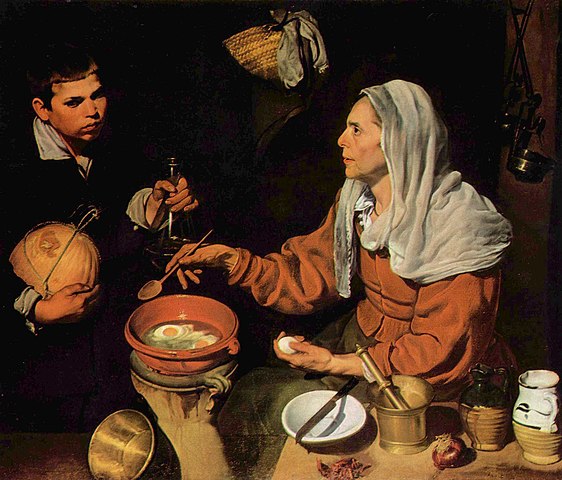
One of the great paintings by Velázquez is that of an old woman frying eggs while a young boy looks on and helps her.
The wonderful chiaroscuro is a joy to behold with the light appearing to come from the left. It was painted during his Seville period.
 (Source of painting: Wikipedia.)
But what is she doing?
She is making huevos fritos con puntilla. These are eggs fried in hot olive oil where the oil is flicked around the edge of the egg to achieve a delicate lacey frill like that of a traje de Sevillana.
The evidence is the hot oil that she should be flicking over the edges of the egg whites with her wooden spoon. This is a reasonably high-risk procedure with the chance of hot droplets of oil splashing all over. Her right sleeve covers her hand to protect it but not her left. Most importantly, since this procedure can easily make the egg whites overcooked without the yolk having set, she seems instructing the boy to add a slug of olive oil to the earthenware cooking pot to cool down the oil.
She seems to be about to speak to him but his interest seems to have wandered. He just wants his abuela to make the damned eggs, and enough with the instruction already.
The eternal drama of youth and old age captured in a succint way!
The wonderful chiaroscuro is a joy to behold with the light appearing to come from the left. It was painted during his Seville period.
 (Source of painting: Wikipedia.)
But what is she doing?
She is making huevos fritos con puntilla. These are eggs fried in hot olive oil where the oil is flicked around the edge of the egg to achieve a delicate lacey frill like that of a traje de Sevillana.
The evidence is the hot oil that she should be flicking over the edges of the egg whites with her wooden spoon. This is a reasonably high-risk procedure with the chance of hot droplets of oil splashing all over. Her right sleeve covers her hand to protect it but not her left. Most importantly, since this procedure can easily make the egg whites overcooked without the yolk having set, she seems instructing the boy to add a slug of olive oil to the earthenware cooking pot to cool down the oil.
She seems to be about to speak to him but his interest seems to have wandered. He just wants his abuela to make the damned eggs, and enough with the instruction already.
The eternal drama of youth and old age captured in a succint way!
Friday, February 24, 2012
Winter Mac 'n Cheese
When winter strikes, there's nothing like a warm oven and some comfort food.
This, of course, is a classic but it's been gussied up with winter vegetables. It takes a little longer because you have to roast all the vegetables separately but it's wonderful when it all comes together.
The trick with vegetables of the brassica family (brussel sprouts, cauliflower, cabbage, kale, etc.) is to roast them. It brings out the inherent sweetness in them without the smelly part (which occurs if you boil them.) They also happen to be absurdly nutritious.
The house will smell really nice with all the roasting and if you really want to amp it up a notch, a little truffle oil will take it to the next level.
Ingredients
4 cups whole-wheat penne
1 head radicchio (sliced into thin strips)
1 small cauliflower (cut into florets)
1 large carrot (diced)
butter
2 cups milk
1/2 cup all-purpose flour
1 cup gruyère (grated coarsely)
1 cup parmigiano-reggiano (grated coarsely)
4 tbsp fresh rosemary (chopped fine)
4 tbsp fresh thyme
breadcrumbs
nutmeg
olive oil
sea salt
black pepper
2 tbsp truffle oil (optional)
Recipe
Preheat the oven to 350°F. Toss the radicchio with olive oil, salt and pepper and bake for about 15-18 minutes. Remove.
Toss the cauliflower with olive oil and pepper (no salt! - otherwise the mixture will be overly salty) and roast for about 15 minutes. Remove.
Cook the penne in heavily salted water until under al dente (about 12 minutes.)
Meanwhile, make the béchamel. Heat the butter. Add the flour, and let it cook at medium low heat until it is golden (but not brown). Add the milk and continue stirring. The sauce will continue to thicken. Add the salt, black pepper, nutmeg, rosemary and thyme, and take it off the heat.
Combine the penne, the sauce, vegetables, the cheeses, and truffle oil (if using) in a oven-proof casserole. Top off the dish with the breadcrumbs (this is the real secret to success!)
Bake covered for about 30 minutes. Bake uncovered for about 12-15 minutes until the top is golden and crispy.
Thursday, February 23, 2012
Arroz caldoso con sepia y coliflor
This is an entirely unusual recipe in that it sounds positively weird on paper but is absolutely delicious in practice.
Arroz caldoso is the ultimate comfort food. Rice, protein and seasonings in a soupy broth that is absolutely perfect when the weather gets cold.
Best of all, it reheats wonderfully (attn: office dwellers) and the taste improves with time.
It's Valencian in origin, and originally features cuttlefish (sepia) but lacking that, the CC used squid.
You will notice below that the technique is entirely unusual. Instead of the onions and garlic being sautéed first, the squid is. There is logic here. Squid needs to be either cooked very little, or a long time otherwise you get a rubbery unappetizing texture. This recipe uses the latter method.

Ingredients
2 cups Valencian short-grain rice (substitute by Arborio)
6 cups fish broth
1/2 lb tomatoes (passed through a food mill)
1 lb cauliflower florets
1 lb cuttlefish (or squid) cut into 1/2 inch slices
4 large garlic cloves, minced
1 large onion, coarsely grated
4 tbsp olive oil
1/2 tsp saffron
1 tsp sweet paprika (preferably Spanish smoked)
4 tbsp fresh parsley (chopped fine)
sea salt
Recipe
Combine the broth and saffron in a pot and keep warm over a very low flame.
Preheat the oven to 400°F.
In an oven-proof casserole, heat the olive oil, and sauté the squid. Sprinkle with the sea salt while this is happening. Stir in the cauliflower, garlic and grated onion and sauté for 5 minutes. Add the tomatoes, parsley and cook for 3 minutes. Turn the heat to low and let cook for 10 minutes.
Stir in the paprika, rice, and sauté until the rice is well coated with the mixture. Pour in the broth and boil for 5-8 minutes until the rice is slightly done. Transfer to the oven and cook for 10 minutes, uncovered until the rice is still al dente.
The mixture should be still soupy at this point.
Remove from the oven and let sit for 5 minutes. Serve.
Tuesday, February 21, 2012
Asari Gohan
This is a basic every day dish that is so amazing that you will be forever checking how you lived your life before it. It's nutritionally complete, visually appealing, complex enough to be served at a state dinner. (In short, the platonic ideal of a Japanese dish.)
It's neither complicated nor hard in the least but it requires a fairly elaborate explanation of how all the pieces actually work.

Ingredients
12-18 clams
1/3 cup sake
1 tbsp ginger (cut into fine matchsticks)
1 cup japonica rice
2 cups kombu dashi
1/4 cup carrots (cut into matchsticks)
1/4 cup shiitake mushrooms (cut into matchsticks)
1 tbsp ginger (cut into fine matchsticks)
2 tbsp tamari (soy sauce)
2 tbsp sake
2 tbsp mirin
1 scallion (white and green parts sliced thin at a steep diagonal)
nori (sliced really thin)
Recipe
The first thing that you must do is wash the rice in cold water. The rice must be "polished" with your hands until all the surface starch is eliminated, and the water runs clear. Typically, this takes anywhere from 4-6 washings.
Drain the rice and let it sit wet for at least 30 minutes. (Yes, this matters.)
Add 1/3 cup of the sake to the ginger. Bring to a boil. Steam the clams. Remove as they open, and shuck them.
When all the clams are done, filter the liquid (= clam broth) through a cheesecloth/paper towel and reserve.
Combine the dashi, clam broth, 2 tbsp of sake, the tamari and the mirin. Add the rice, carrots, shiitake mushrooms and cook till the rice is well done.
The logic of this step is that the rice is cooked in an intensely umami-laden broth that makes it completely irresistible. Add to that the fact that esterification takes place means that it's almost impossible to resist.
Top with the clams, the scallion and the nori, and serve.
The clams add the protein, the scallion and the nori, the textural interest.
Sunday, February 19, 2012
The Haul (from Astoria)
Anchovies, octopus, Greek chickpeas, the large white beans, bulgur wheat (of two grades), spanakopita, dried oregano, taramosalata, tzatziki, amazing pita bread.
Thursday, February 9, 2012
Hazelnut Crusted Cod with Roasted New Potatoes
One of the tricks that professional chefs have is to give thematic unity to a seemingly disparate ensemble.
The dish below is an example of that.
 The cod has been crusted with a mixture of hazelnuts, breadcrumbs, thyme and lemon zest.
The potatoes have been roasted with harissa, olive oil and thyme.
The vinaigrette for the salad in the background is made with lemon juice, thyme and hazelnut oil.
As you can see there's a clear thematic element of lemon, hazelnuts and thyme running through the ensemble.
There is also a clear visual and methodic disparateness. Textures, colors, cooking methods all separate to provide interest but tied into an integrated whole at an underlying level.
Saturday, January 28, 2012
Organic Chemistry Rules!
One of the great tricks of Japanese cuisine is to cook "stuff" with sake (or mirin) and dashi.
Traditionally, the simplest dish of rice would have this but it extends in general to tons of dishes.
The reason is something that Coco Chanel would know like (the smell of) the back of her hand.
It's esterification.
When an alcohol and an acid — in this case, the various glutamic acids in the dashi — react with the alcohol, you create a whole range of esters. Esters are what give the fragrant fruity smells that we all love.
Add to that, the umami from the dashi and you realize that just "plain rice" is a killer dish.
As far as the CC is aware, this is unique in the world. He has not seen this technique being used anywhere else.
Tuesday, January 3, 2012
Break
The CC has been taking unusually long hiatuses as of late but he's going to take an even longer one.
Headed to India for even more culinary adventures. Back at the end of January with wondrous photos and recipes!
Headed to India for even more culinary adventures. Back at the end of January with wondrous photos and recipes!
Sunday, January 1, 2012
New Year's Eve
The menu:
Cheese platter (Stilton, Montbriac)
Crusty Baguette
Figs stuffed w. Almonds, Rosemary & Sea-Salt
Spicy Pickled Mushrooms
Walnuts caramelized w. Rosemary & Sea-Salt
Olives
Figs w. Prosciutto
Plenty of Champagne, of course!
Happy New Year!
Crusty Baguette
Figs stuffed w. Almonds, Rosemary & Sea-Salt
Spicy Pickled Mushrooms
Walnuts caramelized w. Rosemary & Sea-Salt
Olives
Figs w. Prosciutto
Plenty of Champagne, of course!
Happy New Year!
Sunday, December 25, 2011
Food as Metaphorical Horror
Humans have always had a slightly complex relationship with food in as much as it reminds them of their animal origins. For starters, carnivores that we may be, we have always had a slightly problematic relationship with slaughter and novelists, artists and film makers have exploited that endlessly.
Here are some of the best food metaphors in the interest of horror that the CC knows of in the medium of film.
Rules of the Game Rosemary's Baby Repulsion
Saló
Here are some of the best food metaphors in the interest of horror that the CC knows of in the medium of film.
Slaughter as a metaphor for the ruthless elimination of an entire generation in World War I.
Bonus: Made in 1939. Looks forward presciently and sees a repeat upcoming.
If you can make tea horrifying, you have real cinematic skill.
Bonus: The Lipton tea ad-placement near the end of the movie.
It's straightforward enough to horrify using a skinned putrefying rabbit but it takes a special talent to turn toast and (exhausted) marmalade into one for a horrific sexual frigidity gone awry.
The perfect meeting of medium and subject. Integrated into the film as a logical progression of horrors, Pasolini mentioned that he intended it as a "commentary on the horrors of fast food".
(You'll have to see this one. Can't reveal it without giving it away.)
Bonus: Nails.
Tuesday, December 20, 2011

Sunday, December 4, 2011
The Warrior Class Enters the Kitchen
After the Meiji Restoration, the carrying of swords was banned for the samurai class. Since there was significant industry in providing swords to the samurai, as basic economic theory would tell you, the merchants evolved the product into something else.
That something was the production of knives for professional cooking.
Japanese knives are unique in the world. They are arguably closer to swords than they are to Western knives. For starters, they are frequently, but not always, single-ground (sharpened on exactly one side.) In the modern world, double-beveled knives do exist (e.g. santoku which evolved as a response to the French chef's knife) but the rule still stands.
They are also made to a much harder temper and and seriously sharp. You can cut a piece of paper just by gently caressing it against the blade.
Also, the number and variety of precision knives is far higher than what you would see in a traditional French kitchen. The level of detail and control is far far higher.
Lastly, the tradition of sword-like skills in the kitchen made evolve as a matter of routine, an equally important culture of safety skills. Japanese chefs cut away from the body never towards it. Equally importantly when doing fine fillet-work, the knife will angle away from the body while the top is restrained with the flat-face of the left hand. At all points in time, the blade is kept away from the body. It is quite amazing to watch a master knivesman in action.
Like all highly evolved technical cultures, there's an elaborate array of knives and an elaborate vocabulary to describe their properties, relative merits and demerits but that's just grind for a later post.
Thursday, November 24, 2011
Thanksgiving
The CC has been in absentia for a while. Life sometime gets in the way. But he's back!
Here's the Thanksgiving menu chez CC:
Acorn Squash stuffed with wild mushrooms
♥
Pear, chanterelles & prosciutto stuffing
♦
Fingerling potatoes with figs & thyme
♦
Brussel sprouts with pomegranate vinegar, black walnuts & pomegranates
♦
Pears poached in red wine with stilton
Here's the Thanksgiving menu chez CC:
Acorn Squash stuffed with wild mushrooms
♥
Pear, chanterelles & prosciutto stuffing
♦
Fingerling potatoes with figs & thyme
♦
Brussel sprouts with pomegranate vinegar, black walnuts & pomegranates
♦
Pears poached in red wine with stilton
Subscribe to:
Posts (Atom)

